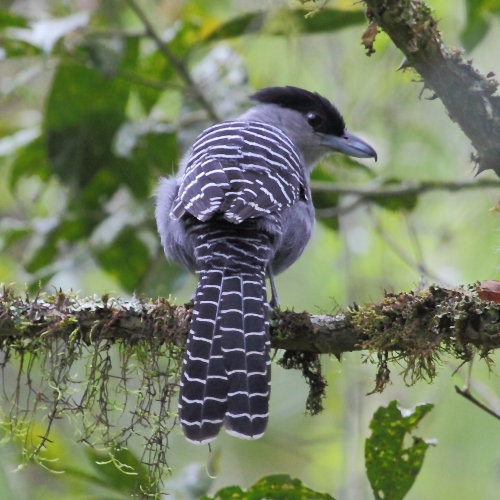
Ancient Antwren
Herpsilochmus gentryi
Order: Passeriformes / Family: Thamnophilidae

Wikimedia Commons
About the Ancient Antwren
The Ancient Antwren, or Herpsilochmus gentryi, is a small passerine bird belonging to the Thamnophilidae family. This bird is primarily found in the lowland regions of Ecuador and Peru, specifically thriving in subtropical or tropical moist lowland forests. The species prefers the canopy and edges of mature forests, where it can exploit the dense foliage for cover and foraging opportunities. The Ancient Antwren plays a crucial role in its ecosystem by controlling insect populations and acting as a prey species for larger predators. This bird is named in honor of the late botanist Alwyn Howard Gentry, reflecting the intersection between avian and botanical biodiversity in the Neotropics.
Ecuador's Napo and Pastaza provinces serve as strongholds for this species, where it occupies a niche within the rich tapestry of Amazonian biodiversity. The bird's presence signifies the health of these ecosystems, as it requires relatively undisturbed habitats to thrive. Its ecological role extends beyond predation; by feeding on insects, it aids in the control of herbivorous insect populations, contributing to forest health.
Seasonal behaviors of the Ancient Antwren are marked by subtle changes, as it remains largely resident throughout its range. However, slight altitudinal shifts may occur in response to resource availability, particularly during the wet season when insect abundance peaks. The Ancient Antwren's sedentary nature ensures that any shifts are localized, with the bird often remaining within a defined home range year-round. The Ancient Antwren's presence, albeit elusive, underscores the importance of conserving mature forest habitats within its range.
The Ancient Antwren belongs to the family Thamnophilidae, within the order Passeriformes. These birds typically live average 4-7 years, with a maximum recorded of 8 years..
How to Identify a Ancient Antwren
The Ancient Antwren presents a combination of field marks that make it identifiable to the trained observer. Adult birds exhibit a predominantly gray plumage with subtle black barring on the wings and tail. Their underparts are lighter, with a wash of white visible on the belly and vent. The male and female Ancient Antwrens are similar in appearance, though males may boast slightly darker markings, particularly around the face and throat.
Juvenile Ancient Antwrens can be distinguished by their paler coloration and less defined wing barring, which gradually becomes more pronounced as they mature. In comparison to similar species within the genus Herpsilochmus, such as the Spot-tailed Antwren, Herpsilochmus gentryi can be identified by the absence of a prominent tail spot.
In flight, the Ancient Antwren displays a rapid, undulating flight pattern typical of small passerines. When perched, it often adopts a horizontal stance, with its tail slightly cocked upwards, a posture that aids in distinguishing it from other sympatric antbird species. Its subtle field marks necessitate keen observation, often aided by the bird's distinctive vocalizations.
Having trouble telling birds apart? Upload a photo to our bird identification tool for an instant species match.
Ancient Antwren Habitat and Range
Preferred Habitat
The Ancient Antwren inhabits primary lowland tropical forests, with a preference for humid, dense canopy regions. It is typically found at elevations ranging from 200 to 800 meters above sea level. These birds favor the forest interior, often near water sources, though they can occasionally be found at forest edges where vegetation remains dense.
While primarily associated with mature forests, the Ancient Antwren can also be seen in selectively logged areas, provided that sufficient canopy cover and habitat structure remain intact. Seasonal shifts in habitat use are minimal, as this species remains largely sedentary, utilizing the same territory throughout the year. Despite its adaptability to some degree of habitat disturbance, the Ancient Antwren is generally absent from heavily degraded or urbanized areas.
Geographic Range
Herpsilochmus gentryi is endemic to the western Amazon basin, with a range that spans parts of eastern Ecuador and northern Peru. In Ecuador, it is predominantly found in the provinces of Napo, Pastaza, and Orellana. In Peru, it inhabits regions within Loreto and Ucayali provinces. The Ancient Antwren's distribution is closely tied to the presence of undisturbed lowland tropical forests.
This species does not engage in long-distance migrations, instead exhibiting minor altitudinal movements in response to local environmental conditions. These movements are typically associated with the availability of food resources rather than seasonal breeding or weather changes.
Population density of the Ancient Antwren tends to be higher in areas where forest structure and composition remain relatively intact. Its range highlights the importance of conservation efforts within these biodiverse regions, as habitat loss poses a significant threat to its continued survival.
Want to know which birds visit your area? Browse our backyard birds by location guides for region-specific species lists.
What Does the Ancient Antwren Eat?
The diet of the Ancient Antwren consists primarily of small arthropods, including insects such as beetles, caterpillars, and ants, as well as spiders. This insectivorous bird employs a gleaning foraging technique, meticulously searching leaves and branches in the forest canopy for prey. During the wet season, when insect abundance is at its peak, the Ancient Antwren's diet becomes more varied, occasionally incorporating small fruits or seeds.
The bird's foraging activity peaks during the early morning hours, aligning with heightened insect activity. Throughout the day, it continues to feed opportunistically, making use of mixed-species foraging flocks to enhance food acquisition. This social foraging strategy not only increases the efficiency of prey capture but also provides safety in numbers against potential predators.
The Ancient Antwren's small size dictates its prey preferences, focusing on insects and arachnids that measure less than 5 millimeters in size. This dietary specialization underscores its role in regulating prey populations within its ecosystem.
Ancient Antwren Behavior and Social Structure
The Ancient Antwren exhibits a complex social structure, often participating in mixed-species foraging flocks. These flocks, composed of various insectivorous birds, provide mutual benefits such as increased foraging efficiency and predator vigilance. Within these groups, the Ancient Antwren maintains a degree of territoriality, especially during the breeding season when pairs become more conspicuous.
Courtship displays of the Ancient Antwren are subtle but involve coordinated movements and vocalizations between pairs. During the breeding season, males engage in soft, whistling calls to attract females and establish territory boundaries.
Flocking patterns vary with seasons; while non-breeding flocks may include several individuals, breeding pairs remain more isolated to ensure successful nesting. The Ancient Antwren remains vigilant against predators such as raptors and snakes, relying on its cryptic coloration and the alarm calls of other species to avoid detection.
Daily activities of the Ancient Antwren are largely diurnal, with peak activity occurring in the morning and late afternoon. During the heat of the day, the bird seeks shelter in the dense foliage, minimizing exposure to predators and harsh environmental conditions.
Ancient Antwren Nesting and Reproduction
The nesting habits of the Ancient Antwren are characterized by the construction of small, cup-shaped nests, typically situated in the fork of a tree branch. These nests, made from plant fibers, leaves, and fine twigs, are carefully camouflaged to blend with the surrounding foliage.
Preferred nesting sites are located within the mid-canopy, often 3 to 6 meters above ground, providing protection from ground-based predators. The clutch size ranges from two to three eggs, with both parents sharing incubation duties, which last approximately 14 to 16 days.
Upon hatching, the young are altricial, requiring extensive parental care. Both parents participate in feeding and caring for the nestlings, which fledge after approximately 10 to 12 days. The Ancient Antwren typically raises one brood per year, although favorable conditions may occasionally permit a second.
Parental roles are shared, with males often taking a more active role in territory defense while females focus on feeding duties. This cooperative breeding strategy enhances the chances of offspring survival in the challenging forest environment.
Ancient Antwren Sounds and Vocalizations
The Ancient Antwren's primary song consists of a series of soft, high-pitched whistles, often delivered in rapid succession. These vocalizations, resembling the sound of wind passing through leaves, serve to establish territory and attract mates. The song's rhythm is steady, with a gentle rise and fall in pitch, creating an almost melodic quality.
In addition to its song, the Ancient Antwren produces a variety of call notes, including short, sharp chips used for communication between pair members and within foraging flocks. Alarm calls are more abrupt and louder, designed to alert conspecifics to potential threats.
During the dawn chorus, the Ancient Antwren becomes particularly vocal, contributing to the symphony of the forest with its distinctive whistling. This behavior underscores its role in the acoustic landscape of its habitat, where vocal communication is essential for survival.
Interesting Facts About the Ancient Antwren
- 1The Ancient Antwren was only officially described as a species in 1997, highlighting the ongoing discoveries within the Amazon's avian diversity.
- 2Despite its name, the Ancient Antwren is not actually ancient, but it was named in honor of the botanist Alwyn Howard Gentry.
- 3The Ancient Antwren's subtle plumage allows it to blend seamlessly into the forest canopy, a crucial adaptation for avoiding predators.
- 4Unlike many antbird species, the Ancient Antwren participates in mixed-species foraging flocks, indicating a highly social nature.
- 5The intricate vocalizations of the Ancient Antwren play a significant role in its territorial and mating behaviors.
- 6The species' preference for undisturbed forest habitats makes it an important indicator of ecosystem health in the Amazon basin.
- 7Ancient Antwrens are known to be monogamous, forming long-term pair bonds that last several breeding seasons.
Ancient Antwren Conservation Status
The IUCN currently lists the Ancient Antwren as Near Threatened, with its population trend showing signs of decline. Primary threats to this species include habitat loss due to deforestation for agriculture, logging, and infrastructure development in the Amazon basin. Conservation efforts focus on protecting and restoring critical forest habitats within its range, with particular emphasis on areas within Ecuador and Peru where deforestation rates are highest. The establishment of protected areas and sustainable land-use practices are vital to mitigating these threats. Historically, the Ancient Antwren's population likely fluctuated in response to natural forest dynamics, but recent human activities have exacerbated these changes. Efforts to monitor populations and enforce conservation legislation remain crucial to ensure the species' long-term survival.