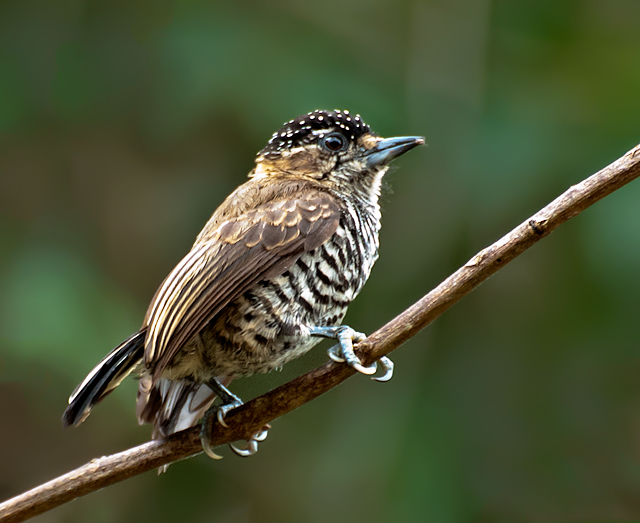
Arrowhead Piculet
Picumnus minutissimus
Order: Piciformes / Family: Picidae

Wikimedia Commons
About the Arrowhead Piculet
The Arrowhead Piculet, scientifically known as Picumnus minutissimus, is one of the smallest members of the Picidae family. This tiny bird, reaching only about 8-10 centimeters in length, is a marvel of adaptation and survival in the dense forests of northern South America. Predominantly found in the tropical regions of Venezuela and Trinidad, the Arrowhead Piculet plays a crucial role in the ecosystem as both a predator of insects and a disperser of seeds. Its presence is vital for maintaining the health of forested areas, where it helps regulate insect populations. With a striking appearance, the Arrowhead Piculet showcases a beautiful blend of green, yellow, and white plumage, making it a favorite among bird watchers and naturalists. Unlike some of its larger relatives, this piculet prefers to remain within the canopy and subcanopy layers, where it forages on tree trunks and branches. The Arrowhead Piculet is non-migratory, remaining within its tropical range year-round, though it may exhibit some altitudinal movements in response to food availability. During the breeding season, which coincides with the wet months from May to August, the Arrowhead Piculet becomes more vocal, with its rapid drumming resonating through the forest. It is during this time that they are most active, defending territories and engaging in courtship rituals. The ecological significance of the Arrowhead Piculet extends beyond its role as an insectivore. Its interaction with the flora and fauna of its habitat contributes to the maintenance of biodiversity. The bird's preference for secondary forests and edge habitats also makes it an important species in areas undergoing ecological succession. Conservation of the Arrowhead Piculet's habitat is essential, as deforestation and habitat fragmentation pose significant threats to its population. The bird's adaptability to secondary growth areas can be seen as both a strength and a vulnerability, as these areas are often subject to human encroachment and land-use changes. Understanding the ecological role and behavior of the Arrowhead Piculet can aid in developing conservation strategies to ensure the survival of this charming avian species.
The Arrowhead Piculet belongs to the family Picidae, within the order Piciformes. These birds typically live estimated 5-6 years in the wild..
How to Identify a Arrowhead Piculet
Adult Arrowhead Piculets exhibit a distinct combination of greenish upperparts and pale underparts. Their crown is often speckled with white, giving a mottled appearance that helps in identifying them from a distance. Males can be distinguished from females by a small patch of reddish-orange feathers on the forehead, a feature absent in females. Juveniles resemble adults but generally have duller plumage and lack the distinctive forehead markings of the males. These piculets are often confused with other small woodpecker species, but their diminutive size and unique head markings set them apart. In flight, the Arrowhead Piculet presents a silhouette typical of woodpeckers, with rapid wingbeats and short glides. When perched, they often cling to vertical surfaces like tree trunks or branches, using their tail feathers as a prop. Observers can look for their characteristic tail flicking behavior, which is a common trait among Picumnus species.
Having trouble telling birds apart? Upload a photo to our bird identification tool for an instant species match.
Arrowhead Piculet Habitat and Range
Preferred Habitat
The Arrowhead Piculet primarily inhabits tropical and subtropical forests, with a preference for secondary growth and forest edges. These birds are most commonly found at elevations ranging from sea level to about 600 meters. They thrive in areas where there is a mix of deciduous and evergreen trees, which provide ample foraging opportunities. The piculet is adaptable, sometimes venturing into plantations and areas of human-modified landscape, as long as there is sufficient tree cover. Unlike some woodpecker species, the Arrowhead Piculet is less likely to be found in open grasslands or heavily urbanized settings, though it may occasionally visit gardens and parks in rural areas.
Geographic Range
The Arrowhead Piculet is endemic to northern South America, specifically Venezuela and Trinidad. Within these regions, it occupies a relatively narrow range, favoring forested areas and regions with high humidity. The bird's range does not extend far inland, as it is largely confined to the coastal and near-coastal zones. There is no significant migratory movement associated with this species, as it remains within its established range throughout the year. However, local movements may occur in response to changes in food availability or during the breeding season. Population density tends to be higher in areas with abundant secondary forest and minimal human disturbance.
Want to know which birds visit your area? Browse our backyard birds by location guides for region-specific species lists.
What Does the Arrowhead Piculet Eat?
The diet of the Arrowhead Piculet consists primarily of insects, with a particular fondness for ants and beetles. They forage by gleaning insects from the bark and leaves of trees, employing a technique that involves rapid pecking and probing. This method is reminiscent of larger woodpeckers, though the piculet's actions are quicker and less forceful due to its small size. In addition to insects, they consume small amounts of fruit and seeds, which provide essential nutrients and energy. During the wet season, when insect populations are at their peak, the Arrowhead Piculet's diet is almost exclusively insectivorous. In drier months, when insects are less abundant, they rely more heavily on plant material.
Arrowhead Piculet Behavior and Social Structure
Arrowhead Piculets are generally solitary birds, although they may be seen in pairs during the breeding season. They establish and defend small territories, using their drumming as a means of communication and deterrence against intruders. Courtship involves a series of displays that include mutual drumming, wing flicking, and gentle pecking between potential mates. These birds are diurnal, with peak activity occurring during the early morning and late afternoon. Their response to predators involves stealth and rapid movement, often freezing in place or scuttling around the trunk of a tree to remain out of sight. The Arrowhead Piculet is not known to form large flocks, although it may join mixed-species foraging groups occasionally.
Arrowhead Piculet Nesting and Reproduction
The nesting habits of the Arrowhead Piculet involve excavation of small cavities in soft or decaying wood. These cavities, typically located 1-3 meters above the ground, provide a secure environment for raising young. The female lays a clutch of 2-4 eggs, which both parents incubate for about 12-14 days. After hatching, the chicks remain in the nest for an additional 18-21 days before fledging. Both parents share responsibilities in feeding and caring for the young, ensuring a high survival rate. The species generally raises one brood per year, though in particularly favorable conditions, a second brood may occur.
Arrowhead Piculet Sounds and Vocalizations
The Arrowhead Piculet's primary song is a series of rapid, high-pitched notes that resemble a continuous trill. This song serves multiple purposes, including attracting mates and establishing territory. Its call notes, often described as sharp 'peek' or 'pit' sounds, are less complex but effective in communication within dense foliage. Their alarm calls, a rapid series of ascending 'chip' notes, alert others to potential threats. During the dawn chorus, the piculet's drumming, a rapid tapping sound, adds a rhythmic element to the forest soundscape, akin to a quick, mechanical staccato.
Interesting Facts About the Arrowhead Piculet
- 1Despite being a woodpecker, the Arrowhead Piculet relies more on its agility than brute force to forage, using rapid movements to catch insects.
- 2The Arrowhead Piculet's drumming is one of the fastest among woodpeckers, serving as both communication and courtship display.
- 3A study in Venezuela found that Arrowhead Piculets contribute to seed dispersal, aiding in forest regeneration.
- 4Their ability to thrive in secondary forests makes them an indicator species for habitat recovery and ecological health.
- 5The Arrowhead Piculet's preference for lower canopy levels sets it apart from many other woodpeckers which forage higher up.
- 6Its small size allows it to exploit niches unavailable to larger woodpeckers, demonstrating niche partitioning in forest ecosystems.
Arrowhead Piculet Conservation Status
The Arrowhead Piculet currently holds a status of Least Concern according to the IUCN Red List. While the species is not considered at immediate risk, its population is believed to be stable, though precise numbers are not well-documented. The primary threats include habitat loss due to deforestation and land conversion for agriculture. Conservation efforts focus on protecting their natural habitats and promoting sustainable land management practices. Historically, the population has been relatively stable, but ongoing habitat fragmentation could pose future challenges.
Other Picidae Species


Birds Similar to the Arrowhead Piculet
These species are often confused with the Arrowhead Piculet due to similar appearance or overlapping range.