Ash-throated Antwren
Herpsilochmus parkeri
Order: Passeriformes / Family: Thamnophilidae

Wikimedia Commons
About the Ash-throated Antwren
The Ash-throated Antwren, Herpsilochmus parkeri, is a captivating member of the Thamnophilidae family, captivating bird enthusiasts with its unique plumage and secretive nature. This small passerine dwells primarily in the biodiverse regions of northern Peru, specifically within the department of San Martín. The species was only recently described in 2000, highlighting the continuous discoveries in avian biodiversity within the Amazon Basin and adjacent Andean foothills.
This bird holds significant ecological roles as both a predator of small insects and a prey species to larger birds. By controlling insect populations, the Ash-throated Antwren contributes to the balance of the ecosystems it inhabits. The bird thrives in subtropical or tropical moist lowland forests and montane forests, often found at elevations between 700 and 1,200 meters. Its presence in these habitats underscores the importance of forest conservation for maintaining biodiversity.
The Ash-throated Antwren exhibits intriguing seasonal behaviors, though it is not known for long-distance migration. Its activities are closely linked to the availability of food resources and breeding opportunities. During the breeding season, which typically coincides with periods of increased insect abundance, the bird becomes more vocal and visible. It is a vital component of the complex avian community in its native range, often interacting with mixed-species flocks. These interactions enhance its chances of survival by providing increased vigilance against predators and access to diverse food sources.
The Ash-throated Antwren belongs to the family Thamnophilidae, within the order Passeriformes. These birds typically live average 3-4 years, with a max recorded of 5 years.
How to Identify a Ash-throated Antwren
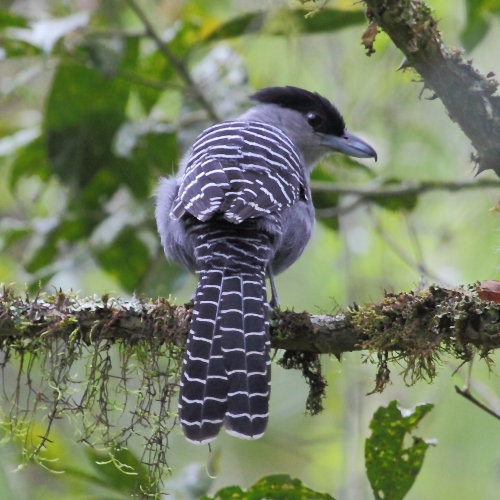
The Ash-throated Antwren is a small bird, measuring about 11 to 12 centimeters in length, making it a petite yet agile presence in its forested habitat. The adult male is distinguished by its grayish-white throat, a key feature that sets it apart from other antwrens. This ash-colored throat contrasts with the darker gray head and upperparts. The back and wings display subtle olive tones, while the underparts are lighter with some streaking.
Females and juveniles exhibit similar plumage patterns, with females having a slightly duller appearance compared to males. The female's throat is less pronounced in its ash coloration, making sex differentiation somewhat challenging from a distance. Juveniles lack the distinct throat coloration and possess more uniform grayish-brown plumage.
In flight, the Ash-throated Antwren presents a compact silhouette with rapid wingbeats. Its perching posture is often horizontal, and it can be frequently observed darting between branches in search of prey. The bird's small size and subtle coloration can lead to confusion with other small antwrens, but its unique throat pattern aids in accurate identification.
Having trouble telling birds apart? Upload a photo to our bird identification tool for an instant species match.
Ash-throated Antwren Habitat and Range
Preferred Habitat
The Ash-throated Antwren predominantly inhabits subtropical and tropical moist lowland forests, as well as montane forests. It thrives at elevations ranging from 700 to 1,200 meters, preferring dense understory vegetation where it can forage and nest protected from predators. This bird is primarily found in the northern regions of Peru, particularly within the San Martín department, an area known for its rich biodiversity and extensive forest cover.
While the Ash-throated Antwren is not typically found in urban settings, its presence is most prevalent in undisturbed forest areas, making it a species sensitive to habitat destruction. Seasonal shifts in habitat use are minimal, as the bird maintains its residence within forested regions year-round, relying on the stable microclimate and resources provided by these habitats.
Conservation efforts focusing on preserving forest habitats are crucial for the survival of this species, as deforestation poses a significant threat to its limited range.
Geographic Range
The geographical range of the Ash-throated Antwren is relatively restricted, primarily confined to the northern regions of Peru. It is most commonly encountered in the department of San Martín, where suitable forest habitats support its populations. Unlike many passerines, this species does not undertake long migratory journeys, maintaining a year-round presence within its range.
The bird's breeding range overlaps significantly with its overall distribution, as it tends to remain in areas where it can find sufficient food and nesting sites. The absence of long-distance migrations means that population densities can vary with local environmental conditions, such as food availability and habitat quality.
While the Ash-throated Antwren's range is limited, it represents an important component of the avian diversity within the Amazon Basin's foothills, contributing to the ecological richness of the region.
Want to know which birds visit your area? Browse our backyard birds by location guides for region-specific species lists.
What Does the Ash-throated Antwren Eat?
The Ash-throated Antwren's diet primarily consists of small insects and arthropods, which it skillfully captures through active foraging. This bird employs a variety of foraging techniques, including gleaning from foliage and branches, as well as sallying to catch prey in mid-air. Its agile movements and quick reflexes make it an effective insectivore.
Seasonal changes in diet are relatively minor, as the bird remains in the same habitat throughout the year. However, during the breeding season, there may be an increased focus on protein-rich prey items to support the nutritional needs of chicks. The Ash-throated Antwren occasionally consumes small fruits and seeds, supplementing its diet when insect abundance fluctuates.
The bird's feeding schedule aligns with its daily activity pattern, with peak foraging occurring during the cooler morning and late afternoon hours. This behavior helps the bird avoid the heat of midday and potentially increases its foraging efficiency.
Ash-throated Antwren Behavior and Social Structure
The Ash-throated Antwren exhibits intriguing social and territorial behaviors that reflect its adaptation to forest life. This bird often participates in mixed-species flocks, a strategy that enhances its foraging success and reduces predation risk. Within these flocks, the Ash-throated Antwren maintains a degree of territoriality, defending its space against conspecifics while cooperating with other species.
Courtship behaviors in this species involve vocal displays and subtle physical interactions between mates. Males may engage in singing to establish territories and attract females, with songs conveying information about the singer's fitness and readiness to breed. Pair bonds are typically strong, with both members cooperating in nesting and rearing of young.
The Ash-throated Antwren's response to predators includes alarm calls and evasive maneuvers. When threatened, these birds may take cover in dense vegetation or join mixed flocks to increase group vigilance. Their daily activity patterns involve frequent periods of foraging, interspersed with rest and preening, which are critical for maintaining plumage condition and overall health.
Ash-throated Antwren Nesting and Reproduction
The Ash-throated Antwren constructs a delicate, cup-shaped nest using fine plant fibers, leaves, and spider webs. Nests are typically placed in dense foliage, often low to the ground or in understory shrubs, providing concealment from predators. The choice of nesting site is strategic, ensuring protection and proximity to food sources.
Clutch sizes generally range from two to three eggs, with both parents sharing incubation duties over a period of approximately 14 to 16 days. After hatching, the altricial chicks are cared for by both parents, who take turns feeding and guarding the nest. Fledging occurs roughly 12 to 15 days post-hatching, although parental care continues for some time as the young gain independence.
The Ash-throated Antwren typically raises one brood per year, though favorable conditions may lead to a second. The species' reproductive success is closely tied to habitat quality and food availability, underscoring the need for conservation of its forest habitats.
Ash-throated Antwren Sounds and Vocalizations
The vocalizations of the Ash-throated Antwren are characterized by a series of clear, high-pitched notes delivered in rapid succession. Its primary song has a rhythmic, musical quality, often described as a series of 'twee-twee-twee' sounds, each note distinct and melodious. These songs serve multiple purposes, from territory establishment to mate attraction.
In addition to its song, the Ash-throated Antwren produces a variety of call notes, including short, sharp 'chip' sounds used for communication between mates or within mixed-species flocks. When alarmed, it may emit a harsher, more urgent call to alert others of potential threats.
The bird is most vocally active during the early morning hours, participating in the dawn chorus that resonates through its forest habitat. Its vocal repertoire plays a vital role in maintaining social bonds and coordinating activities with its mate and flock members.
Interesting Facts About the Ash-throated Antwren
- 1The Ash-throated Antwren was only scientifically described in the year 2000, making it a relatively recent discovery.
- 2This species is named in honor of Theodore A. Parker III, an influential ornithologist known for his work in the Neotropics.
- 3Despite its small size, the Ash-throated Antwren can be quite vocal, with a repertoire that includes both songs and calls.
- 4The bird's distinctive ash-colored throat is a key feature for identification, helping distinguish it from similar species.
- 5The Ash-throated Antwren is found at elevations between 700 and 1,200 meters, preferring dense forest habitats.
- 6Its participation in mixed-species flocks highlights its social nature and adaptation to forest life.
- 7The species is predominantly found in the San Martín department of northern Peru, underscoring its limited range.
Ash-throated Antwren Conservation Status
The Ash-throated Antwren is currently classified as Near Threatened on the IUCN Red List, with population trends indicating a potential decline due to habitat loss. The primary threat to this species is deforestation, driven by agricultural expansion and logging activities, which reduce the availability of suitable habitats. Conservation initiatives aimed at preserving the montane and lowland forests of northern Peru are crucial for the survival of this bird. Protected areas and sustainable land-use practices can help mitigate habitat degradation, providing refuges for the Ash-throated Antwren and other forest-dependent species. Historically, the Ash-throated Antwren's limited range has made it vulnerable to environmental changes. Continued research and monitoring are essential to understand its population dynamics and inform effective conservation strategies. Efforts to raise awareness about the importance of forest conservation can contribute to preserving the ecological integrity of the regions it inhabits.