Ashy Antwren
Myrmotherula grisea
Order: Passeriformes / Family: Thamnophilidae

Wikimedia Commons
About the Ashy Antwren
The Ashy Antwren (Myrmotherula grisea) is a small bird species belonging to the Thamnophilidae family, predominantly found in the Amazon Basin. This bird plays a vital role in the ecosystem as an insectivore, contributing to the control of insect populations within its habitat. With its adapted foraging behavior, the Ashy Antwren expertly navigates the dense understory of tropical rainforests, often in mixed-species flocks. Its presence is a testament to the rich biodiversity of these ecosystems. The bird's range includes parts of Brazil, Peru, and Colombia, where it inhabits lowland rainforest areas, typically below 500 meters in elevation. During the breeding season, which aligns with the rainy periods in the Amazon, the Ashy Antwren becomes more vocal, aiding in territory establishment and mate attraction. The bird's ecological significance extends beyond its immediate environment, as it contributes to the broader health of the forest by participating in seed dispersal and nutrient cycling through its feeding activities. The Ashy Antwren's adaptability to different forest strata and its interactions within mixed-species flocks highlight its importance as both a consumer and a prey species. As a member of the antbird family, it engages in mutualistic relationships with other bird species, enhancing the foraging efficiency of the group. Despite its inconspicuous appearance, the Ashy Antwren is an integral component of the tropical rainforest's complex food web, illustrating the interconnectedness of species within these biodiverse habitats.
The Ashy Antwren belongs to the family Thamnophilidae, within the order Passeriformes. These birds typically live average 5 years with a maximum recorded of 8 years..
How to Identify a Ashy Antwren
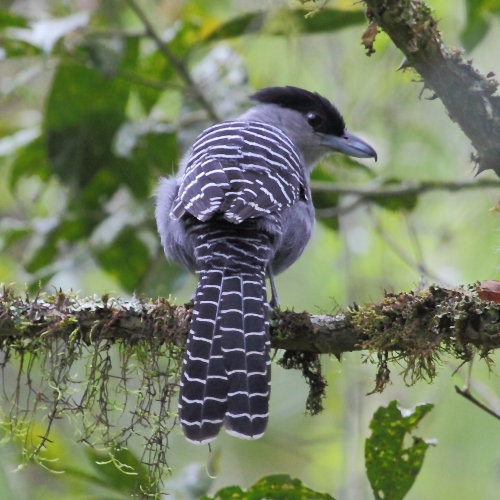
The Ashy Antwren is a diminutive bird, measuring approximately 9-10 cm in length. Adult males display a predominately gray plumage, which provides effective camouflage against the backdrop of dense foliage. They exhibit subtle white wing bars and a faint eyeline that aids in differentiation from similar species. Females, in contrast, have a slightly browner wash to their feathers and lack the male's more pronounced wing bars. Juveniles resemble females but with even duller coloration. One might confuse the Ashy Antwren with the related Plain-throated Antwren, which shares overlapping habitats. However, the Ashy Antwren's more uniform gray and distinctive foraging behavior, often lower in the understory, can assist in accurate identification. In flight, the Ashy Antwren has a rapid wingbeat pattern typical of small passerines, but it remains most often observed while perched or moving methodically through vegetation. Its posture is characterized by a slight tilt forward, a common trait among antwrens as they inspect leaves for prey.
Having trouble telling birds apart? Upload a photo to our bird identification tool for an instant species match.
Ashy Antwren Habitat and Range
Preferred Habitat
The Ashy Antwren predominantly inhabits the understory of lowland rainforests within the Amazon Basin. These environments, rich in leaf litter and dense shrubbery, provide the ideal conditions for its foraging habits. The species is primarily found at elevations ranging from sea level to about 500 meters. Unlike some bird species that adapt to urban environments, the Ashy Antwren remains closely tied to pristine, undisturbed forest habitats where it takes advantage of the complex structure and diversity. Seasonal changes do not significantly affect its habitat preference, as the bird is non-migratory and maintains a year-round presence within tropical rainforests.
Geographic Range
The Ashy Antwren's range extends across the Amazon Basin, with populations recorded in Brazil, Peru, and Colombia. Its distribution is patchy, often confined to areas of suitable forest habitat. Within these countries, it is most commonly found in the vast expanses of rainforest that dominate the landscape. Population densities tend to be higher in regions with extensive forest cover and minimal human disturbance. The bird does not undertake long migrations, instead exhibiting localized movements in search of resources. Its presence in conservation areas and protected reserves highlights the importance of these regions in maintaining healthy populations of the Ashy Antwren.
Want to know which birds visit your area? Browse our backyard birds by location guides for region-specific species lists.
What Does the Ashy Antwren Eat?
Insectivorous by nature, the Ashy Antwren primarily feeds on a diet of small arthropods, including ants, beetles, and spiders. The bird forages methodically, gleaning insects from leaves and branches within the understory. During wetter months, when insect abundance peaks, its diet may expand to include larger prey items. The Ashy Antwren uses short, swift movements to capture its prey, often joining mixed-species flocks to increase foraging efficiency. These flocks enable the bird to exploit a variety of niches, from low shrubs to mid-canopy levels, thereby enhancing its dietary breadth. The Ashy Antwren's feeding schedule is diurnal, with peak activity occurring during early morning and late afternoon when insects are most active.
Ashy Antwren Behavior and Social Structure
The Ashy Antwren displays a complex social structure, often participating in mixed-species foraging flocks that enhance its feeding success. This cooperative behavior reduces predation risk and increases access to a variety of food resources. Territorial behavior becomes prominent during the breeding season, when males use vocalizations to establish and defend their territory. Courtship displays involve a combination of vocal and visual signals, including wing flicking and tail spreading. Despite its generally solitary nature outside of the breeding season, the Ashy Antwren readily integrates into flocks, where it communicates through a series of soft calls. Predation by snakes and raptors poses a constant threat, and the species relies on its agility and cryptic plumage for evasion. The bird's daily activities include periods of intense foraging interspersed with rest and preening, maintaining its plumage in optimal condition.
Ashy Antwren Nesting and Reproduction
The Ashy Antwren constructs small, cup-shaped nests using materials such as leaves, grass, and spider silk. These nests are typically situated low in the understory, often in forked branches that provide stability and concealment. Clutch size generally ranges from two to three eggs, with both parents participating in incubation and subsequent feeding of the chicks. Incubation lasts approximately 14-16 days, followed by a fledging period of about 12-14 days. The parental roles are well-defined, with males primarily defending the territory while females focus on brooding and feeding. The species typically raises one brood per year, with breeding closely tied to the rainy season when food resources are abundant.
Ashy Antwren Sounds and Vocalizations
The primary song of the Ashy Antwren is a sharp, repetitive series of high-pitched notes, often described as 'tsee-tsee-tsee'. This song serves as both a territorial marker and a contact call within mixed-species flocks. The call notes are softer and more variable, used for communication between mates and flock members. Alarm calls are distinctive, characterized by a rapid series of short, sharp notes that signal the presence of predators. At dawn, the Ashy Antwren participates in the forest's chorus, its sounds blending with those of other avian species to create a complex auditory tapestry.
Interesting Facts About the Ashy Antwren
- 1The Ashy Antwren is often found in mixed-species flocks, benefiting from the diversity of foraging strategies.
- 2Despite its small size, the Ashy Antwren plays a significant role in controlling insect populations within the Amazon.
- 3Its nests, constructed with spider silk, demonstrate the bird's resourcefulness in utilizing available materials.
- 4The Ashy Antwren's subtle plumage allows it to blend seamlessly into the dense rainforest understory.
- 5This species is non-migratory, remaining within the tropical rainforests year-round, despite seasonal changes.
- 6The Ashy Antwren engages in mutualistic relationships with other bird species, enhancing group foraging success.
- 7With a range limited to the Amazon Basin, the Ashy Antwren serves as a bioindicator of rainforest health.
Ashy Antwren Conservation Status
The Ashy Antwren is currently classified as Least Concern by the IUCN, with stable population trends. However, ongoing threats such as deforestation and habitat fragmentation pose potential risks to its habitat. Conservation efforts focus on protecting large swaths of rainforest and promoting sustainable land-use practices. Historical population fluctuations have been closely tied to changes in forest cover, underscoring the need for continued monitoring and habitat conservation.