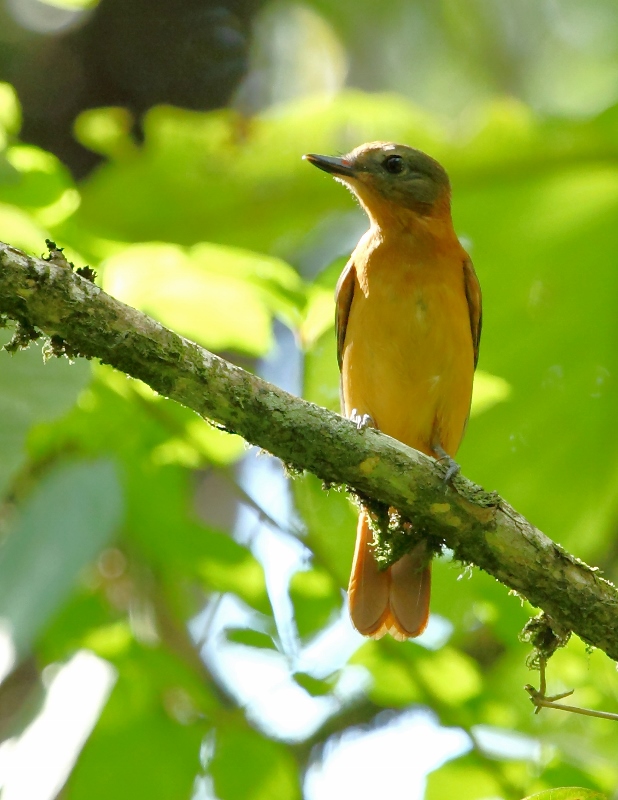
Flammulated Attila
Attila flammulatus
Order: Passeriformes / Family: Tyrannidae
About the Flammulated Attila
The Flammulated Attila (Attila flammulatus) is an intriguing member of the Tyrannidae family, known for its striking appearance and elusive behavior. This passerine bird inhabits the dense forests and woodlands of Central and South America, particularly thriving in regions from Southern Mexico to Northern Ecuador. Within these areas, it plays a crucial role as a predator of insects and small vertebrates, contributing to the ecological balance by controlling pest populations. The Flammulated Attila exhibits a preference for humid environments and is often found in subtropical and tropical moist lowland forests. Its presence is significant as an indicator of healthy forest ecosystems, where it fulfills its role in the food chain by preying on a variety of arthropods and small animals. During the breeding season, which typically occurs between April and June, the Flammulated Attila becomes more conspicuous, as males engage in vocal displays to attract mates and establish territories. Outside the breeding season, the bird's behavior shifts to more solitary or small family group arrangements. This seasonal behavior is crucial for the maintenance of its population across its range. The Flammulated Attila's ecological role extends beyond predation, as it also serves as a prey species for larger raptors and mammals. Its presence in diverse forest habitats underscores the importance of conserving these environments, which provide essential resources and shelter for the bird. The bird's adaptation to specific forest types also highlights the need to understand the intricate dynamics of forest ecosystems to ensure its continued survival. Overall, the Flammulated Attila's ecological significance, coupled with its striking appearance and elusive nature, makes it a species of interest for ornithologists and conservationists alike.
The Flammulated Attila belongs to the family Tyrannidae, within the order Passeriformes. These birds typically live average 5 years, with a maximum recorded of 8 years..
How to Identify a Flammulated Attila
The Flammulated Attila is a medium-sized bird, measuring about 18 to 20 centimeters in length. Its most distinguishing feature is its flammulated, or flame-like, facial pattern, which comprises reddish-brown streaks that contrast with its more subdued brownish-gray body plumage. The wings and tail are also tinged with a reddish hue, adding to its distinctive appearance. Male and female Flammulated Attilas exhibit similar plumage, though females may appear slightly duller. Juveniles resemble adults but have less pronounced facial markings and a generally more muted coloration, aiding in camouflage within their forest habitat. In flight, the Flammulated Attila presents a robust silhouette with rounded wings and a somewhat squared tail. Its perching posture is upright, often on exposed branches where it can survey its surroundings. Confusion with similar species can occur, particularly with other members of the genus Attila, but the Flammulated Attila's unique facial pattern and reddish tones help distinguish it from its relatives.
Having trouble telling birds apart? Upload a photo to our bird identification tool for an instant species match.
Flammulated Attila Habitat and Range
Preferred Habitat
The Flammulated Attila primarily inhabits subtropical and tropical moist lowland forests, favoring areas with dense canopy cover and rich undergrowth. It is commonly found at elevations ranging from sea level up to 1,500 meters, although it occasionally ventures to higher altitudes in search of food. While it prefers undisturbed primary forests, it can also be observed in secondary growth and forest edges, particularly during periods of food scarcity. The species is generally absent from urban environments but may appear in rural areas where forest fragments remain intact. Seasonal shifts in habitat use are primarily driven by food availability and breeding requirements, leading to temporary movements within its range.
Geographic Range
The Flammulated Attila's range extends from Southern Mexico through Central America, including countries such as Guatemala, Honduras, and Costa Rica, down to Northern Ecuador in South America. It is primarily a resident species within this range, exhibiting some altitudinal migration as it moves between different elevations in response to seasonal changes. Population density tends to be higher in regions with extensive forest cover, such as the Amazon basin and the lowland rainforests of the Chocó region. Although it occupies a relatively broad range, the bird's preference for specific forest habitats limits its distribution to areas where suitable environments are intact and protected.
Want to know which birds visit your area? Browse our backyard birds by location guides for region-specific species lists.
What Does the Flammulated Attila Eat?
The Flammulated Attila's diet primarily consists of insects, such as beetles, caterpillars, and grasshoppers, which it captures through a combination of aerial sallies and gleaning from foliage. During certain times of the year, it supplements its diet with small vertebrates, including lizards and frogs, demonstrating its role as an opportunistic feeder. Seasonal changes in diet are influenced by prey availability, with a greater emphasis on insect prey during the breeding season to meet the increased nutritional demands of rearing young. The bird forages actively throughout the day, often employing a sit-and-wait strategy from a prominent perch, where it remains vigilant for passing prey.
Flammulated Attila Behavior and Social Structure
The Flammulated Attila is generally a solitary bird outside of the breeding season, although it may be seen in pairs or small family groups during the breeding period. It establishes and defends territories through vocal displays and physical presence, with males often engaging in elaborate courtship rituals to attract mates. These displays include a combination of vocalizations and visual presentations, such as wing fluttering and tail fanning. The bird exhibits a strong territorial instinct, vigorously defending its chosen area from intruders. Daily activities are primarily diurnal, with peak activity occurring during early morning and late afternoon, coinciding with periods of high prey availability. The Flammulated Attila demonstrates a cautious yet curious approach to potential threats, often using its cryptic plumage to remain inconspicuous among the foliage.
Flammulated Attila Nesting and Reproduction
Flammulated Attilas construct cup-shaped nests using a variety of materials such as twigs, leaves, and moss. These nests are typically situated in the forks of trees or shrubs, at heights ranging from 3 to 10 meters above the ground. The female lays a clutch of 2 to 3 eggs, which she incubates for approximately 14 days. Both parents participate in feeding the hatchlings, which fledge about 18 days after hatching. The parental care continues for a short period post-fledging, ensuring the young birds develop the skills necessary for independent survival. The Flammulated Attila usually raises one brood per year, although favorable conditions may lead to a second brood.
Flammulated Attila Sounds and Vocalizations
The Flammulated Attila's primary song is a series of clear, melodious whistles that rise and fall in pitch. These vocalizations serve both territorial and courtship functions, with males often repeating the song from prominent perches to announce their presence. In addition to its song, the bird emits a variety of call notes, including sharp 'peet' sounds and softer 'churrs', which facilitate communication between mates and signal alarm when predators are nearby. During the dawn chorus, the Flammulated Attila's song contributes to the rich acoustic landscape of its forest habitat.
Interesting Facts About the Flammulated Attila
- 1The Flammulated Attila is named for its distinct facial pattern, which resembles flames, setting it apart from other birds in its genus.
- 2Despite its striking appearance, the Flammulated Attila blends seamlessly into its forest habitat, making it a challenging bird to observe in the wild.
- 3This species exhibits a unique courtship behavior where males perform a fluttering display accompanied by a series of whistles.
- 4The Flammulated Attila's diet expansion to include small vertebrates highlights its adaptability and opportunistic feeding strategy.
- 5Its preference for dense, humid forests underscores the importance of conserving these ecosystems for the bird's continued survival.
Flammulated Attila Conservation Status
Currently, the Flammulated Attila is listed as Least Concern by the IUCN, with its population considered stable. However, habitat loss due to deforestation poses a significant threat, particularly in areas of Central America where forest cover is being rapidly reduced. Conservation efforts focus on preserving critical habitats through protected areas and sustainable land-use practices. Historical population trends indicate that the Flammulated Attila has maintained a relatively stable presence across its range, though ongoing monitoring is essential to detect any future changes.
Other Tyrannidae Species


Birds Similar to the Flammulated Attila
These species are often confused with the Flammulated Attila due to similar appearance or overlapping range.