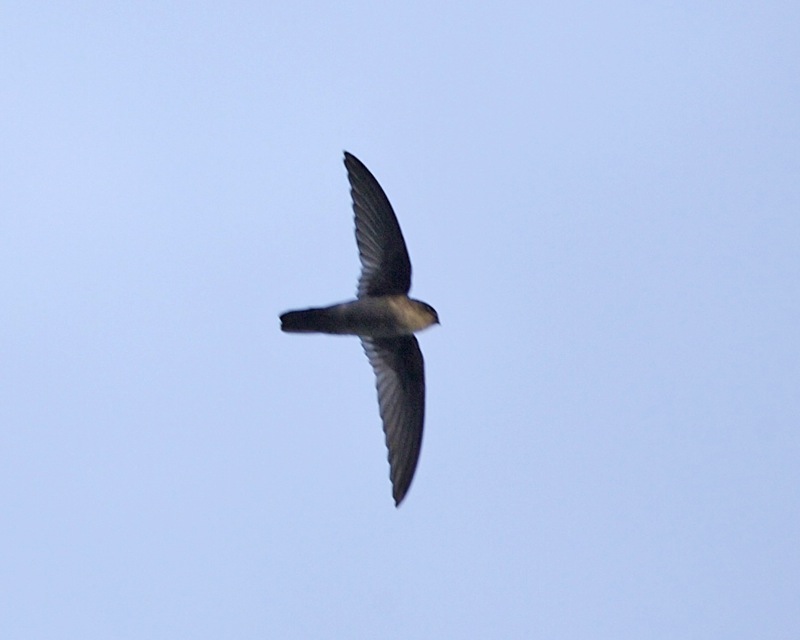
Australian Swiftlet
Aerodramus terraereginae
Order: Apodiformes / Family: Apodidae

Wikimedia Commons
About the Australian Swiftlet
The Australian Swiftlet, Aerodramus terraereginae, is a small bird belonging to the swift family Apodidae, renowned for its remarkable aerial agility. This species is primarily found in the northeastern regions of Australia, particularly in Queensland. It plays a crucial ecological role as an insectivore, helping control insect populations. The swiftlet is known for its distinctive behavior of using echolocation, a trait shared with bats but rare among birds. This adaptation allows it to navigate through the dark caves where it roosts and nests. The Australian Swiftlet typically inhabits coastal rainforests and nearby areas, relying on the dense canopy and proximity to water bodies for foraging. During the breeding season, these birds become more visible as they engage in their aerial courtship displays. The swiftlet is a year-round resident in its range, showing minimal migratory behavior. However, it may adjust its range locally based on food availability and environmental conditions. Conservation efforts focus on preserving its natural habitats, as deforestation and human encroachment pose significant threats. Despite facing habitat challenges, the Australian Swiftlet maintains a stable population, underscoring its adaptability. Its role in the ecosystem as an efficient insect predator highlights the importance of maintaining biodiversity in its native regions.
The Australian Swiftlet belongs to the family Apodidae, within the order Apodiformes. These birds typically live typically 4-6 years, with a maximum recorded lifespan of 10 years..
How to Identify a Australian Swiftlet
The Australian Swiftlet is a small bird, measuring about 11-12 cm in length with a wingspan of approximately 27 cm. Its plumage is predominantly dark gray, with lighter underparts that offer a subtle contrast. Both males and females exhibit similar coloration, making visual differentiation challenging. Juveniles resemble adults but may have slightly duller plumage. The swiftlet's wings are long and narrow, adapted for swift, agile flight. Its tail is short and square, lacking the forked appearance seen in some other swift species. One of the key identification features of the Australian Swiftlet is its flight silhouette, characterized by rapid, fluttering wingbeats and swift, direct flight patterns. Unlike many other birds, swiftlets rarely perch, spending most of their time on the wing. This constant aerial activity, combined with their ability to echolocate, makes them unique among their avian peers. When seen in flight, the swiftlet's streamlined body and rapid movements set it apart from similarly sized birds.
Having trouble telling birds apart? Upload a photo to our bird identification tool for an instant species match.
Australian Swiftlet Habitat and Range
Preferred Habitat
The Australian Swiftlet primarily inhabits coastal rainforests, particularly in the northeastern regions of Queensland. These environments provide dense canopies and an abundance of insects for feeding. The species also frequents areas near water bodies, such as rivers and streams, where insect activity is high. Elevation ranges from sea level to the lower montane forests, generally not exceeding 800 meters. While swiftlets are not commonly found in urban settings, they may occasionally venture into rural areas if food resources are plentiful. During the breeding season, they prefer nesting in caves, utilizing their echolocation abilities to navigate these dark, enclosed spaces. Seasonal habitat shifts are minimal, but local movements may occur in response to changes in food availability or environmental disturbances.
Geographic Range
The Australian Swiftlet's range is largely confined to northeastern Australia, specifically within Queensland. Its breeding range is concentrated along the coastal and rainforest regions, where suitable nesting caves are abundant. The bird is predominantly a year-round resident, showing limited migratory behavior. However, some local movements may occur, especially in response to shifts in food resources or environmental conditions. The swiftlet does not typically migrate long distances, unlike some of its swift relatives found in other parts of the world. Population density is highest in areas where nesting caves and abundant food sources coexist. Despite its restricted range, the Australian Swiftlet forms stable populations in these habitats, contributing to its resilience as a species.
Want to know which birds visit your area? Browse our backyard birds by location guides for region-specific species lists.
What Does the Australian Swiftlet Eat?
The Australian Swiftlet primarily feeds on flying insects, which it catches in mid-air with remarkable precision. Its diet includes a variety of small insects, such as flies, beetles, and moths, all of which are abundant in its rainforest habitat. During the breeding season, the swiftlet's feeding activity intensifies, as it requires additional energy to sustain itself and feed its young. Foraging occurs mainly during the day, with peak activity in the early morning and late afternoon when insect activity is highest. The bird employs a highly efficient aerial hunting technique, using its rapid flight and agility to capture prey on the wing. Seasonal variations in diet are minimal, as the swiftlet's primary food sources remain available year-round in its tropical environment. However, fluctuations in insect populations can lead to shifts in foraging patterns.
Australian Swiftlet Behavior and Social Structure
The Australian Swiftlet exhibits fascinating social and foraging behaviors. It is a highly social bird, often found in flocks that can number in the hundreds, especially when roosting or foraging. Despite its social nature, the swiftlet displays minimal territorial behavior, likely due to the abundant food resources in its habitat. Courtship displays occur in flight, with pairs engaging in synchronized aerial maneuvers. Flocking patterns vary, with larger groups forming during non-breeding periods. In response to predators, the swiftlet relies on its rapid flight and agility to evade capture. The species is primarily diurnal, with peak activity occurring during early morning and late afternoon. At night, swiftlets retreat to caves or dense foliage for roosting, where they use echolocation to navigate in the dark. This unique adaptation allows them to occupy niches typically inaccessible to other birds, further underscoring their ecological importance.
Australian Swiftlet Nesting and Reproduction
The Australian Swiftlet constructs its nest within the confines of dark caves, utilizing its echolocation abilities to navigate these spaces. Nests are cup-shaped, constructed primarily from saliva and plant materials, which harden upon drying to form a sturdy structure. Nest placement on cave walls ensures protection from predators and environmental elements. The typical clutch size ranges from one to two eggs, with incubation lasting around 20 days. Both parents share incubation duties, alternating between foraging and sitting on the nest. Once hatched, chicks remain in the nest for approximately 40 days before fledging. During this period, both parents actively feed the young, ensuring their rapid growth. The species typically raises one brood per year, with breeding occurring during the wetter months when food is abundant. The swiftlet's nesting strategy, combined with its specialized habitat requirements, highlights its unique adaptations for survival.
Australian Swiftlet Sounds and Vocalizations
The Australian Swiftlet's vocalizations are subtle yet distinctive, primarily consisting of high-pitched calls and clicks. These sounds serve dual purposes: communication and echolocation. The calls are characterized by a rapid, repetitive series of clicks, which help the bird navigate through dark caves. Alarm calls are sharper, serving as warnings to other swiftlets of potential threats. During the dawn chorus, swiftlets contribute with their rhythmic, continuous calls, blending into the ambient sounds of the rainforest. Their echolocation clicks, although not as refined as those of bats, are crucial for orientation and locating nests in complete darkness. Compared to other birds, the swiftlet's vocalizations are less melodic, focusing instead on functionality and survival.
Interesting Facts About the Australian Swiftlet
- 1The Australian Swiftlet is one of the few bird species that uses echolocation, similar to bats, to navigate in the dark.
- 2This swiftlet can fly at speeds up to 120 km/h, making it one of the fastest birds in Australia.
- 3Nests of the Australian Swiftlet are constructed primarily from saliva, which hardens to form a strong structure.
- 4Despite being a small bird, the Australian Swiftlet can consume hundreds of insects in a single day.
- 5The swiftlet's ability to echolocate in caves is a rare adaptation among birds, shared by only a few other swift species.
Australian Swiftlet Conservation Status
Currently, the Australian Swiftlet holds a status of Least Concern according to the IUCN Red List, with stable population trends. However, its reliance on specific habitats makes it vulnerable to threats such as deforestation and habitat degradation. Conservation efforts focus on preserving rainforest habitats and protecting nesting caves from disturbance. Historically, the swiftlet's population has remained relatively stable, benefitting from the remote and inaccessible nature of its preferred roosting sites. Despite these challenges, the swiftlet's adaptability and unique ecological niche contribute to its resilience. Ongoing research and habitat preservation initiatives aim to ensure the long-term survival of this remarkable species.
Other Apodidae Species


Birds Similar to the Australian Swiftlet
These species are often confused with the Australian Swiftlet due to similar appearance or overlapping range.