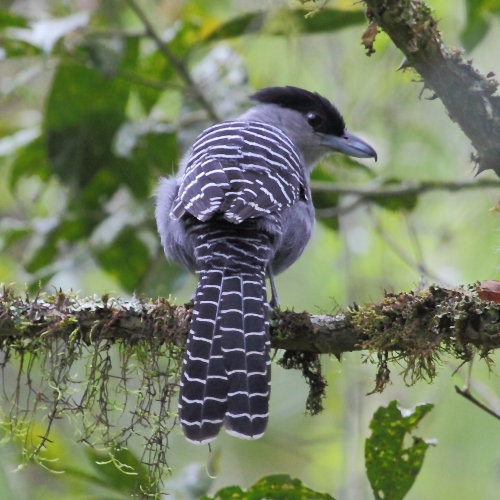
Bahia Antwren
Herpsilochmus pileatus
Order: Passeriformes / Family: Thamnophilidae

Wikimedia Commons
About the Bahia Antwren
The Bahia Antwren (Herpsilochmus pileatus) is a small bird endemic to the Atlantic Forest region of eastern Brazil, specifically within the state of Bahia. This species is part of the Thamnophilidae family, commonly known as antbirds, a group characterized by their insectivorous diet and preference for dense forest undergrowth. The Bahia Antwren is particularly significant due to its restricted range and specialized habitat requirements. As a forest-dependent species, it plays a crucial role in the ecological dynamics of its environment, particularly in controlling insect populations and contributing to the forest's biodiversity. The bird's presence often indicates a healthy, undisturbed habitat, making it an important species for conservation monitoring. In terms of seasonal behavior, the Bahia Antwren remains largely resident within its range, with no significant migratory movements reported. However, it may exhibit some local movements in search of food or suitable breeding sites, particularly during the breeding season, which usually coincides with the rainy months when insect prey is most abundant. Observing this species requires patience and keen hearing, as it often remains hidden within the foliage, giving away its presence only through its characteristic calls.
The Bahia Antwren belongs to the family Thamnophilidae, within the order Passeriformes. These birds typically live average 3-4 years, with a max recorded of 5 years.
How to Identify a Bahia Antwren
The Bahia Antwren is distinguished by its contrasting black and white plumage. Adult males typically feature a bold black cap, which extends from the beak to the nape, setting off their otherwise grayish body. Their wings and tail bear distinctive white markings, providing a striking contrast against the darker feathers. Adult females, while similar in structure, exhibit a more muted coloration, with brownish tones replacing the black cap, making them somewhat less conspicuous. Juveniles resemble females but with even duller and browner hues, lacking the sharp contrast seen in adults. In terms of behavior, the Bahia Antwren is usually observed flitting through the mid-story and lower canopy, often in pairs or small family groups. Its rapid movements and the flicking of its wings and tail can be useful identification cues, particularly when observed at a distance. Although similar in size and shape to other antwrens, such as the Pectoral Antwren, the Bahia Antwren's distinct cap and vocalizations help differentiate it from its relatives.
Having trouble telling birds apart? Upload a photo to our bird identification tool for an instant species match.
Bahia Antwren Habitat and Range
Preferred Habitat
The Bahia Antwren inhabits the humid tropical forests of the Atlantic Forest biome in eastern Brazil. Its preferred habitat includes dense, tall forests with a well-developed undergrowth layer, often near streams or moist areas. This bird is typically found at low to mid-elevations, ranging from sea level up to about 800 meters, where it forages in the mid-story and understory vegetation. While it primarily occupies primary forests, the Bahia Antwren can occasionally be found in secondary growth areas, provided they offer sufficient cover and food resources. Unlike some other forest-dwelling species, the Bahia Antwren does not adapt well to urban environments and is rarely found near human settlements, except where forest fragments persist.
Geographic Range
The Bahia Antwren's range is confined to the state of Bahia in eastern Brazil, specifically within the Atlantic Forest's remaining fragments. This region is one of the most biologically diverse and endangered ecosystems in the world, making the Bahia Antwren a species of special concern. The bird's limited range means its population density can vary significantly depending on the quality of the habitat. In areas where suitable forest is intact, the Bahia Antwren may be relatively common, though overall it is considered rare due to the extensive deforestation in its range. There are no known migratory patterns for this species, as it tends to remain within its established territories throughout the year. The concentration of the Bahia Antwren within such a restricted geographic area underscores the importance of targeted conservation efforts to ensure the survival of this distinctive bird.
Want to know which birds visit your area? Browse our backyard birds by location guides for region-specific species lists.
What Does the Bahia Antwren Eat?
The Bahia Antwren primarily feeds on insects and other small arthropods, making it an integral part of the ecosystem's insect control. It forages actively among the foliage, often gleaning insects from leaves and branches. The bird's diet includes beetles, spiders, and caterpillars, which it captures with quick, precise movements. During the breeding season, when energy demands increase, the Bahia Antwren may expand its diet to include small fruits and seeds that are readily available. Its foraging technique involves a combination of visual hunting and rapid movements through the vegetation, occasionally joining mixed-species foraging flocks to increase feeding efficiency. This behavior not only helps the Bahia Antwren find food but also reduces the risk of predation by increasing vigilance within the group.
Bahia Antwren Behavior and Social Structure
Bahia Antwrens display interesting social behaviors, often seen in pairs or small family groups, indicating a monogamous social structure. They are territorial, with pairs defending their home range against intruders with vocalizations and displays. During the breeding season, males engage in courtship displays that include song and physical posturing to attract mates and establish pair bonds. The Bahia Antwren is an active bird, spending much of its day foraging through the dense undergrowth, rarely staying still for long. It is more often heard than seen, using its distinctive calls to communicate with its mate and offspring. In response to predators, the Bahia Antwren employs stealth and rapid movement, diving into dense foliage to evade capture. Its activity peaks during the early morning and late afternoon when insect prey is most active.
Bahia Antwren Nesting and Reproduction
The Bahia Antwren constructs its nest in the understory of dense forests, typically using fine plant materials such as twigs, leaves, and fibers to create a small, cup-shaped structure. These nests are often placed in low vegetation, providing both concealment from predators and proximity to foraging grounds. The female typically lays a clutch of two to three eggs, which both parents incubate over a period of approximately 14 days. Once hatched, the chicks are altricial, requiring significant parental care. Both parents participate in feeding and protecting the young, which fledge about two weeks post-hatching. The Bahia Antwren often raises one brood per year, although in favorable conditions, a second brood may be attempted. The timing of breeding generally aligns with the rainy season when food resources are most abundant.
Bahia Antwren Sounds and Vocalizations
The Bahia Antwren's primary song consists of a series of sharp, high-pitched notes delivered in rapid succession. This song is often described as a 'tsee-tsee-tsee-tsee,' reminiscent of a sewing machine's hum. Males and females both sing, although the male's song is usually more elaborate. Besides their song, Bahia Antwrens communicate with a variety of call notes, including soft chattering sounds used for maintaining contact with mates and high-pitched alarm calls that alert to the presence of predators. At dawn, their vocal activity intensifies, creating a morning chorus that resonates through the forest, a key time for establishing territorial boundaries and strengthening pair bonds.
Interesting Facts About the Bahia Antwren
- 1The Bahia Antwren was only recognized as a distinct species in 1995, highlighting ongoing discoveries within the Atlantic Forest.
- 2Despite its small size, the Bahia Antwren has a surprisingly loud voice, often heard before it is seen.
- 3This species exhibits strong site fidelity, with individuals rarely venturing far from their established territories.
- 4Their nests are often strategically placed near ant trails, benefiting from the presence of ants as a deterrent to predators.
- 5The Bahia Antwren plays a key role in mixed-species foraging flocks, contributing to the overall vigilance of the group.
- 6While many birds show sexual dimorphism in coloration, the Bahia Antwren's females are notably different, with brown caps instead of black.
- 7Deforestation in the Bahia Antwren's habitat has been so severe that less than 10% of the original Atlantic Forest remains intact.
Bahia Antwren Conservation Status
The IUCN currently classifies the Bahia Antwren as Vulnerable due to its limited range and the ongoing threat of habitat destruction. Deforestation for agriculture, urban expansion, and logging are primary threats, significantly reducing available habitat. Conservation efforts focus on protecting remaining forest fragments and promoting reforestation in degraded areas. Historical data suggests a decline in Bahia Antwren populations paralleling the loss of the Atlantic Forest. Conservationists emphasize the importance of establishing protected areas and community-based conservation projects to stabilize and potentially increase population numbers.