
Band-tailed Antshrike
Thamnophilus melanothorax
Order: Passeriformes / Family: Thamnophilidae

Wikimedia Commons
About the Band-tailed Antshrike
The Band-tailed Antshrike, scientifically known as Thamnophilus melanothorax, is a captivating species within the Thamnophilidae family. This bird inhabits the dense forests of South America, with notable populations found in Brazil, Peru, and Bolivia. It thrives in lowland tropical forests, specifically those rich in undergrowth and dense foliage. The species plays a crucial ecological role as both predator and prey within its ecosystem. Its predation on insects helps control insect populations, contributing to the ecological balance of its habitat.
In terms of significance, the Band-tailed Antshrike is an indicator species, reflecting the health of the tropical forests it inhabits. Its presence often signifies a well-preserved habitat, as it requires dense, undisturbed forest conditions. The bird's ecological role extends to seed dispersal, albeit indirectly, as it preys on insects that interact with flowering plants.
Seasonally, the Band-tailed Antshrike exhibits relatively sedentary behavior, with no significant migration patterns. However, during the breeding season, typically from September to February, its activities become more pronounced. Males engage in vocal displays to establish territories and attract mates, a behavior that underscores the importance of sound in its ecological interactions. As a result, the Band-tailed Antshrike is not only a fascinating subject for ornithologists but also a vital component of the tropical ecosystems it inhabits.
The Band-tailed Antshrike belongs to the family Thamnophilidae, within the order Passeriformes. These birds typically live average 4-7 years with a maximum recorded of 10 years..
How to Identify a Band-tailed Antshrike
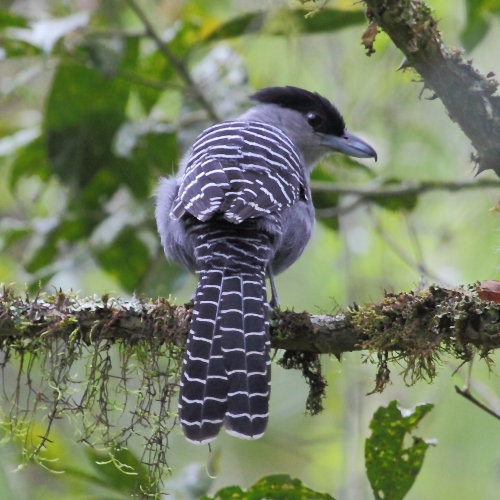
The Band-tailed Antshrike is a medium-sized bird, approximately 16 centimeters in length. Its plumage is striking, with males displaying a predominantly black body adorned with white streaks on the wings and a distinctly banded tail. Females, while similar in size, exhibit more subdued coloring, with brownish tones replacing the male's stark black.
Juveniles resemble females but often have a mottled appearance as they transition into adult plumage. In the field, the bird's tail is a key identifying feature, with alternating black and white bars that are visible even from a distance. Its robust bill and dark eyes add to its characteristic appearance, making it distinct among other antshrikes.
When observing the Band-tailed Antshrike, one might confuse it with the Barred Antshrike, another member of the Thamnophilidae family. However, the Band-tailed Antshrike's unique tail pattern and less pronounced barring on the body help differentiate it. Its flight is typically short and direct, often interspersed with pauses, reflecting its preference for dense forest undergrowth.
Having trouble telling birds apart? Upload a photo to our bird identification tool for an instant species match.
Band-tailed Antshrike Habitat and Range
Preferred Habitat
The Band-tailed Antshrike primarily inhabits tropical lowland forests, particularly those with dense undergrowth. It favors regions rich in vines and tangled vegetation, which provide both cover and foraging opportunities. This bird is typically found at elevations ranging from sea level to about 1,200 meters, although it prefers lower elevations where forest density is greatest.
In terms of habitat shifts, the Band-tailed Antshrike remains within the confines of its preferred forest environment year-round, exhibiting little to no seasonal migration. While it is predominantly a forest-dwelling species, it occasionally ventures into adjacent scrublands, especially when searching for food.
The presence of the Band-tailed Antshrike in urban areas is rare, as it relies heavily on the undisturbed forest interior. Its dependence on specific habitat conditions makes it particularly vulnerable to deforestation and habitat fragmentation.
Geographic Range
The Band-tailed Antshrike's range extends across various parts of South America, with the most significant populations residing in the Amazon Basin. It is predominantly found in northern Brazil, extending into southern Venezuela and eastern Peru, with scattered populations in Bolivia. This range encompasses some of the densest tropical forests in the world, where the bird thrives.
During the breeding season, the Band-tailed Antshrike does not exhibit notable migration, remaining within its established range. This sedentary nature limits its presence to specific forested areas, unlike more migratory species that traverse broader regions.
Population density hotspots include the Brazilian states of Amazonas and Pará, where forest conditions are optimal for the species. Here, the Band-tailed Antshrike can be observed in relatively stable numbers, benefiting from the extensive forest cover that these regions provide. However, deforestation poses a significant threat, potentially impacting its distribution in the future.
Want to know which birds visit your area? Browse our backyard birds by location guides for region-specific species lists.
What Does the Band-tailed Antshrike Eat?
The Band-tailed Antshrike primarily feeds on insects, with a diet that includes ants, beetles, and spiders. It employs a methodical foraging technique, navigating through the dense undergrowth while gleaning prey from foliage and branches. The bird's sturdy bill is well-suited for capturing insects, allowing it to pry into crevices where prey might hide.
Seasonal changes in its diet occur in response to insect availability. During the wet season, when insects are more abundant, the Band-tailed Antshrike may supplement its diet with small fruits and seeds, although this is secondary to its insectivorous habits.
The bird typically forages during the early morning and late afternoon, avoiding the midday heat. Its feeding schedule aligns with the activity patterns of its prey, ensuring an efficient foraging strategy. Prey size varies, but the bird often targets small to medium-sized insects that can be easily managed and consumed on the spot.
Band-tailed Antshrike Behavior and Social Structure
The Band-tailed Antshrike exhibits distinctive social and territorial behaviors. It is generally a solitary bird or found in pairs, with pair bonds forming during the breeding season. Males actively defend their territory, using vocalizations to ward off intruders and assert dominance.
During courtship, the Band-tailed Antshrike engages in elaborate displays, with males showcasing their plumage and performing subtle movements to attract females. These displays highlight both visual and auditory elements, with song playing a crucial role in mate selection.
The bird's response to predators is cautious, often retreating into the dense undergrowth when threatened. While not typically an aggressive species, it may exhibit defensive behavior if a nest or young are at risk. Daily activity patterns involve periods of foraging interspersed with rest and preening, reflecting a balance between energy expenditure and conservation.
Flocking is uncommon, but the Band-tailed Antshrike may occasionally join mixed-species flocks, especially in areas where food resources are patchy. This behavior allows it to benefit from the collective vigilance of a group while foraging.
Band-tailed Antshrike Nesting and Reproduction
The Band-tailed Antshrike constructs a cup-shaped nest, often placed in the fork of a branch or amidst dense foliage. Nest materials include twigs, leaves, and spider silk, which provide both structure and camouflage. The location preference is typically a few meters above ground, ensuring protection from ground-dwelling predators.
Clutch size ranges from two to three eggs, with incubation lasting approximately 14 days. Both parents share incubation duties, demonstrating a cooperative breeding strategy. Once hatched, the fledglings remain in the nest for about 12 to 14 days before venturing out.
Parental roles extend beyond incubation, as both male and female Band-tailed Antshrikes actively feed and protect their young. This shared responsibility ensures high survival rates among fledglings. The species typically produces one to two broods per year, depending on environmental conditions and resource availability.
Band-tailed Antshrike Sounds and Vocalizations
The primary song of the Band-tailed Antshrike is a series of sharp, rhythmic notes, often described as a repetitive 'chip, chip, chip.' The pitch is relatively high, with a clear and piercing quality that can carry through the dense forest canopy.
In addition to its primary song, the bird emits various call notes that range from soft chirps to more urgent alarm calls. These vocalizations serve different purposes, from maintaining contact with a mate to alerting of potential threats.
The Band-tailed Antshrike participates actively in the dawn chorus, its songs and calls contributing to the rich acoustic tapestry of the forest habitat. Its vocal repertoire is comparable to other antshrikes, but the distinctive rhythm and clarity of its notes set it apart.
Interesting Facts About the Band-tailed Antshrike
- 1The Band-tailed Antshrike's song can be heard from up to 100 meters away, making it a prominent voice in the forest.
- 2This species is known to follow army ant swarms, taking advantage of the insects flushed out by the ants.
- 3Despite its striking appearance, the Band-tailed Antshrike is adept at remaining concealed in dense foliage.
- 4The bird's scientific name, Thamnophilus melanothorax, reflects its dark-throated appearance.
- 5Band-tailed Antshrikes are monogamous, often forming pair bonds that last for several breeding seasons.
- 6Their nests are typically located 1 to 3 meters above ground, a strategic height for avoiding predators.
- 7The Band-tailed Antshrike is a key species for birdwatchers visiting South America's tropical forests.
Band-tailed Antshrike Conservation Status
Currently, the Band-tailed Antshrike holds a status of Least Concern on the IUCN Red List, with a population trend that appears stable. However, deforestation and habitat loss pose significant threats to its long-term survival. Large-scale logging and agricultural expansion in the Amazon Basin could lead to habitat fragmentation, affecting the bird's distribution and population dynamics. Conservation efforts focus on habitat preservation, including the establishment of protected areas and reserves. These initiatives aim to safeguard vital forest habitats and ensure the continuity of ecological processes. Historical population changes have been minimal, but ongoing environmental pressures necessitate vigilant monitoring. Collaborative conservation programs involving local communities, governments, and international organizations are crucial for the long-term protection of the Band-tailed Antshrike and its habitat.
Other Thamnophilidae Species



Birds Similar to the Band-tailed Antshrike
These species are often confused with the Band-tailed Antshrike due to similar appearance or overlapping range.

