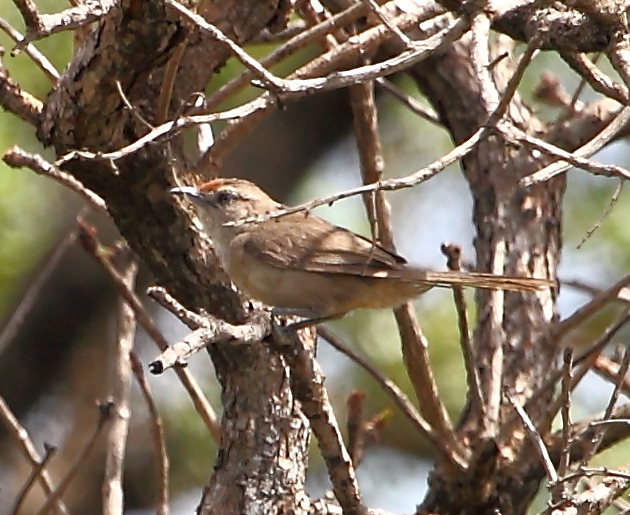
Band-tailed Eremobius
Eremobius phoenicurus
Order: Passeriformes / Family: Furnariidae

Wikimedia Commons
About the Band-tailed Eremobius
The Band-tailed Eremobius, Eremobius phoenicurus, is a charismatic member of the Furnariidae family, renowned for its agility and distinctive rufous tail. This small passerine inhabits the arid and semi-arid environments of South America, particularly thriving in the scrublands and dry forests of Argentina, Bolivia, and Paraguay. Its presence in these challenging habitats underscores its adaptability and ecological significance as a seed disperser and insect controller. This bird plays a crucial role in maintaining the ecological balance by consuming insects that could potentially become agricultural pests. The Band-tailed Eremobius is particularly associated with the Chaco region, a hot and semi-arid plain where it frequents areas with scattered shrubs and bushes. During the breeding season, which aligns with the Southern Hemisphere's spring, this bird exhibits increased vocal activity and territoriality. It uses a combination of visual displays and vocalizations to establish its presence and attract mates. As seasons change, the Band-tailed Eremobius may adjust its diet and foraging patterns to align with food availability, showcasing its remarkable adaptability. Observers often note its busy, terrestrial foraging behavior, as it moves quickly along the ground in search of food, pausing occasionally to flick its tail or issue metallic calls. Its role in the ecosystem extends beyond mere survival; it contributes to the health of its environment by participating in the control of insect populations and seed dispersal. This ecological niche makes the Band-tailed Eremobius an important species for the maintenance of biodiversity in its native habitats.
The Band-tailed Eremobius belongs to the family Furnariidae, within the order Passeriformes. These birds typically live average 4 years with a max recorded of 7 years.
How to Identify a Band-tailed Eremobius
Identifying the Band-tailed Eremobius involves noting its small size, typically around 14 centimeters in length. Its most striking feature is the rufous tail, which contrasts with its otherwise brown and gray plumage. The back and wings display a warm brown color, while the underparts are a paler gray-brown. The bird's slender, slightly curved bill is well-suited for its insectivorous diet. Males and females look similar, though males may appear slightly brighter during the breeding season. Juveniles resemble adults but tend to have duller plumage and a less pronounced tail coloration. In flight, the Band-tailed Eremobius shows a distinctive silhouette with its relatively long tail and pointed wings. When perched, its posture is upright, often with the tail slightly cocked. Confusion with similar species can occur, particularly with the Rufous Hornero, but the latter lacks the distinctive tail markings and tends to be larger with a different foraging style. Observers should also note the Band-tailed Eremobius's unique habit of tail flicking, which can aid in its identification.
Having trouble telling birds apart? Upload a photo to our bird identification tool for an instant species match.
Band-tailed Eremobius Habitat and Range
Preferred Habitat
The Band-tailed Eremobius prefers arid and semi-arid habitats, often found in the Chaco region's dry forests and scrublands. It thrives in areas with sparse vegetation, utilizing the cover of bushes and small trees for foraging and nesting. This species is typically found at elevations ranging from 200 to 1,000 meters, avoiding dense forests and high-altitude regions. Seasonal shifts in habitat are minimal, as it remains largely sedentary, though it may move locally to exploit food resources. In urban or suburban areas, it is rare but may occasionally be found in parks or gardens that mimic its natural habitat. The bird's ecological niche in these habitats makes it an important component of the lowland South American ecosystems.
Geographic Range
The Band-tailed Eremobius is primarily found in South America, with its range concentrated in northwestern Argentina, southern Bolivia, and parts of Paraguay. It inhabits the Gran Chaco, a vast region characterized by its hot, semi-arid climate and lowland plains. Unlike many passerines, the Band-tailed Eremobius does not undertake long-distance migrations, generally remaining within its breeding range year-round. However, it may exhibit some altitudinal movements, descending to lower elevations during colder months. The species is relatively common within its range, although population densities can be patchy, depending largely on habitat quality and availability.
Want to know which birds visit your area? Browse our backyard birds by location guides for region-specific species lists.
What Does the Band-tailed Eremobius Eat?
The diet of the Band-tailed Eremobius primarily consists of insects and other small invertebrates, which it actively forages for on the ground. It employs a gleaning technique, using its slender bill to capture prey among leaf litter and low vegetation. During the wet season, when insect abundance is high, this bird's diet is heavily insectivorous, including ants, beetles, and caterpillars. In drier months, its diet diversifies to include seeds and berries, demonstrating its adaptability. It forages alone or in pairs, often in the early morning or late afternoon when insect activity peaks. The prey size is generally small, aligning with its bill size and foraging method.
Band-tailed Eremobius Behavior and Social Structure
The Band-tailed Eremobius exhibits solitary or pair-based social structures, particularly during the breeding season when it defends its territory aggressively. Territorial disputes may involve vocalizations and visual displays, including tail flicking and wing flapping. Courtship displays are subtle yet involve increased vocal activity and mutual preening between pairs. Unlike many passerines, the Band-tailed Eremobius is not known for forming large flocks outside the breeding season, maintaining its solitary nature. Its response to predators includes alarm calls and evasive flight, often retreating to dense cover. Daily activity patterns show peak foraging during cooler parts of the day, with rest periods during midday heat. This behavior reflects its adaptation to the hot, arid environments it inhabits.
Band-tailed Eremobius Nesting and Reproduction
Band-tailed Eremobius nests are typically constructed in natural cavities found in trees or large shrubs. The bird uses a variety of materials, including grass, twigs, and feathers, to create a soft lining within the cavity. The typical clutch size ranges from two to three eggs, which are incubated by both parents for approximately 14 to 16 days. Following hatching, the chicks remain in the nest for another two to three weeks before fledging. Both parents participate in feeding and caring for the young, ensuring high survival rates. The species usually raises one brood per year, although conditions may allow for a second brood if resources are abundant.
Band-tailed Eremobius Sounds and Vocalizations
The primary song of the Band-tailed Eremobius is a rapid series of metallic notes, delivered with a clear, rhythmic pattern. These songs occur more frequently during the breeding season as the bird establishes its territory and attracts a mate. Call notes are short and sharp, often used in communication between pairs or to signal alarm. These vocalizations can resemble the sound of a small bell or chime, adding a unique acoustic element to its environment. During the dawn chorus, the Band-tailed Eremobius is one of the early singers, contributing to the morning symphony with its distinctive calls.
Interesting Facts About the Band-tailed Eremobius
- 1The Band-tailed Eremobius can flick its tail up to 20 times per minute when foraging, an unusual behavior among its relatives.
- 2Despite its small size, the Band-tailed Eremobius plays a significant role in controlling insect populations in its habitat.
- 3This bird's rufous tail is a key field mark, helping it stand out even among the diverse avian fauna of the Chaco region.
- 4The Band-tailed Eremobius's vocalizations have been likened to the sound of a small bell, making it easy to identify by ear.
- 5Its preference for arid and semi-arid environments showcases its adaptability, thriving where many other passerines do not.
- 6Unlike many songbirds, the Band-tailed Eremobius does not migrate long distances, staying close to its breeding grounds year-round.
- 7The Band-tailed Eremobius is an important seed disperser, aiding in the regeneration of its native shrubland habitats.
Band-tailed Eremobius Conservation Status
The IUCN currently classifies the Band-tailed Eremobius as Least Concern, with stable population trends across its range. Its adaptability to various semi-arid habitats contributes to its resilience against habitat loss. However, agricultural expansion and deforestation in some areas pose potential threats. Conservation efforts focus on preserving the Chaco region's natural habitats, which are vital for this species' survival. Historical data suggest that the Band-tailed Eremobius maintains stable populations, benefiting from its ecological role and habitat flexibility.
Other Furnariidae Species


Birds Similar to the Band-tailed Eremobius
These species are often confused with the Band-tailed Eremobius due to similar appearance or overlapping range.