
Banded Antbird
Dichrozona cincta
Order: Passeriformes / Family: Thamnophilidae

Wikimedia Commons
About the Banded Antbird
The Banded Antbird, scientifically known as Dichrozona cincta, is a captivating bird species found predominantly in the dense tropical forests of South America. As a member of the Thamnophilidae family, this bird is particularly associated with the understory of lowland forests, where it often remains hidden among the dense foliage. The Banded Antbird plays a crucial ecological role by controlling insect populations, as it primarily feeds on ants and other small invertebrates. Its presence indicates a healthy forest ecosystem, as it thrives in areas with rich biodiversity and dense vegetation. Found in countries like Brazil, Colombia, and Peru, the Banded Antbird prefers habitats with high humidity and abundant leaf litter, which provide ample foraging opportunities. This bird is especially significant in the Amazon Basin, where it contributes to the complex web of predator-prey interactions. During the breeding season, which typically occurs during the wetter months, the Banded Antbird becomes more vocal, allowing birdwatchers to spot this otherwise elusive species. Its distinctive calls and secretive nature make it a favorite among ornithologists and birding enthusiasts. Understanding the behaviors and ecological significance of the Banded Antbird offers insights into the health and dynamics of tropical forest ecosystems. Monitoring its population trends can also provide valuable data on the impacts of deforestation and habitat fragmentation, which are pressing conservation concerns in its native range. The Banded Antbird showcases the intricate relationships within its ecosystem and highlights the importance of preserving tropical forests for the myriad species that call these environments home.
The Banded Antbird belongs to the family Thamnophilidae, within the order Passeriformes. These birds typically live average 5 years with a maximum recorded of 9 years..
How to Identify a Banded Antbird
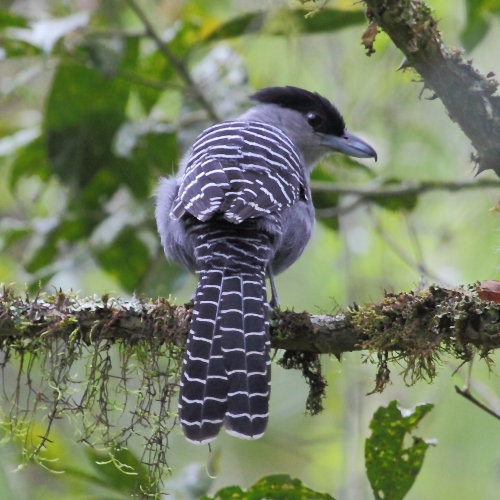
Identifying the Banded Antbird involves noting its distinct black-and-white plumage. Adult birds display bold, horizontal bands across the chest, which are a key feature distinguishing them from similar species. The rest of the plumage is predominantly brown with subtle gray tones, helping them blend into their forest surroundings. Males and females look similar, though females may exhibit slightly duller plumage. Juveniles lack the pronounced banding seen in adults and are generally more uniformly brown, making them harder to identify. In flight, the Banded Antbird's silhouette is compact, with a short tail and rounded wings. When perched, this bird often adopts a low profile, staying close to the ground or within dense vegetation. Its posture and behavior can be confused with other antbirds, but the distinctive banding is a reliable field mark. Observers should note the bird's size, which falls in the small to medium range, further aiding in identification.
Having trouble telling birds apart? Upload a photo to our bird identification tool for an instant species match.
Banded Antbird Habitat and Range
Preferred Habitat
The Banded Antbird is typically found in the understory of tropical lowland forests, favoring areas with dense foliage and abundant leaf litter. These environments provide optimal conditions for foraging and nesting. It thrives at elevations ranging from sea level to 1,200 meters in regions like the Amazon Basin. Seasonal habitat shifts are minimal, as the species is largely sedentary, relying on the consistent climate and resources of the forest. While primarily a forest dweller, the Banded Antbird does not venture into urban or heavily disturbed areas. The bird's preference for undisturbed habitats makes it an indicator species for forest health and biodiversity.
Geographic Range
The Banded Antbird's range is concentrated in northern South America, with its breeding and residential territories spanning Brazil, Venezuela, Colombia, Ecuador, and Peru. It is most commonly found in the Amazon Basin, where the dense, humid forests provide ideal living conditions. The bird does not migrate, maintaining year-round residency within its range. Population densities can vary, with hotspots occurring in pristine forest areas where human disturbance is minimal. As a non-migratory species, the Banded Antbird relies heavily on the stability of its habitat, making it vulnerable to deforestation and habitat destruction.
Want to know which birds visit your area? Browse our backyard birds by location guides for region-specific species lists.
What Does the Banded Antbird Eat?
The diet of the Banded Antbird primarily consists of small invertebrates, with ants being a staple food source. The bird employs a foraging technique known as 'ant-following', wherein it trails army ant swarms to catch insects and other invertebrates flushed out by the ants. This behavior allows the bird to capitalize on the movements of ants, ensuring a consistent supply of prey. The diet can vary seasonally, with an increase in feeding frequency during the breeding season to support offspring. The Banded Antbird typically forages at dawn and dusk, taking advantage of cooler temperatures and heightened prey activity.
Banded Antbird Behavior and Social Structure
The Banded Antbird exhibits a solitary or paired social structure, often seen alone or with a mate. Territorial behavior is pronounced, with individuals actively defending their feeding and nesting areas from intruders. Courtship displays are subtle, involving calls and mutual preening rather than elaborate dances. The bird does not form flocks, preferring the company of its mate or solitude. In response to predators, the Banded Antbird employs a freeze-and-hide strategy, utilizing its cryptic plumage to blend into the forest understory. Its daily activity pattern includes active foraging during the cooler parts of the day and resting during midday heat.
Banded Antbird Nesting and Reproduction
Banded Antbirds build cup-shaped nests using materials such as leaves, twigs, and grasses. These nests are strategically placed low to the ground, often in dense thickets or among vines, providing camouflage and protection from predators. The typical clutch size ranges from 2 to 3 eggs, which are incubated by both parents. The incubation period lasts approximately 14 days, followed by a fledging period of around 12 to 15 days. Both parents share responsibilities, including feeding and protecting the young. The species typically raises one brood per year, with breeding timed to coincide with periods of increased insect abundance.
Banded Antbird Sounds and Vocalizations
The primary song of the Banded Antbird is a series of short, sharp whistles that rise and fall in pitch, creating a rhythmic, cascading effect. Its call notes are softer, often described as a series of 'cheep' sounds used for communication between mates. Alarm calls are more insistent and harsh, serving to alert others to potential threats. During the dawn chorus, the Banded Antbird's song contributes to the rich tapestry of sounds that fill the tropical forest, often starting its vocalizations before sunrise when the forest is still cloaked in darkness.
Interesting Facts About the Banded Antbird
- 1The Banded Antbird is one of the few birds that rely heavily on army ants to flush out prey, showcasing a unique ecological dependency.
- 2Despite its striking appearance, the Banded Antbird's secretive nature makes it a challenging species to observe in the wild.
- 3The bird's name comes from its distinctive banding pattern, which serves as an effective camouflage in its forest habitat.
- 4Banded Antbirds are known for their territoriality, often chasing away larger birds that encroach on their space.
- 5Their nesting sites are carefully chosen to maximize camouflage and minimize predation risk, demonstrating strategic nesting behavior.
- 6The Banded Antbird's song is a key tool for maintaining territory and attracting mates, especially during the breeding season.
- 7Ornithologists study the Banded Antbird to learn more about the dynamics of tropical forest ecosystems and antbird-ant interactions.
Banded Antbird Conservation Status
The Banded Antbird is currently classified as Least Concern by the IUCN, with a stable population trend. However, ongoing threats such as deforestation and habitat fragmentation pose risks to its long-term survival. Conservation efforts focus on preserving large tracts of intact forest and establishing protected areas to safeguard its habitat. Historically, the bird's population has remained stable, but continued monitoring is essential to ensure that habitat loss does not lead to future declines.
Other Thamnophilidae Species



Birds Similar to the Banded Antbird
These species are often confused with the Banded Antbird due to similar appearance or overlapping range.
