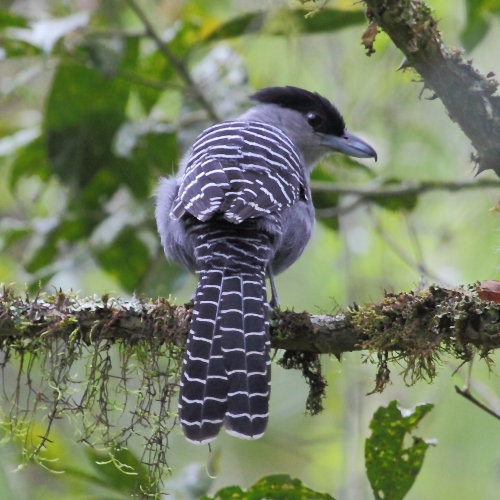
Bare-crowned Antbird
Gymnocichla nudiceps
Order: Passeriformes / Family: Thamnophilidae

Wikimedia Commons
About the Bare-crowned Antbird
The Bare-crowned Antbird, scientifically known as Gymnocichla nudiceps, is a fascinating species within the family Thamnophilidae. It is primarily found in the dense, humid forests of Central America, with its range extending from Honduras through Nicaragua, Costa Rica, and into Panama. This antbird plays a significant ecological role within these ecosystems, primarily through its feeding habits, which help control insect populations.
Typically inhabiting lowland rainforests, the Bare-crowned Antbird is a specialist in its environment, thriving in areas with dense understory vegetation. Its presence is a good indicator of healthy, undisturbed forest habitats. This bird is non-migratory, meaning it resides in its tropical habitat year-round. Its behavior is notably associated with army ant swarms, which it follows to catch insects flushed out by the ants. This feeding strategy highlights its ecological role in maintaining the balance of forest insect populations.
The Bare-crowned Antbird is an intriguing study subject for ornithologists due to its unique adaptations and behaviors. During the wet season, which generally occurs from May to November in its range, the bird's activity levels increase as it exploits the abundance of food. This period also coincides with its breeding season, when the forest is lush and resources are plentiful. Seasonal behaviors such as these underscore the bird's adaptation to its environment and its reliance on the forest's natural cycles.
The significance of the Bare-crowned Antbird extends beyond its ecological role, as it also serves as a subject of interest for birdwatchers and naturalists. Its striking appearance and specialized behaviors make it a sought-after species for wildlife enthusiasts visiting Central America's tropical forests. Additionally, its presence can serve as a marker for conservationists assessing the health of forest ecosystems, given its dependence on pristine habitats.
The Bare-crowned Antbird belongs to the family Thamnophilidae, within the order Passeriformes. These birds typically live average 4-6 years, with a max recorded at 9 years..
How to Identify a Bare-crowned Antbird
The Bare-crowned Antbird is a medium-sized bird, easily identifiable by its distinctive bare blue crown. This feature is unique among the antbirds and serves as a key identification marker. Adult males and females both exhibit this bare crown, though the intensity of the blue may vary slightly. The rest of the male's plumage is primarily black, providing a stark contrast to the bare crown. In contrast, females display a more subdued plumage with brown and rufous tones, particularly on the wings and back.
Juveniles resemble females in coloration but lack the mature intensity of the bare crown found in adults. Over time, as they reach sexual maturity, the blue crown becomes more pronounced. When comparing this species to others within the family, its bare crown is a definitive field mark, setting it apart from other antbirds that may have similar body coloration but with crests or feathered crowns.
In flight, the Bare-crowned Antbird has a compact silhouette with rapid wingbeats, typical of forest-dwelling birds that need agility to navigate dense foliage. When perched, it often adopts a horizontal posture, with its tail slightly cocked-a characteristic stance that can aid in identification when observing from a distance.
Having trouble telling birds apart? Upload a photo to our bird identification tool for an instant species match.
Bare-crowned Antbird Habitat and Range
Preferred Habitat
The Bare-crowned Antbird thrives in lowland tropical forests, favoring areas with dense understory vegetation. It commonly inhabits regions where the forest floor is relatively open but surrounded by thick shrubbery, providing ample cover. These habitats are typically found at elevations ranging from sea level to about 1,200 meters.
Within Central America, it occupies various forest types, including primary rainforests and well-structured secondary forests. Seasonal changes do not significantly alter its habitat preferences, as this species is non-migratory and remains in its chosen environment throughout the year.
While it predominantly inhabits rural and undisturbed forested areas, it is occasionally found near forest edges in proximity to human settlements, provided that the natural vegetation remains largely intact. Its presence in urban areas is rare, as it requires the complexity and cover of natural forests to thrive.
Geographic Range
The Bare-crowned Antbird's range is confined to the tropical zones of Central America. It breeds and resides year-round in countries such as Honduras, Nicaragua, Costa Rica, and Panama. These regions provide the humid, dense forest environments that are crucial for its survival.
The species does not undertake long-distance migrations, instead remaining within its established range throughout the year. However, it may exhibit some altitudinal movement, particularly during the wet season, as it follows the availability of food resources driven by army ant swarms.
Hotspots for population density are often found in protected forest reserves and national parks within its range. These protected areas ensure the preservation of its preferred habitats, allowing stable population numbers where human impact is minimized. The species is not found outside of Central America, making it endemic to this specific region.
Want to know which birds visit your area? Browse our backyard birds by location guides for region-specific species lists.
What Does the Bare-crowned Antbird Eat?
The Bare-crowned Antbird primarily feeds on insects and other arthropods, a diet that is intricately linked to its association with army ant swarms. As these ants move through the forest, they flush out a variety of prey, which the antbird efficiently captures.
During the wet season, when insect abundance increases, the bird's diet may expand slightly to include larger prey items such as beetles and spiders. However, it remains predominantly insectivorous year-round.
Foraging usually occurs in the morning and late afternoon, aligning with the activity patterns of army ants. The Bare-crowned Antbird exhibits a keen ability to catch insects mid-air or snatch them from leaves and branches, showcasing its adaptability in exploiting the resources provided by its environment.
Bare-crowned Antbird Behavior and Social Structure
The Bare-crowned Antbird exhibits fascinating behaviors, particularly in its relationship with army ant swarms. It is a solitary forager, often seen following these swarms alone or in small family groups.
Territorial by nature, the antbird defends its feeding and nesting areas vigorously, often engaging in vocal displays to ward off intruders. Its courtship behavior includes a series of vocalizations and physical displays, with males showcasing their striking blue crowns to attract females.
Daily activity patterns are influenced by the movement of army ants, with the bird remaining active primarily in the early morning and late afternoon. When faced with potential predators, the antbird relies on its ability to blend into the dense foliage, often staying motionless until the threat passes.
Bare-crowned Antbird Nesting and Reproduction
The Bare-crowned Antbird constructs a simple, cup-shaped nest using leaves, twigs, and other forest debris, typically located low to the ground in dense shrubbery. This positioning provides concealment from predators and protection from the elements.
Breeding occurs during the wet season, with the female laying 2 to 3 eggs per clutch. Both parents share in incubation duties, which last approximately 16 to 18 days. After hatching, the chicks fledge in about 12 to 14 days, though they remain dependent on the parents for food and protection for several weeks.
The species generally raises one brood per year, although in regions with especially abundant resources, two broods might be possible. Parental roles are shared, with both male and female participating in feeding and caring for the young until they are fully independent.
Bare-crowned Antbird Sounds and Vocalizations
The Bare-crowned Antbird's primary song consists of a series of rapid, high-pitched notes, often described as a 'tseep-tseep-tseep' pattern. These notes are delivered in a regular rhythm, serving both as a territorial marker and a mating call.
In addition to its song, the antbird emits a range of call notes, including sharp 'chip' sounds used as contact calls between mates or family members. Alarm calls are harsher and more abrupt, alerting nearby antbirds to potential threats.
During the dawn chorus, the Bare-crowned Antbird contributes with its distinct song, creating a vibrant soundscape within its forest habitat. These vocalizations play a crucial role in establishing and maintaining territories amidst the dense, competitive environment.
Interesting Facts About the Bare-crowned Antbird
- 1The Bare-crowned Antbird's striking blue crown is devoid of feathers, a unique feature among antbirds in Central America.
- 2This species is known to follow army ant swarms, benefiting from the insects flushed out by the ants.
- 3Despite its vivid crown, the Bare-crowned Antbird relies on its drab body coloration to blend into the forest understory.
- 4The bird's song, a rapid 'tseep-tseep-tseep,' serves as an auditory beacon in its dense habitat.
- 5Bare-crowned Antbirds exhibit strong territorial behaviors, often vocalizing to defend their space from intruders.
- 6They are non-migratory, residing year-round in the same tropical forest habitats.
- 7The Bare-crowned Antbird's presence indicates a healthy, undisturbed forest ecosystem, making it a valuable indicator species.
Bare-crowned Antbird Conservation Status
According to the IUCN, the Bare-crowned Antbird is currently listed as Least Concern, although its populations are subject to pressures from habitat loss due to deforestation. While stable in some areas, populations are decreasing in regions where forest habitats are being converted for agriculture or urban development. Conservation efforts focus on preserving the forest ecosystems upon which this species relies. Protected areas and national parks within its range serve as critical refuges, helping to mitigate the impact of habitat destruction. Historically, the bird's population has remained relatively stable in protected regions, underscoring the importance of continued conservation initiatives.