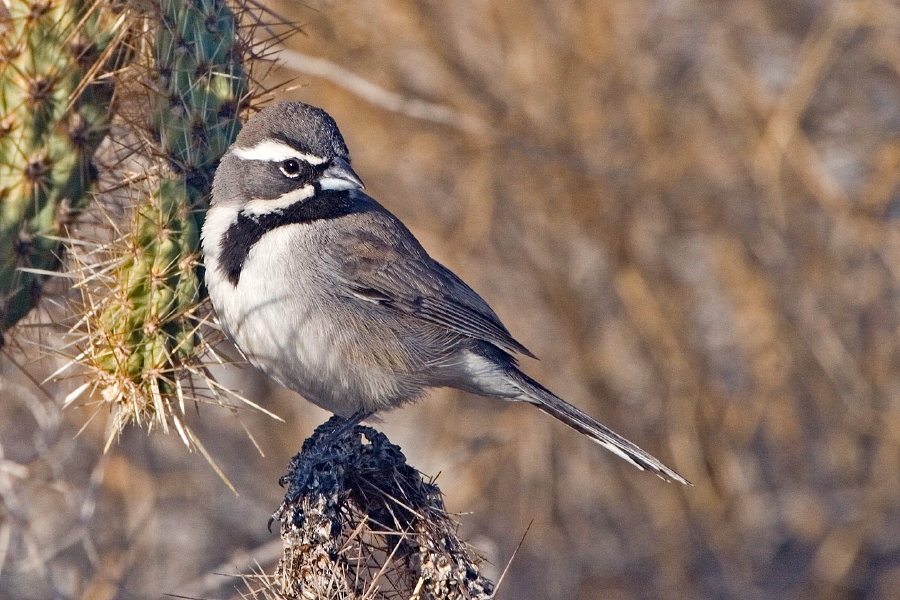
Bell's Sparrow
Artemisiospiza belli
Order: Passeriformes / Family: Passerellidae

Wikimedia Commons
About the Bell's Sparrow
The Bell's Sparrow, known scientifically as Artemisiospiza belli, is a small, elusive songbird that plays a vital role in the ecosystems of North American deserts and coastal scrublands. This species is predominantly found in California, extending into parts of Nevada and Baja California, Mexico. Its presence is notable in the chaparral and coastal sage scrub habitats, where it utilizes dense thickets of sagebrush for nesting and foraging. Unlike many other sparrows, Bell's Sparrows are well adapted to arid environments, often thriving in regions where other species struggle to survive. This adaptability makes them a key species in maintaining the ecological balance in these fragile environments.
Bell's Sparrows serve as important seed dispersers and pest controllers within their habitat. By consuming a variety of seeds and insects, they aid in plant reproduction and help control insect populations, which can become pests if left unchecked. Their diet includes seeds from native plants like California sagebrush and buckwheat, contributing to the propagation of these essential flora. Moreover, during the breeding season, they consume a higher proportion of insects, providing a critical food source for their growing chicks.
The bird's annual cycle reflects a well-adapted strategy to the seasonal variations of its habitat. During the spring and summer breeding season, Bell's Sparrows establish territories in dense, shrubby areas where they find ample cover and food resources. As autumn approaches, some populations exhibit limited altitudinal migration, moving to slightly lower elevations to avoid the colder temperatures of their breeding grounds. This seasonal movement, however, is relatively minor compared to the long migratory journeys of other sparrow species. In winter, they remain in their general range, relying on the evergreen parts of their habitat to sustain them through the cooler months. The Bell's Sparrow's ability to persist in such a specialized niche underscores its importance and adaptability within its ecosystem.
The Bell's Sparrow belongs to the family Passerellidae, within the order Passeriformes. These birds typically live average lifespan of 4-5 years, with a maximum recorded of 7 years..
How to Identify a Bell's Sparrow
Bell's Sparrows are characterized by their small size and distinctive plumage, which aids in their identification. Adults exhibit grayish-brown upperparts with a subtle streaking pattern that provides effective camouflage among the shrubs. The most striking feature is the dark central spot on their otherwise pale breast, a key field mark that distinguishes them from similar species. Their face is marked with a white eye-ring and a gray crown, giving them a slightly capped appearance. Juvenile Bell's Sparrows resemble adults but often display a more heavily streaked breast and duller plumage.
Sexual dimorphism is minimal in Bell's Sparrows, with males and females having similar plumage, though males may appear slightly brighter during the breeding season. Observers might confuse them with Sagebrush Sparrows, particularly in regions where their ranges overlap. However, Sagebrush Sparrows typically exhibit more extensive streaking on the breast and a less pronounced central spot. In flight, Bell's Sparrows show a relatively short, rounded tail, which is often fanned out to reveal white edges.
When perched, Bell's Sparrows adopt a characteristic stance, often sitting upright with their tails slightly cocked. This posture, combined with their tendency to remain motionless within dense shrubbery, can make them difficult to spot, requiring patience and keen observation from birders actively seeking them in their native habitats.
Having trouble telling birds apart? Upload a photo to our bird identification tool for an instant species match.
Bell's Sparrow Habitat and Range
Preferred Habitat
Bell's Sparrows primarily inhabit arid and semi-arid regions, thriving in environments dominated by sagebrush, chaparral, and coastal sage scrub. These habitats are found extensively throughout California, such as in the Mojave Desert and along the coastal ranges. The species prefers areas with dense, low-growing shrubs that offer both cover from predators and a rich source of food. Elevations up to 1,500 meters are typical, though they can be found at lower elevations, particularly in coastal regions.
Seasonal changes can lead to minor shifts in habitat preference. While they breed in dense chaparral or sagebrush-dominated areas during the spring and summer, they may move to slightly more open areas in winter, where evergreen shrubs provide necessary cover and sustenance. Despite their adaptability, Bell's Sparrows are generally absent from urban areas, preferring the undisturbed natural landscapes of rural regions. Their reliance on specific shrubland ecosystems underscores the importance of habitat conservation efforts to maintain suitable living conditions for this species.
Geographic Range
The breeding range of Bell's Sparrows spans the arid and semi-arid regions of the western United States, primarily concentrated in California, with extensions into southern Nevada and northern Baja California. Within California, they are widespread across the coastal sage scrub and chaparral habitats, particularly in areas like the Central Valley and the foothills surrounding the Sierra Nevada. Some populations may breed as far north as the San Francisco Bay area.
In winter, Bell's Sparrows remain largely within their breeding range, though some individuals may move to lower elevations or more southern locales to escape harsher conditions. Unlike many sparrows, they do not undertake long-distance migrations, reflecting their adaptation to the stable climate of their native regions.
Population densities are highest in regions with extensive, continuous shrubland, particularly in protected areas such as national parks and nature reserves. While relatively common within their suitable habitat, their population density can vary significantly depending on the quality and continuity of the shrubland, with fragmentation leading to lower densities.
Want to know which birds visit your area? Browse our backyard birds by location guides for region-specific species lists.
What Does the Bell's Sparrow Eat?
Bell's Sparrows have a varied diet that changes with the seasons, ensuring their survival in the challenging conditions of their arid habitats. During the spring and summer, they predominantly consume insects, which are abundant and provide essential protein for breeding adults and their chicks. Common prey includes beetles, grasshoppers, and caterpillars, which they forage from the ground or glean from vegetation.
As the seasons shift to autumn and winter, their diet transitions to include a higher proportion of seeds, reflecting the seasonal availability of food resources. Seeds from native shrubs, such as California sagebrush and buckwheat, become vital components of their diet during these months. This dietary flexibility allows Bell's Sparrows to adapt to the changing availability of food resources within their environment.
Their foraging behavior is typically solitary or in pairs, with individuals hopping on the ground or low in shrubs, using their slender bills to pick insects and seeds. This behavior highlights their ecological role as both seed dispersers and insect population regulators, contributing to the health of their ecosystems.
Bell's Sparrow Behavior and Social Structure
Bell's Sparrows exhibit a range of behaviors that are well adapted to their arid environment. They are generally solitary or found in pairs, especially during the breeding season, when they establish and defend territories. Males sing from prominent perches to assert territory boundaries and attract mates, often engaging in song duels with neighboring males.
Territorial disputes can involve aggressive displays, including wing flicking and chasing intruders, though physical confrontations are rare. Courtship involves males performing a display flight, fluttering above their territory while singing, to impress potential mates. Once paired, both sexes participate in caring for the young, with males often providing food while females incubate the eggs.
Bell's Sparrows are most active during the cooler parts of the day, such as early morning and late afternoon, which helps them avoid the harsh midday heat typical of their habitats. While generally non-migratory, they may exhibit minor local movements in response to weather conditions, seeking out areas with more cover during particularly cold or wet periods. Their vigilance and cryptic behavior, such as remaining motionless in dense shrubs, help them avoid predators like hawks and snakes.
Bell's Sparrow Nesting and Reproduction
Nesting for Bell's Sparrows typically occurs from March to July, coinciding with the peak availability of food resources. They build cup-shaped nests, well-hidden within dense shrubs such as sagebrush or chaparral, to protect against predators and harsh weather. The nest consists primarily of grasses, twigs, and plant fibers, often lined with softer materials like animal hair or fine grasses for insulation.
A typical clutch contains three to four eggs, which are pale and speckled with brown. The incubation period lasts about 11 to 13 days and is typically the responsibility of the female, while the male provides food. Once hatched, the young sparrows remain in the nest for approximately 9 to 11 days before fledging. During this time, both parents feed the chicks, ensuring a steady supply of protein-rich insects for rapid growth.
Bell's Sparrows usually raise one or two broods per year, depending on food availability and environmental conditions. The fledglings remain with the parents for several weeks post-fledging, learning essential survival skills such as foraging and predator avoidance before becoming independent.
Bell's Sparrow Sounds and Vocalizations
The primary song of the Bell's Sparrow is a melodious series of notes, often described as a clear, musical trill. The rhythm is consistent, with a rapid succession of notes that can carry over long distances, allowing males to defend territories and attract mates effectively. Calls are softer and more subdued, comprising short chips and buzzes used for communication between individuals, especially during foraging.
Alarm calls are sharp and metallic, serving to alert other sparrows of potential threats, such as predators. During the dawn chorus, males can be heard singing frequently, taking advantage of the calm early morning hours when sound travels best. The song's quality is often likened to a softer version of the Song Sparrow's, though the Bell's Sparrow's call lacks the same variety and complexity.
Interesting Facts About the Bell's Sparrow
- 1Bell's Sparrows were once considered conspecific with Sagebrush Sparrows, but genetic studies led to their classification as separate species in 2013.
- 2These sparrows are named after John Graham Bell, a 19th-century ornithologist and taxidermist who accompanied John James Audubon on his travels.
- 3Bell's Sparrows are known for their impressive ability to survive in some of the harshest desert environments, showcasing their remarkable adaptability.
- 4Despite their small size, Bell's Sparrows can be fiercely territorial, with males defending their territories through persistent singing and displays.
- 5Their preference for dense shrubbery provides them with excellent camouflage, making them one of the more challenging sparrows to spot in the wild.
- 6Unlike many sparrow species, Bell's Sparrows do not undergo significant long-distance migrations, showcasing a strong fidelity to their native habitats.
- 7The genus name, Artemisiospiza, reflects their close association with sagebrush (Artemisia), highlighting their ecological niche.
Bell's Sparrow Conservation Status
The current IUCN status of Bell's Sparrow is Least Concern, though its population has experienced fluctuations due to habitat loss and fragmentation. Urban development, agriculture, and wildfires pose significant threats by reducing the availability of suitable habitats. While overall numbers remain relatively stable, localized declines have been noted in areas where natural habitats have been severely altered. Conservation efforts focus on preserving and restoring native shrubland habitats, particularly in California, where much of their range is concentrated. Protected areas and conservation easements play a crucial role in maintaining the integrity of these ecosystems. Historical records indicate that while Bell's Sparrow populations have faced challenges, the species' adaptability has enabled it to persist across much of its range.
Other Passerellidae Species


Birds Similar to the Bell's Sparrow
These species are often confused with the Bell's Sparrow due to similar appearance or overlapping range.