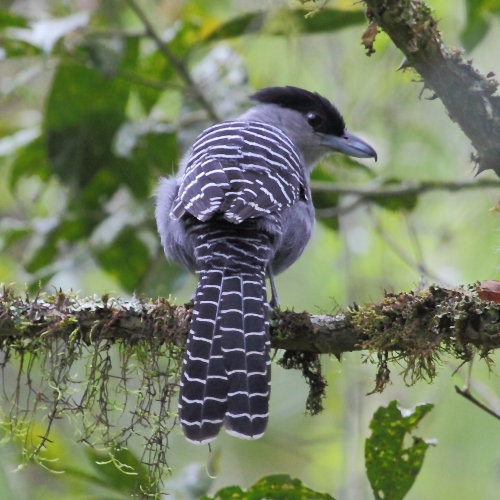
Black Antbird
Cercomacra serva
Order: Passeriformes / Family: Thamnophilidae

Wikimedia Commons
About the Black Antbird
The Black Antbird (Cercomacra serva) is a small passerine bird native to the humid tropical forests of South America. It belongs to the Thamnophilidae family, which is known for an array of ant-following birds. This bird is primarily found in the Amazon Basin, thriving in countries like Brazil, Peru, and Colombia. The Black Antbird plays a critical role in the ecosystem by controlling insect populations, particularly ants. Notably, it participates in a fascinating mutualistic relationship with army ants. As these ants march through the forest floor, they flush out insects from their hiding spots, which the Black Antbird then preys upon. This relationship exemplifies the bird's significance in maintaining the delicate balance within its habitat. Black Antbirds are highly adapted to life in dense forest undergrowth, where they exhibit remarkable agility. They are sedentary birds, spending much of their time within a specific territory. During the breeding season, which generally aligns with the rainy season, Black Antbirds become particularly vocal, using their calls to establish and defend territory. Seasonal rains can influence their behaviors, as they rely on the abundance of insects that flourish in the wet season. Though predominantly a forest bird, sightings in secondary growth and forest edges are not uncommon. The Black Antbird's ecological role extends beyond predation; they contribute to the forest's acoustic landscape with their vocalizations. Their calls and songs play essential roles in communication, mate attraction, and territorial disputes, further embedding them into the fabric of the forest ecosystem.
The Black Antbird belongs to the family Thamnophilidae, within the order Passeriformes. These birds typically live average 4-6 years, with a maximum recorded of 8 years..
How to Identify a Black Antbird
The adult Black Antbird is characterized by its glossy black plumage, which provides effective camouflage in the shadowy forest undergrowth. Males and females are similar in appearance, though males tend to have slightly more lustrous feathers. Juveniles often display a more muted version of the adult plumage, with some brownish tones. The bird's slender body, coupled with its agile movements, distinguishes it from many other forest birds. Its eyes are dark, providing a striking contrast against its black feathers. The Black Antbird's flight is typically low and direct, suitable for navigating dense vegetation. When perched, it often holds its body horizontally, a posture that aids in quick take-offs. Its short tail is usually held slightly cocked. While confusion with other similar-sized black birds is possible, the Black Antbird's habitat preference and behavior can aid identification. It is less likely to be mistaken for open-area blackbirds due to its preference for dense forest environments.
Having trouble telling birds apart? Upload a photo to our bird identification tool for an instant species match.
Black Antbird Habitat and Range
Preferred Habitat
The Black Antbird thrives in the humid lowland forests of the Amazon Basin, preferring areas with dense undergrowth and ample canopy cover. It can be found at elevations ranging from sea level up to about 800 meters. The bird's affinity for dense forest habitats makes it less common in urban or heavily disturbed areas. However, it may sometimes venture into secondary growth forests or forest edges. Seasonal changes do not significantly alter its preferred habitats, as it remains within forested areas year-round.
Geographic Range
The Black Antbird's range is confined to the tropical regions of South America, predominantly within the Amazon Basin. Its presence spans countries such as Brazil, Colombia, Peru, and Bolivia. The species is non-migratory, establishing territories and remaining within them throughout the year. Within its range, population densities can vary, with higher concentrations typically found in undisturbed forest areas. Localized populations may experience fluctuations due to changes in habitat availability or environmental conditions.
Want to know which birds visit your area? Browse our backyard birds by location guides for region-specific species lists.
What Does the Black Antbird Eat?
The diet of the Black Antbird mainly consists of insects, with ants being a primary food source. It also feeds on other small arthropods, such as spiders and beetles. The bird employs a foraging technique that involves following army ant swarms, capitalizing on the insects flushed out by the ants. This strategy allows the Black Antbird to exploit a consistent food source without expending excessive energy. While its diet remains relatively consistent year-round, the bird may adapt to seasonal variations in insect abundance. Feeding typically occurs during daylight hours, with peaks in activity during the cooler parts of the day.
Black Antbird Behavior and Social Structure
Black Antbirds exhibit territorial behavior, with pairs often defending a specific area within the forest. The birds communicate using a variety of vocalizations, which play a crucial role in territory establishment and mate attraction. During courtship, males may perform simple displays, involving wing flicking and tail fanning to attract females. These birds generally forage alone or in pairs, although they may form loose associations with other ant-following species when food is abundant. In response to predators, the Black Antbird relies on its cryptic plumage and ability to remain motionless within dense cover. Daily activities include foraging, preening, and vocal interactions, with periods of heightened activity during the early morning and late afternoon.
Black Antbird Nesting and Reproduction
The Black Antbird constructs a cup-shaped nest using plant fibers, leaves, and twigs. Nests are typically located low to the ground, often in dense vegetation, providing concealment from predators. The clutch size usually consists of two eggs, which are incubated by both parents. The incubation period lasts approximately 14-16 days, with both parents sharing feeding duties once the eggs hatch. Fledging occurs about 12-15 days after hatching. The Black Antbird typically raises one brood per year, though it may attempt a second brood if conditions are favorable.
Black Antbird Sounds and Vocalizations
The primary song of the Black Antbird is a series of sharp, repetitive whistles that rise and fall in pitch. These vocalizations serve to establish territory and attract mates. Their call notes are short, chipping sounds that convey alarm or communicate with mates. During the dawn chorus, the Black Antbird's song can be heard over considerable distances, blending into the symphony of forest sounds. Compared to other forest birds, their calls are distinct yet harmonize with the ambient noise.
Interesting Facts About the Black Antbird
- 1The Black Antbird is one of the many bird species that follow army ants, a behavior known as ant-following.
- 2Unlike many birds, the Black Antbird does not migrate, remaining in its established territory throughout the year.
- 3Despite their name, Black Antbirds do not actually eat the ants they follow, but rather prey on other insects disturbed by the ants.
- 4Black Antbirds are known for their secretive nature, often remaining hidden in dense foliage despite being vocal.
- 5The species' dependence on army ants means that they are often found in mixed-species foraging flocks.
Black Antbird Conservation Status
Currently, the Black Antbird is listed as Least Concern by the IUCN, with stable population trends. However, habitat destruction through deforestation poses a growing threat. Conservation efforts focus on preserving large tracts of continuous forest habitat, essential for the species' survival. Historically, the Black Antbird has maintained stable populations due to its adaptability to various forest types, but continued vigilance is necessary to ensure its protection.