
Black Curassow
Crax alector
Order: Galliformes / Family: Cracidae
Wikimedia Commons
About the Black Curassow
The Black Curassow, scientifically named Crax alector, is a remarkable bird native to the dense tropical forests of South America. These birds play a crucial role in their ecosystems by aiding seed dispersal, which supports forest regeneration. They are predominantly found in the Amazon Basin, thriving in regions such as Venezuela, Colombia, and Brazil. The Black Curassow favors pristine rainforests, though it can occasionally be found in secondary growth forests. This bird is non-migratory, meaning it remains in its preferred habitat year-round, becoming a permanent feature of the forest landscape. With its significant size, the Black Curassow is one of the largest members of the Cracidae family. It reaches up to 95 centimeters in length and can weigh up to 3.5 kilograms. Its size and striking appearance make it an unmistakable presence in its environment. The Black Curassow is vital for maintaining the ecological balance of its habitat, as its foraging habits help to distribute seeds across vast areas. During the breeding season, which typically aligns with the rainy season, the Black Curassow becomes more vocal and visible as it establishes territories. The increased humidity and availability of food during this period support its reproductive activities. These birds are known for their monogamous pair bonds, often seen foraging for fruits, seeds, and small animals together. Its presence is a strong indicator of a healthy and intact forest, highlighting its importance not only as a species but also as a barometer of environmental health.
The Black Curassow belongs to the family Cracidae, within the order Galliformes. These birds typically live typically 15-20 years in the wild, with some individuals living longer in captivity..
How to Identify a Black Curassow
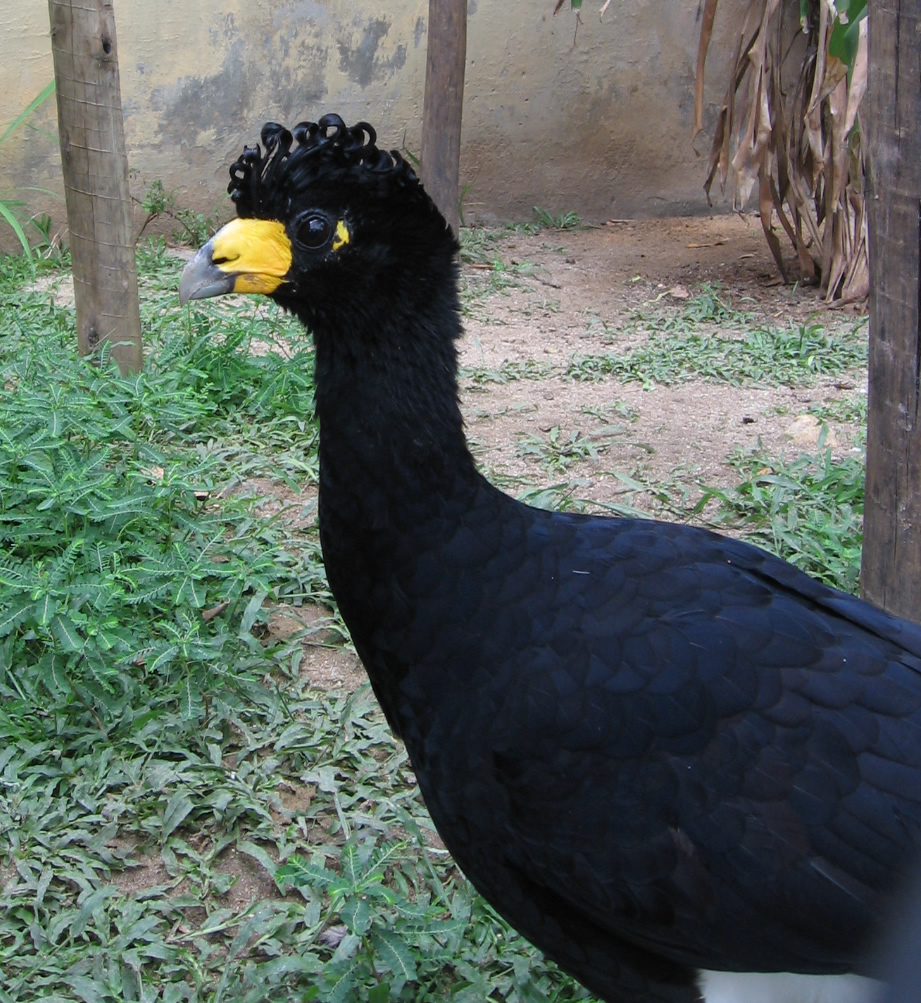
The Black Curassow is easily identified by its large size and glossy black plumage, which is complemented by a striking white-tipped tail. Adult males and females exhibit similar plumage, though females may sometimes display a browner hue on their underparts. Unlike many bird species, sexual dimorphism is not pronounced in the Black Curassow. Juveniles, however, differ considerably with more mottled brown and white feathers, which offer them camouflage in the dappled light of the forest understory. In flight, the Black Curassow displays broad, rounded wings and a long tail, creating a distinctive silhouette. Its strong legs and upright posture are notable when perched or walking along the forest floor. Observers might confuse the Black Curassow with similar species such as the Great Curassow, but the latter generally has a more prominent casque and differs in plumage patterns. The Black Curassow's call, a series of deep, resonant booming sounds, can also help in identifying it amidst the cacophony of the forest.
Having trouble telling birds apart? Upload a photo to our bird identification tool for an instant species match.
Black Curassow Habitat and Range
Preferred Habitat
Black Curassows inhabit the dense, humid tropical forests of the Amazon Basin, where they prefer areas with abundant fruiting trees and a dense understory. They are typically found at elevations from sea level up to 1000 meters, although they are more commonly encountered in lowland forests. These birds exhibit a strong preference for pristine primary forests, where they benefit from the complex canopy structure and diverse plant life. In regions like Venezuela's Guayana Shield, they can also be found in semi-deciduous forests. Seasonal habitat shifts are minimal due to their non-migratory nature, and while they occasionally venture into secondary forests, they are less common in urban areas.
Geographic Range
The Black Curassow's range spans across the northern parts of South America, prominently within the Amazon Basin. They are most commonly found in Venezuela, Colombia, Brazil, and the Guianas. In these areas, the Black Curassow occupies vast tracts of rainforest, from the lowland Amazonian rainforests to the unique ecosystems of the Guiana Shield. While their range covers a wide area, population densities vary, with higher concentrations in regions where forests remain intact and undisturbed by human activity. Unlike some bird species, the Black Curassow does not migrate and maintains a consistent presence in its range throughout the year.
Want to know which birds visit your area? Browse our backyard birds by location guides for region-specific species lists.
What Does the Black Curassow Eat?
The Black Curassow's diet primarily consists of fruits, seeds, and small invertebrates, which they forage from the forest floor. During the wet season, when fruiting trees are abundant, fruits dominate their diet. The birds play a crucial role in seed dispersal, consuming a variety of seeds and excreting them elsewhere, thus promoting forest regeneration. During drier periods, they may shift to a diet that includes more seeds and small animals, such as insects and small reptiles. Foraging typically occurs in the early morning and late afternoon when temperatures are cooler, reducing the risk of overheating during the hottest parts of the day.
Black Curassow Behavior and Social Structure
Black Curassows are social birds, often seen in small family groups or pairs. They establish territories that they defend vigorously against intruders, using vocalizations and displays to assert dominance. Courtship involves elaborate displays, with males showcasing their plumage and performing ritualized movements to attract females. Once paired, Black Curassows maintain strong monogamous bonds. They exhibit a diurnal activity pattern, foraging mostly during the cooler hours of the day. When threatened by predators, these birds rely on their strong legs to run swiftly through the underbrush rather than flying. Their response to threats is typically cautious, preferring to retreat into dense foliage.
Black Curassow Nesting and Reproduction
Black Curassows build their nests in the canopy of dense forests, using a variety of materials such as twigs, leaves, and vines. They prefer sites that offer concealment and protection from predators, often choosing forked branches high above the ground. The female typically lays a clutch of 2 to 4 eggs, which she incubates for about 30 days. During this period, the male provides food and protection. After hatching, the chicks remain in the nest for several weeks before fledging. Both parents participate in feeding and caring for the young. Black Curassows generally have one brood per year, timed with the onset of the rainy season when food resources are plentiful.
Black Curassow Sounds and Vocalizations
The Black Curassow produces a series of deep, resonant booming calls, which serve as both territorial and mating signals. These calls, often described as similar to distant thunder, resonate through the forest, especially during the early morning hours. The call sequences are rhythmic and can carry over long distances, helping individuals maintain contact within dense habitats. Apart from these primary calls, they also emit short, sharp alarm notes when threatened. During the dawn chorus, their booming sounds blend with the calls of other forest inhabitants, creating a rich tapestry of sound.
Interesting Facts About the Black Curassow
- 1The Black Curassow can weigh up to 3.5 kilograms, making it one of the largest birds in the Cracidae family.
- 2Unlike many birds, the Black Curassow forms monogamous pair bonds that can last for many years.
- 3Their booming calls can be heard over a kilometer away, helping them communicate across dense forests.
- 4Black Curassows are key seed dispersers, aiding in the regeneration of tropical forests.
- 5These birds have strong legs and prefer running to flying when escaping predators.
- 6Black Curassows build their nests high in the canopy to protect their young from ground predators.
- 7They exhibit minimal sexual dimorphism, with both males and females looking strikingly similar.
Black Curassow Conservation Status
The Black Curassow is currently classified as Least Concern by the IUCN. However, its populations are declining due to habitat loss and hunting pressure. Deforestation, driven by logging and agriculture, poses the most significant threat, as it leads to habitat fragmentation. Conservation efforts focus on habitat protection and anti-poaching measures. Organizations work with local communities to promote sustainable land use and raise awareness about the importance of preserving these birds and their habitats. Historically, Black Curassow numbers have fluctuated with changes in land use, highlighting the need for continued conservation vigilance.
Other Cracidae Species


Birds Similar to the Black Curassow
These species are often confused with the Black Curassow due to similar appearance or overlapping range.

