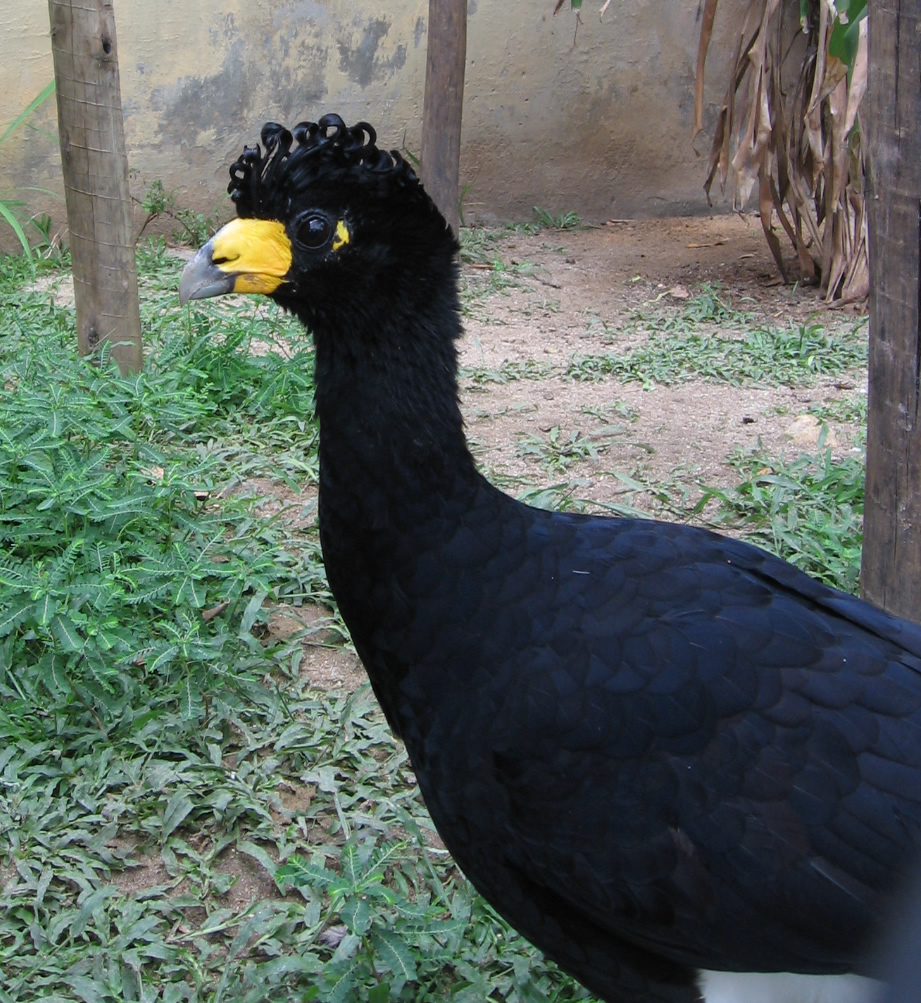
Red-billed Curassow
Crax blumenbachii
Order: Galliformes / Family: Cracidae

Wikimedia Commons
About the Red-billed Curassow
The Red-billed Curassow (Crax blumenbachii) is a large, ground-dwelling bird native to the Atlantic Forest of eastern Brazil. This critically endangered species plays a vital role in seed dispersal, contributing significantly to the forest ecosystem. Males and females exhibit sexual dimorphism; males boast striking black plumage with a vibrant red bill, while females have a more subdued appearance with brownish feathers. Found primarily in the states of Espírito Santo, Bahia, and Minas Gerais, the species prefers lowland forests, though it can occasionally be seen in secondary growth areas. Despite its preference for dense forest habitats, the Red-billed Curassow shows some adaptability to altered environments, albeit with limited success due to habitat fragmentation. During the breeding season, these birds become more vocal and territorial, often heard producing deep, booming calls that resonate through the forest. The Red-billed Curassow is non-migratory, with its activities largely influenced by the availability of food and breeding opportunities within its home range. Its ecological role is critical, as these birds help to maintain forest health through the dispersal of seeds from the fruits they consume. However, their populations have been severely impacted by habitat loss and hunting, with efforts underway to reintroduce captive-bred individuals into protected areas. Conservationists are working to preserve the remaining fragments of the Atlantic Forest, which are crucial for the survival of this species.
The Red-billed Curassow belongs to the family Cracidae, within the order Galliformes. These birds typically live typically 15-20 years in the wild, with individuals in captivity living longer..
How to Identify a Red-billed Curassow
The Red-billed Curassow is easily identified by its large size, reaching up to 90 cm in length. Males have glossy black plumage, contrasted by a vivid red bill and a distinct white-tipped tail. Females, on the other hand, are less conspicuous, displaying brownish feathers with a mottled pattern, allowing them to blend into their surroundings more effectively. Juveniles resemble females but are generally lighter in color with more pronounced markings. When in flight, the Red-billed Curassow exhibits a broad, rounded wing shape, and its flight pattern is characterized by strong, direct flapping followed by glides. On the ground, the bird's posture is upright, with a distinctive gait that facilitates movement through dense underbrush. While the Red-billed Curassow is unique in its habitat, it might be confused with other cracids, such as the Black Curassow. However, the red bill of Crax blumenbachii is a distinguishing feature that sets it apart from its relatives.
Having trouble telling birds apart? Upload a photo to our bird identification tool for an instant species match.
Red-billed Curassow Habitat and Range
Preferred Habitat
The Red-billed Curassow primarily inhabits the Atlantic Forest of eastern Brazil, favoring lowland tropical forests with dense understory. These forests provide the necessary cover and food resources critical for their survival. Although typically found at elevations ranging from sea level to 500 meters, they may venture into secondary growths and forest edges. Habitat fragmentation has forced some populations into smaller, isolated patches, which poses significant challenges for their long-term viability. Unlike more adaptable species, the Red-billed Curassow does not thrive in urban environments and is rarely spotted outside forested regions. Seasonal shifts in habitat use are minimal, as these birds are largely sedentary, but they may adjust their movements within their home range in response to resource availability.
Geographic Range
The Red-billed Curassow's distribution is restricted to eastern Brazil, specifically within the Atlantic Forest biome. Its range historically covered the states of Espírito Santo, Bahia, Minas Gerais, and Rio de Janeiro. However, due to deforestation and other anthropogenic pressures, its current range is severely fragmented. While there are no significant migration patterns, the bird's range is limited to areas where suitable habitat remains. Population density is highest in protected areas and private reserves where conservation efforts are concentrated. Reintroduction programs in some regions aim to expand their presence, but the overall population remains critically low.
Want to know which birds visit your area? Browse our backyard birds by location guides for region-specific species lists.
What Does the Red-billed Curassow Eat?
The diet of the Red-billed Curassow consists primarily of fruits, seeds, and insects, reflecting its role as a frugivore and granivore. During the wet season, when fruit is abundant, their diet is dominated by various forest fruits, which they help disperse through their droppings. In the dry season, they rely more on seeds and invertebrates, foraging along the forest floor. Their feeding technique involves walking slowly through the underbrush, using their powerful beak to crack open seeds and access hidden insects. Prey size varies, with insects such as beetles and ants supplementing their diet. Feeding typically occurs during the cooler hours of the day, with birds often seen foraging in pairs or small family groups.
Red-billed Curassow Behavior and Social Structure
Red-billed Curassows are generally monogamous, forming long-term pair bonds. They exhibit territorial behavior, especially during the breeding season, when males become more vocal and aggressive in defending their territory. Courtship involves elaborate displays, where the male fans his tail and produces deep, booming calls to attract a mate. Outside the breeding season, these birds are relatively social, often seen in small family groups. They are diurnal, spending their days foraging and resting within their territory. When faced with predators, they rely on their cryptic plumage and quick escape through dense vegetation. Although they are capable of flight, they prefer to escape danger by running.
Red-billed Curassow Nesting and Reproduction
Red-billed Curassows typically nest in trees, using branches and leaves to construct a sturdy platform. They prefer sites with dense canopy cover to protect against predators. The female lays a clutch of 2-3 eggs, which she incubates for approximately 28 days. During this period, the male plays a supportive role, guarding the nest site and bringing food to the female. Once hatched, the chicks are precocial, leaving the nest shortly after and following their parents. Fledging occurs within 6-8 weeks, during which both parents continue to provide food and protection. Typically, the species raises one brood per year, though favorable conditions may allow for a second.
Red-billed Curassow Sounds and Vocalizations
The primary vocalization of the Red-billed Curassow is a deep, resonant booming call. This call is produced by males, particularly during the breeding season, and can be heard over considerable distances. Additionally, they emit softer, clucking sounds as contact calls between mates or within family groups. Alarm calls are sharp and abrupt, used to warn of potential threats. While not part of a traditional dawn chorus, their calls are more frequent during the early morning and late afternoon, coinciding with peak activity periods.
Interesting Facts About the Red-billed Curassow
- 1The Red-billed Curassow can live up to 20 years in the wild under optimal conditions.
- 2Its booming call can be heard up to 1.5 kilometers away in dense forest habitats.
- 3The species is a key seed disperser, aiding in the regeneration of the Atlantic Forest.
- 4Females and juveniles use their cryptic plumage to blend into the forest, avoiding predators.
- 5The Red-billed Curassow's diet changes seasonally, relying heavily on available fruits and seeds.
- 6Males engage in spectacular displays during courtship, including fanning their tail feathers.
- 7Conservation efforts have established several successful reintroduction sites throughout Brazil.
Red-billed Curassow Conservation Status
The Red-billed Curassow is listed as Critically Endangered by the IUCN, with a population trend that continues to decline. The primary threats to its survival include habitat destruction, hunting, and fragmentation of its forest habitat. Efforts to conserve the species focus on habitat protection, creating biological corridors, and reintroduction programs from captive-bred populations. Historical data indicates a drastic reduction in population size over the last century, underscoring the urgent need for continued conservation action.
Other Cracidae Species


Birds Similar to the Red-billed Curassow
These species are often confused with the Red-billed Curassow due to similar appearance or overlapping range.