Black-faced Antbird
Myrmoborus myotherinus
Order: Passeriformes / Family: Thamnophilidae
Wikimedia Commons
About the Black-faced Antbird
The Black-faced Antbird (Myrmoborus myotherinus) is a small, elusive bird native to the lowland tropical forests of South America. It belongs to the family Thamnophilidae, which is widely known for its diversity and specialization in ant-following behaviors. This bird plays a significant ecological role as it participates in mixed-species foraging flocks, often following swarms of army ants to catch insects that flee from the advancing ants. This behavior not only aids in controlling insect populations but also demonstrates a fascinating example of mutualistic interaction in these ecosystems.
The Black-faced Antbird inhabits countries such as Brazil, Peru, Colombia, and Venezuela, often found at elevations ranging from sea level to about 1200 meters. It prefers dense, humid undergrowth in primary and secondary forests, where it can maneuver through the tangled vegetation to forage effectively. Its presence is indicative of healthy, intact forest ecosystems, making it an important species for conservationists monitoring forest integrity and biodiversity.
During the breeding season, which typically occurs in the rainy months, the Black-faced Antbird becomes more vocal and territorial. Males sing to establish territories and attract females, while both sexes participate in nest-building and rearing the young. The bird's adaptability to different forest types, including degraded habitats, demonstrates its resilience, yet its reliance on forested areas makes it vulnerable to deforestation and habitat fragmentation. Understanding its ecological role provides insights into the health of tropical forest ecosystems and underscores the need for conservation efforts in these biodiverse regions.
The Black-faced Antbird belongs to the family Thamnophilidae, within the order Passeriformes. These birds typically live average 3-5 years, with a maximum recorded of 7 years..
How to Identify a Black-faced Antbird
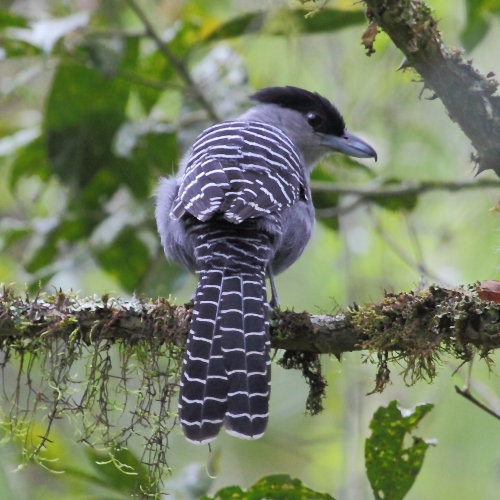
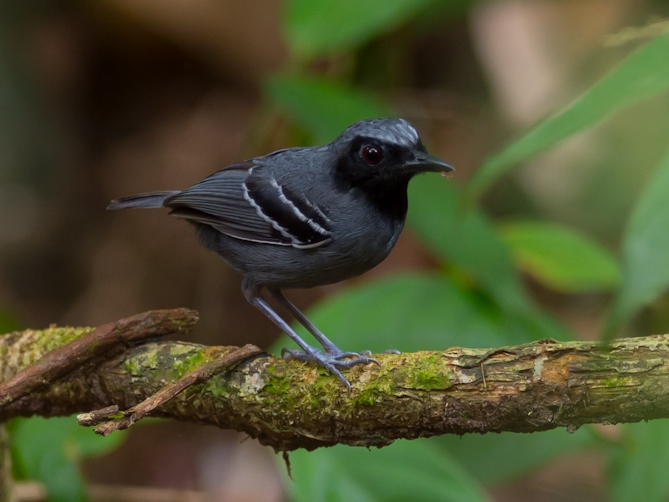
Identifying the Black-faced Antbird involves observing several key features. Adult males boast a striking black face and throat, contrasting sharply with their slate-gray to bluish upperparts and white underparts. The black facial mask is a defining characteristic, with the rest of the head, nape, and back shaded in dark gray. Females, however, have a more subdued appearance, with brownish upperparts and a paler gray face, lacking the bold black mask seen in males. Juveniles resemble females but are generally duller, with less distinct color contrasts.
The bird is medium-sized for an antbird, measuring around 13 to 15 centimeters in length and weighing approximately 20 grams. When perched, the Black-faced Antbird typically holds its tail slightly cocked, which, along with its habit of flicking its wings, can aid in identification. Its wings are short and rounded, suitable for navigating dense undergrowth rather than long-distance flight.
In the field, the Black-faced Antbird may be confused with similar antbird species. However, the unique facial pattern of the male is a reliable differentiator. Observing its behavior, such as following ant swarms and staying close to the ground, further aids in distinguishing it from other birds that inhabit the same regions.
Having trouble telling birds apart? Upload a photo to our bird identification tool for an instant species match.
Black-faced Antbird Habitat and Range
Preferred Habitat
The Black-faced Antbird thrives in the lush, dense undergrowth of lowland tropical forests, preferring areas with ample leaf litter and tangled vegetation. It is often found in primary forests, but it can also adapt to secondary growth and edge habitats, provided there is sufficient cover. This adaptability makes it possible for the species to persist in somewhat disturbed areas, though it is still dependent on forested environments.
Typically found at elevations below 1200 meters, the Black-faced Antbird does not exhibit seasonal habitat shifts, remaining in its preferred habitat year-round. Unlike some other bird species, it avoids urban areas, instead favoring continuous stretches of forest that allow it to forage and breed effectively. Its presence in a habitat is a good indicator of forest health, as it relies on the complex forest structure for feeding and nesting.
Geographic Range
The range of the Black-faced Antbird encompasses a broad swath of northern South America. It is primarily found in the Amazon basin, with its distribution extending across Brazil, eastern Peru, southern Colombia, northern Bolivia, and the Guianas. This range includes some of the most biodiverse regions on the planet, where it inhabits lowland tropical forests.
Unlike migratory birds, the Black-faced Antbird is a resident species, spending its entire life cycle within these forests. While it does not undertake long-distance migrations, it may move locally to exploit variations in food availability or to find suitable breeding territories. Population density is generally highest in intact, undisturbed forests where food resources are abundant and nesting sites secure.
Want to know which birds visit your area? Browse our backyard birds by location guides for region-specific species lists.
What Does the Black-faced Antbird Eat?
The diet of the Black-faced Antbird consists mainly of insects and other arthropods, which it skilfully extracts from the forest floor and leaf litter. Its primary foraging strategy involves following swarms of army ants, a behavior known as ant-following. As the ants move through the forest, they flush out insects and other small creatures, which the antbird then captures.
This bird's diet includes beetles, spiders, and small invertebrates, with prey size generally small to medium. Although primarily insectivorous, the Black-faced Antbird may occasionally consume small fruits or seeds if readily available, particularly when insect prey is less abundant. Foraging is mostly conducted during daylight hours, with peak activity in the early morning and late afternoon, when ant swarms are most active.
Black-faced Antbird Behavior and Social Structure
The Black-faced Antbird exhibits fascinating social and territorial behaviors. It often forms part of mixed-species flocks, especially around active ant swarms, where individuals maintain a pecking order to access the best feeding spots. Within these flocks, the Black-faced Antbird is a subordinate species, often deferring to larger or more aggressive birds.
Territoriality is pronounced during the breeding season, with males singing to defend their territory and deter rivals. The song is a series of sharp, metallic notes that carry well through dense undergrowth. Courtship involves displays of plumage and song, with males often presenting food items to potential mates.
In response to predators, the Black-faced Antbird relies on its cryptic coloration and the dense vegetation for cover. It remains motionless or quietly retreats into the undergrowth to avoid detection, demonstrating a cautious and alert nature.
Black-faced Antbird Nesting and Reproduction
The Black-faced Antbird constructs its nest close to the ground, hidden in dense shrubbery or among fallen leaves and branches. The nest itself is an open cup structure, composed of leaves, grass, and plant fibers, intricately woven to provide protection for the eggs.
A typical clutch consists of two to three eggs, which both parents incubate over a period of approximately 14 to 16 days. The involvement of both parents continues after hatching, as they share responsibilities for feeding and protecting the chicks. The fledging period lasts about 10 to 12 days, after which the young birds remain dependent on their parents for some time until they are capable of independent foraging.
The Black-faced Antbird generally produces one to two broods per year, with breeding coinciding with the rainy season when food resources are most abundant.
Black-faced Antbird Sounds and Vocalizations
The primary song of the Black-faced Antbird is a series of sharp, metallic notes delivered in rapid succession. This song serves as both a territorial call and an advertisement to potential mates. The pitch is relatively high, and the quality is piercing, making it easily distinguishable from other sounds in the dense forest.
In addition to its song, the Black-faced Antbird produces various call notes, including harsh alarm calls when disturbed or threatened. These calls are less melodic than the song but serve important communicative functions within pairs and flocks. During the dawn chorus, the Black-faced Antbird's song is particularly prominent, contributing to the acoustic tapestry of the tropical forest.
Interesting Facts About the Black-faced Antbird
- 1Despite being called an antbird, the Black-faced Antbird does not eat ants but follows ant swarms to catch prey.
- 2The Black-faced Antbird's distinctive black facial mask sets it apart from many other antbird species in the dense Amazon forests.
- 3During breeding season, the Black-faced Antbird becomes more vocal, often heard at dawn and dusk in the rainforest.
- 4Unlike some other bird species, the Black-faced Antbird can adapt to secondary forests, provided there is enough cover.
- 5The bird's piercing song and calls can travel long distances through dense underbrush, aiding in territory establishment and partner attraction.
- 6The Black-faced Antbird's reliance on ant swarms showcases a unique ecological niche and dependency on army ants for food.
- 7Both male and female Black-faced Antbirds participate in nest-building, incubation, and feeding of the young, illustrating cooperative breeding behavior.
Black-faced Antbird Conservation Status
As of the latest assessments, the Black-faced Antbird holds a status of Least Concern according to the IUCN Red List, indicating a stable population across its range. However, ongoing threats such as deforestation and habitat fragmentation pose significant risks to its long-term survival. The expansion of agriculture, logging, and infrastructure development in the Amazon basin contributes to habitat loss, emphasizing the need for effective conservation strategies. Conservation efforts focus on protecting large tracts of contiguous forest and establishing reserves where biodiversity can thrive. Despite facing habitat pressures, the Black-faced Antbird's adaptability to secondary forests offers some resilience, though continuous monitoring and habitat preservation remain vital to ensure its continued survival.