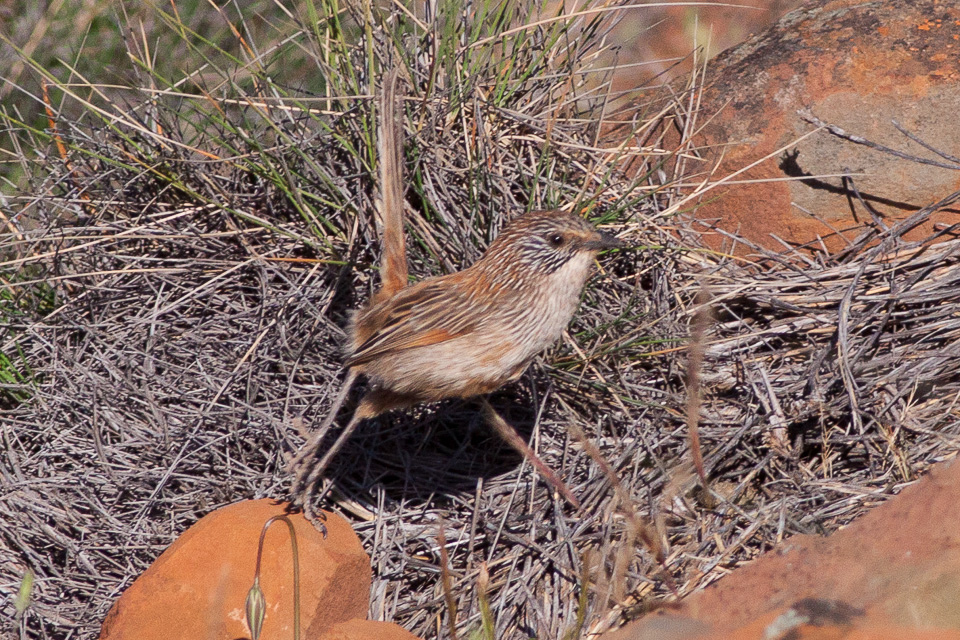
Black Grasswren
Amytornis housei
Order: Passeriformes / Family: Maluridae

Wikimedia Commons
About the Black Grasswren
The Black Grasswren (Amytornis housei) is a rare and elusive songbird endemic to the Kimberley region of northwestern Australia. This bird belongs to the family Maluridae and is primarily found in rocky, spinifex-covered landscapes. The Black Grasswren's presence in such rugged and largely inaccessible areas contributes to its enigmatic reputation among birders and ornithologists alike. Its significance extends beyond mere aesthetics; it plays an important ecological role in its habitat, contributing to the biodiversity of the region. The Black Grasswren is a ground-dwelling bird, and its adaptations to the harsh Australian environment make it a subject of interest for ecological studies. This bird is primarily sedentary, remaining in its preferred habitats year-round, which makes it particularly vulnerable to environmental changes. The Black Grasswren's ecological role includes seed dispersal and insect population control, which helps maintain the delicate balance of its ecosystem. The bird's presence in rocky outcrops and densely vegetated areas underscores the importance of preserving these habitats. Seasonal variations in the Kimberley region affect the Black Grasswren's behavior, with breeding activities primarily observed during the wet season from December to March. During this period, the abundance of food resources supports their reproductive efforts. The bird's elusive nature and preference for remote habitats make it a symbol of the unique biodiversity found in Australia's less explored regions. Conservation efforts for the Black Grasswren focus on habitat protection and minimizing human impact on its environment. The bird's status as a species of least concern does not diminish the importance of continued monitoring and research, as its restricted range makes it susceptible to habitat degradation. Overall, the Black Grasswren embodies the resilience and intricacy of life in Australia's outback, captivating those who seek to understand and protect the natural world.
The Black Grasswren belongs to the family Maluridae, within the order Passeriformes. These birds typically live average 5 years with max recorded 8 years.
How to Identify a Black Grasswren
The Black Grasswren is a medium-sized songbird characterized by its predominantly black plumage, which provides excellent camouflage against the dark shadows of its rocky habitat. Adults feature a subtle brownish wash on the wings and back, which helps distinguish them from juveniles, whose plumage is generally duller and more uniformly dark. Both males and females exhibit similar plumage, making them difficult to differentiate in the field. However, males may appear slightly larger and more robust. The bird's bill is short and stout, adapted for its insectivorous diet, while its legs are strong and well-suited for terrestrial locomotion. In flight, the Black Grasswren presents a compact silhouette with rounded wings and a relatively short tail, which it flicks characteristically. Perching posture is typically low to the ground, often within dense vegetation, making it less conspicuous to predators and observers. The bird's preference for rocky landscapes with spinifex grass further complicates identification, as it rarely ventures into open areas. When observing the Black Grasswren, birders should be attentive to its unique habitat and behavior, as these can aid in distinguishing it from similar species like the Dusky Grasswren and other small ground-dwelling birds. Understanding these nuances is essential for accurate identification and appreciation of this elusive avian species.
Having trouble telling birds apart? Upload a photo to our bird identification tool for an instant species match.
Black Grasswren Habitat and Range
Preferred Habitat
The Black Grasswren inhabits the rugged, rocky landscapes of the Kimberley region in northwestern Australia. This area is characterized by steep gorges, sandstone outcrops, and dense spinifex grass, providing the ideal habitat for this elusive bird. The Black Grasswren thrives in these isolated environments, where its dark plumage offers effective camouflage. It favors elevations ranging from lowland rocky areas to higher altitudes where spinifex grasses thrive. The bird's reliance on such specific habitats makes it particularly vulnerable to environmental changes, as it does not readily adapt to altered landscapes. While the Black Grasswren does not typically inhabit urban areas, its presence in remote, undisturbed regions underscores the importance of habitat conservation efforts. Seasonal habitat shifts are minimal due to the bird's sedentary nature, although breeding activities may prompt localized movements within its preferred environment during the wet season. Conservation of these habitats is critical for the survival and stability of Black Grasswren populations.
Geographic Range
The Black Grasswren's range is limited to the Kimberley region of northwestern Australia. This restricted distribution makes it a particularly interesting subject of study for ornithologists focusing on endemic species. The bird's breeding range is primarily concentrated in areas with abundant rocky outcrops and dense spinifex grass, which provide both shelter and food resources essential for successful reproduction. Unlike many other bird species, the Black Grasswren does not engage in long-distance migration, instead remaining within its home range year-round. This sedentary behavior reflects its adaptation to the challenging conditions of the Australian outback. Within its range, population densities are not evenly distributed, with higher concentrations found in areas where suitable habitat conditions prevail. Human activities and environmental changes can have a profound impact due to the bird's limited range, making the protection of its habitat a priority for conservationists. Understanding the distribution and population dynamics of the Black Grasswren is key to ensuring its continued survival in the wild.
Want to know which birds visit your area? Browse our backyard birds by location guides for region-specific species lists.
What Does the Black Grasswren Eat?
The Black Grasswren has a primarily insectivorous diet, which plays a crucial role in its ecosystem by controlling insect populations. Its foraging behavior involves meticulously searching through leaf litter and undergrowth for a wide variety of insects, including ants, beetles, and caterpillars. The bird's strong, short bill is well-adapted for capturing and consuming prey. During the wet season, when food resources are more abundant, the Black Grasswren may expand its diet to include seeds and small fruits, providing additional nourishment for breeding activities. The bird forages throughout the day, with peak activity occurring during the cooler morning and late afternoon hours. Its foraging technique involves short, deliberate hops and sudden stops to investigate potential food sources. Prey size typically varies from small insects to medium-sized arthropods, which the bird efficiently dispatches with its robust bill. The Black Grasswren's diet reflects its adaptation to the harsh environment of the Kimberley region, where resource availability can be unpredictable.
Black Grasswren Behavior and Social Structure
The Black Grasswren exhibits a solitary and secretive behavior, which makes it a challenging species to observe in the wild. Outside of the breeding season, these birds are typically seen alone or in pairs, maintaining large territories to ensure sufficient food resources. Territorial behavior is pronounced, with males often engaging in vocal displays to assert dominance and deter intruders. During the breeding season, courtship displays become more elaborate, involving a series of vocalizations and physical postures to attract mates. The bird's response to predators includes remaining motionless and using its cryptic plumage to blend into its surroundings, a strategy that enhances its survival in the wild. Daily activity patterns show a preference for early morning and late afternoon foraging, taking advantage of cooler temperatures. The Black Grasswren's elusive nature and tendency to remain hidden within dense vegetation contribute to its mysterious reputation among bird enthusiasts and researchers.
Black Grasswren Nesting and Reproduction
The Black Grasswren constructs its nest within dense spinifex grass, utilizing the natural cover provided by this vegetation. Nests are cup-shaped and built from a combination of grass, twigs, and other plant materials, carefully woven together to provide a secure structure for the eggs. The bird prefers nesting sites that offer protection from predators and harsh weather conditions, often selecting locations close to the ground but well-concealed. Clutch size typically ranges from two to four eggs, with both parents sharing incubation duties. The incubation period lasts approximately 12 to 14 days, followed by a fledging period of about 10 days. Parental roles are shared, with both male and female involved in feeding and protecting the young. The Black Grasswren generally raises one brood per year, although favorable conditions may allow for a second brood. Nesting success is closely tied to the availability of food and the stability of the habitat, highlighting the importance of environmental conservation.
Black Grasswren Sounds and Vocalizations
The primary song of the Black Grasswren consists of a series of rapid, high-pitched notes that create a melodious and intricate tune. These vocalizations play a crucial role in territorial defense and mate attraction. The song's rhythm is fast-paced, with a clear and musical quality that resonates through its rocky habitat. Call notes are softer and more subdued, used for communication between mates or signaling alarm. In the presence of predators, the bird emits sharp, quick alarm calls to alert others of potential danger. During the dawn chorus, the Black Grasswren's song is most prominent, contributing to the vibrant soundscape of its environment. Its vocalizations share similarities with those of other grasswrens but can be distinguished by their unique pattern and tone.
Interesting Facts About the Black Grasswren
- 1The Black Grasswren was first described by ornithologists in the early 20th century, highlighting its relatively recent discovery.
- 2Despite being a songbird, the Black Grasswren is rarely seen in flight, preferring to move stealthily through its rocky habitat.
- 3The bird's cryptic plumage allows it to blend seamlessly into the shadowy crevices of its preferred environment.
- 4Juvenile Black Grasswrens often remain with their parents for several months, learning essential survival skills.
- 5The species' name, 'housei,' honors a prominent Australian ornithologist who contributed significantly to avian studies.
- 6Black Grasswrens have a unique hopping gait that aids in navigating the uneven terrain of the Kimberley region.
- 7The bird's preference for spinifex grass is shared with several other endemic Australian species, highlighting its ecological importance.
Black Grasswren Conservation Status
The Black Grasswren is currently listed as a species of least concern by the IUCN, but its restricted range and specialized habitat requirements make it vulnerable to potential threats. Habitat destruction due to mining, grazing, and uncontrolled fires poses significant risks to its population. Conservation efforts focus on preserving the rocky, spinifex-covered landscapes of the Kimberley region, ensuring that natural processes are maintained. Historical population changes are not well-documented due to the bird's elusive nature, but ongoing monitoring is essential for assessing trends. Collaborative efforts between local communities and conservation organizations aim to protect this unique species and its habitat for future generations.
Other Maluridae Species


Birds Similar to the Black Grasswren
These species are often confused with the Black Grasswren due to similar appearance or overlapping range.