
Short-tailed Grasswren
Amytornis merrotsyi
Order: Passeriformes / Family: Maluridae
Wikimedia Commons
About the Short-tailed Grasswren
The Short-tailed Grasswren (Amytornis merrotsyi) is a species endemic to the arid regions of South Australia, specifically within the ranges of the Flinders and Olary Ranges. This bird occupies a unique ecological niche, thriving in the spinifex-dominated landscapes that characterize its habitat. Its significance lies not only in its restricted range but also in its specialized adaptations to the harsh, dry conditions of its environment. As a ground-dwelling bird, the Short-tailed Grasswren has evolved to exploit the sparse resources available in these arid zones.
The Short-tailed Grasswren plays a critical ecological role as both a predator and prey within its ecosystem. It contributes to the control of insect populations, feeding primarily on a variety of invertebrates found within its habitat. Meanwhile, it serves as a food source for larger predatory birds and mammals, thus maintaining the delicate balance of the arid food web. Observations suggest that the Short-tailed Grasswren is a sedentary species, displaying minimal seasonal movement, which is indicative of its strong adaptation to its specific environment.
Seasonally, the behavior of the Short-tailed Grasswren showcases fascinating adaptations. During the breeding season, which coincides with the cooler months, this species becomes more vocal and territorial. Outside of the breeding season, the Grasswren tends to be more cryptic, relying on its plumage to blend seamlessly into its surroundings. This cryptic nature is essential for survival, especially during the hotter months when resources become scarcer and predation risks increase. The presence of the Short-tailed Grasswren in these regions is a testament to the resilience of avian life in one of Australia's toughest environments.
The Short-tailed Grasswren belongs to the family Maluridae, within the order Passeriformes. These birds typically live average 4 years with max recorded 7 years.
How to Identify a Short-tailed Grasswren
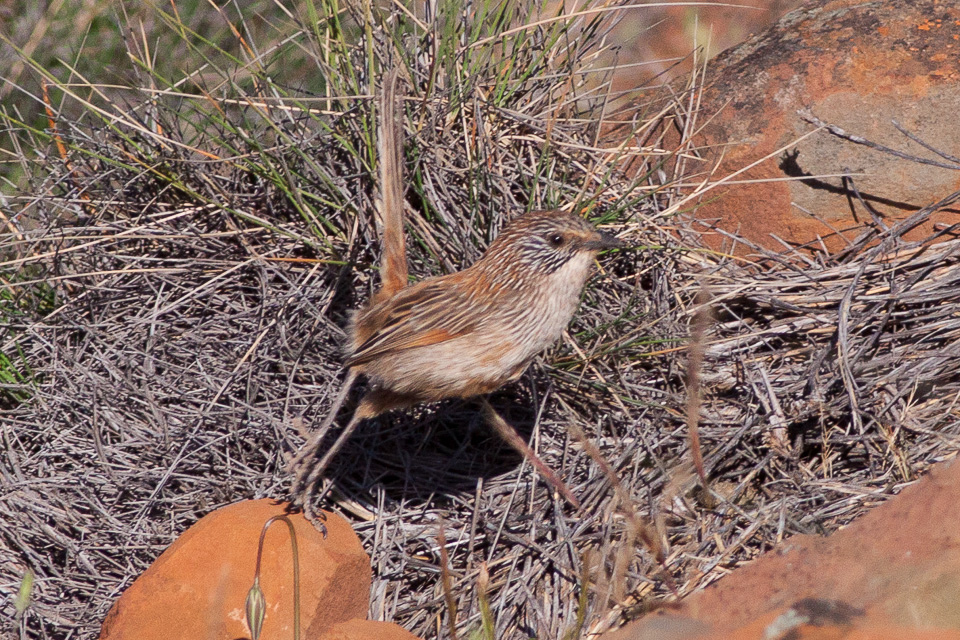
The Short-tailed Grasswren is a small, cryptically colored bird, measuring approximately 17-19 centimeters in length. Its defining feature is its short, rounded tail, which aids in its identification. The plumage is predominantly gray and brown, with fine streaking that provides excellent camouflage amongst the spinifex and rocky outcrops it inhabits. Adult males and females are similar in appearance, although males may have slightly brighter plumage during the breeding season.
Juvenile Short-tailed Grasswrens resemble adults but tend to exhibit a duller overall coloration, lacking the subtle sheen found in mature birds. This lack of distinct sexual dimorphism can make field identification challenging without observing behavior or vocalizations. In flight, the Short-tailed Grasswren displays a rapid and low flight pattern, often moving short distances before diving into cover.
This species can be confused with other grasswrens, such as the Striated Grasswren, but careful observation of the tail length and plumage patterns can aid in distinguishing between them. The Short-tailed Grasswren typically exhibits a more rounded and shorter tail compared to its relatives. When perched, this bird often adopts a horizontal posture, aligning closely with the ground or vegetation, which complements its cryptic coloration.
Having trouble telling birds apart? Upload a photo to our bird identification tool for an instant species match.
Short-tailed Grasswren Habitat and Range
Preferred Habitat
The Short-tailed Grasswren inhabits arid and semi-arid regions characterized by spinifex grasslands, rocky outcrops, and sparse shrublands. These habitats are typically found at elevations ranging from 300 to 800 meters above sea level. The presence of spinifex, a dense, spiky grass, is crucial as it provides both food resources and protection from predators.
While the Grasswren is predominantly found in remote, rural areas, it shows little to no adaptation to urban environments. Its preference for undisturbed habitats means that it is rarely encountered near human settlements. Seasonal shifts in habitat usage are minimal, as the bird remains closely associated with its favored spinifex landscapes throughout the year.
The Short-tailed Grasswren's reliance on specific vegetation types makes it vulnerable to habitat alteration, such as fire and land clearing. Conservation efforts focusing on preserving and managing these habitats are key to ensuring the species' continued survival in its natural range.
Geographic Range
The Short-tailed Grasswren's range is highly restricted, being endemic to South Australia. It is primarily found in the Flinders Ranges, with a smaller population in the Olary Ranges. This limited distribution makes it a species of interest for conservation and study.
Breeding populations are concentrated within these regions, and the Grasswren exhibits little to no migratory behavior. Instead, it occupies its home range year-round, adapting to the varying seasonal conditions of the arid climate.
Population density is generally low, with hotspots of higher density occurring in areas where spinifex grass is abundant and well-established. These areas provide the necessary cover and food resources required for the Grasswren's survival. As a result, the species is considered rare and is closely monitored by ornithologists and conservationists.
Want to know which birds visit your area? Browse our backyard birds by location guides for region-specific species lists.
What Does the Short-tailed Grasswren Eat?
The Short-tailed Grasswren's diet primarily consists of small invertebrates, including ants, beetles, and spiders. These are foraged from the ground and under the dense cover of spinifex grass. During the breeding season, the demand for high-protein food sources like insects increases, supporting both the adults and their growing chicks.
In addition to invertebrates, the Grasswren occasionally consumes seeds and small plant matter, particularly during times when insect availability is low. This opportunistic feeding behavior allows it to survive in its arid environment where food resources can be unpredictable.
Foraging typically occurs during the cooler parts of the day, such as early morning and late afternoon, to avoid the intense midday heat. The bird employs a methodical approach, moving slowly and deliberately through vegetation, often using its bill to probe into leaf litter and crevices.
Short-tailed Grasswren Behavior and Social Structure
The Short-tailed Grasswren is a generally solitary bird, though pairs may be observed during the breeding season. It exhibits strong territorial behavior, with individuals defending their territories with vocalizations and displays. Courtship involves elaborate vocal and physical displays, with males often performing a series of jumps and wing flutters to attract a mate.
Outside of the breeding season, the Grasswren remains relatively inconspicuous, relying on its cryptic plumage to stay hidden from predators. It is primarily diurnal, with peak activity occurring during the cooler hours of dawn and dusk.
In response to predators, the Grasswren exhibits a range of behaviors, including freezing in place and using its cryptic coloration to blend into its surroundings. If threatened, it will engage in short, rapid flights to dense cover. Unlike many other small birds, the Short-tailed Grasswren rarely forms flocks, preferring solitary or paired living.
Short-tailed Grasswren Nesting and Reproduction
The Short-tailed Grasswren constructs a dome-shaped nest on or near the ground, often nestled within a clump of spinifex or under a small shrub. The nest is made from grasses and other plant materials, lined with softer fibers to provide insulation for the eggs and chicks.
A typical clutch consists of two to three eggs, which are incubated by the female for about 14 to 16 days. Both parents participate in feeding the chicks, which fledge approximately two weeks after hatching.
The Grasswren is generally monogamous, and pairs may raise one or two broods per year, depending on environmental conditions. The investment in parental care is significant, as the harsh environment requires well-developed fledglings to survive.
Short-tailed Grasswren Sounds and Vocalizations
The Short-tailed Grasswren's song is a complex series of high-pitched trills and whistles, often delivered from a concealed perch. These vocalizations serve to establish territory and attract mates. The song is melodious and can carry over long distances in the open landscape.
Call notes are typically sharp and metallic, used for communication between mates or to signal alarm. During the dawn chorus, the Grasswren becomes particularly vocal, contributing to the morning symphony of the arid landscape. Alarm calls are distinct, consisting of rapid, repetitive notes that alert conspecifics to potential threats.
Interesting Facts About the Short-tailed Grasswren
- 1The Short-tailed Grasswren is one of the few bird species endemic to South Australia's arid regions, highlighting its unique evolutionary path.
- 2Despite its name, the Short-tailed Grasswren's tail is not significantly shorter than other grasswrens, but its rounded shape is distinct.
- 3The cryptic plumage of the Short-tailed Grasswren makes it incredibly difficult to spot, even for experienced birdwatchers.
- 4The species' preference for spinifex grasslands means its habitat is tightly linked to this vegetation type, which also influences its diet.
- 5Short-tailed Grasswrens are known for their elusive behavior, often remaining hidden in dense vegetation until disturbed.
- 6The bird's vocal repertoire is unusually complex for a small passerine, aiding in territory defense and mate attraction.
- 7Females are solely responsible for incubation, while both parents share in feeding duties, showcasing a balanced parental investment.
Short-tailed Grasswren Conservation Status
The Short-tailed Grasswren is currently listed as Least Concern by the IUCN, though its restricted range and specific habitat requirements make it vulnerable to environmental changes. Habitat destruction, primarily through land clearing and altered fire regimes, poses significant threats to its population. Conservation efforts focus on habitat preservation and management, particularly in the Flinders and Olary Ranges. Monitoring programs have been established to track population trends and the impact of conservation strategies. While current population trends appear stable, ongoing vigilance is necessary to ensure the species does not slip into more threatened categories due to the impacts of climate change and human activity.
Other Maluridae Species


Birds Similar to the Short-tailed Grasswren
These species are often confused with the Short-tailed Grasswren due to similar appearance or overlapping range.

