
Black-headed Nightingale-Thrush
Catharus mexicanus
Order: Passeriformes / Family: Turdidae
Wikimedia Commons
About the Black-headed Nightingale-Thrush
The Black-headed Nightingale-Thrush (Catharus mexicanus) is a captivating member of the Turdidae family, renowned for its melodious song and striking appearance. This medium-sized songbird thrives in the lush, humid forests of Central America, particularly favoring the undergrowth of montane and cloud forests. Its presence is most notable in countries such as Mexico, Guatemala, and Honduras, where the combination of dense vegetation and high humidity creates an ideal environment for its survival and reproduction. The Black-headed Nightingale-Thrush plays a significant ecological role, acting as both a seed disperser and an insect predator. By consuming various fruits and arthropods, it contributes to the health and regeneration of its forest habitat. During the breeding season, which typically spans from March to June, its melodious calls and songs can be heard resonating through the forest, often serving as a territorial declaration and a mating call. As a year-round resident in its preferred habitat, the Black-headed Nightingale-Thrush shows little migratory behavior, although there might be some altitudinal movement depending on local weather conditions and food availability. Its adaptability to the rich, diverse ecosystems of Central America highlights its importance within these forested regions, where it continues to enchant bird enthusiasts and researchers alike.
The Black-headed Nightingale-Thrush belongs to the family Turdidae, within the order Passeriformes. These birds typically live average 5-8 years with a maximum recorded of 12 years..
How to Identify a Black-headed Nightingale-Thrush
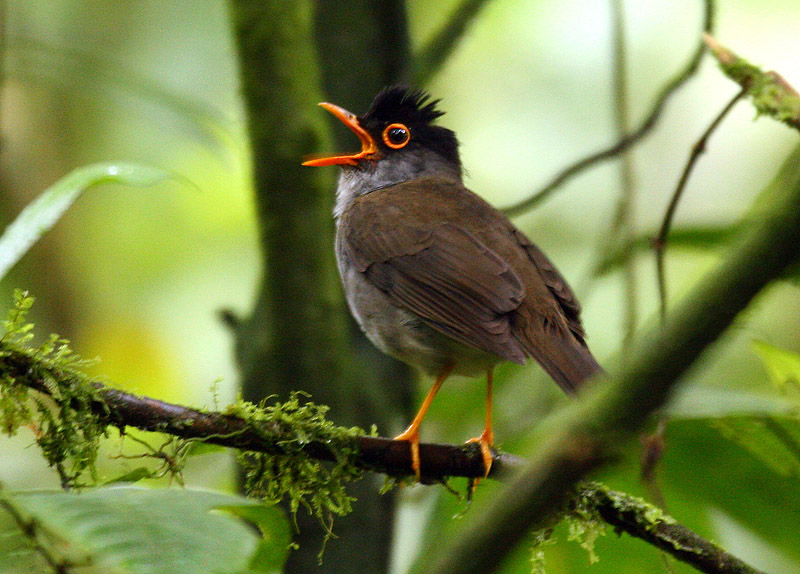
The Black-headed Nightingale-Thrush is easily recognized by its distinct black head and throat, which contrast sharply with its gray body and wings. Adult birds exhibit a vibrant orange bill and legs, adding a splash of color to their otherwise muted palette. Juvenile thrushes, in contrast, display a more subdued coloration with less pronounced black markings and a browner overall appearance. Males and females appear similar, making sex differentiation in the field challenging. The bird's flight silhouette is characterized by a relatively short tail and broad wings, which allow for agile maneuvering through dense vegetation. While perching, the Black-headed Nightingale-Thrush often adopts an upright posture, making its characteristic markings more visible. It can sometimes be confused with other Catharus species, but its unique head coloration and vocalizations help distinguish it from relatives like the Orange-billed Nightingale-Thrush. Birdwatchers often identify this species as much by ear as by sight, given its distinctive song.
Having trouble telling birds apart? Upload a photo to our bird identification tool for an instant species match.
Black-headed Nightingale-Thrush Habitat and Range
Preferred Habitat
The Black-headed Nightingale-Thrush primarily inhabits montane and cloud forests, thriving at elevations ranging from 900 to 2,500 meters. These forests, rich in undergrowth and epiphytes, provide the dense cover and abundant food resources necessary for its survival. Although it prefers undisturbed primary forests, this thrush can also be found in secondary growth areas and edges, indicating some adaptability to habitat changes. During the dry season, the thrush may shift slightly in elevation or move to more humid areas to find food. Unlike some bird species, it does not typically venture into urban areas, remaining largely within the forested confines of rural regions.
Geographic Range
The Black-headed Nightingale-Thrush's range extends through the highlands of Central America, notably found in Mexico, Guatemala, Honduras, and occasionally reaching into El Salvador. Its distribution is patchy, largely confined to areas where suitable montane forest habitats exist. While it is a non-migratory species, there may be minor local movements influenced by seasonal variations in food availability or climatic conditions. Population densities are generally highest in regions where the forest is intact and human disturbance is minimal.
Want to know which birds visit your area? Browse our backyard birds by location guides for region-specific species lists.
What Does the Black-headed Nightingale-Thrush Eat?
The diet of the Black-headed Nightingale-Thrush primarily consists of fruits and small arthropods, making it an important link in the food web of its forest habitat. It forages on the forest floor and within lower to mid-level vegetation, often seen flipping leaves or hopping along branches in search of food. Seasonal variations in fruiting trees can lead to changes in its diet, with a greater emphasis on insect prey during periods of fruit scarcity. Its foraging techniques are characterized by a combination of visual and auditory cues, allowing it to efficiently locate and capture prey throughout the day.
Black-headed Nightingale-Thrush Behavior and Social Structure
The Black-headed Nightingale-Thrush is a solitary or loosely social bird, often observed alone or in pairs rather than large flocks. During the breeding season, males establish and defend territories through vocal displays and occasional physical confrontations. Courtship involves a series of intricate song exchanges and displays between potential mates. This thrush is generally diurnal, with peak activity occurring in the early morning and late afternoon when it forages for food. When threatened by predators, it relies on its cryptic plumage and dense habitat to evade capture, often freezing or quietly slipping into thick cover.
Black-headed Nightingale-Thrush Nesting and Reproduction
Nesting for the Black-headed Nightingale-Thrush involves constructing a well-concealed cup-shaped nest made from twigs, moss, and leaves, typically located in a low shrub or tree. The female lays a clutch of two to three eggs, which she incubates for about two weeks. Both parents share in feeding the fledglings, which leave the nest approximately 12 to 15 days after hatching. The pair may produce one or two broods per year, depending on environmental conditions and food availability.
Black-headed Nightingale-Thrush Sounds and Vocalizations
The primary song of the Black-headed Nightingale-Thrush is a melodious series of flute-like notes, often described as hauntingly beautiful and complex. This song plays a crucial role in mate attraction and territory defense. In addition to its song, the thrush emits various call notes and alarm calls, which are sharper and less musical. During the dawn chorus, its voice stands out, contributing to the rich acoustic tapestry of Central American forests.
Interesting Facts About the Black-headed Nightingale-Thrush
- 1The Black-headed Nightingale-Thrush's song is sometimes compared to the haunting calls of the Wood Thrush, renowned for its beauty.
- 2This thrush is more often heard than seen, making it a favorite among birders who appreciate its vocal talents.
- 3Unlike many thrushes, the Black-headed Nightingale-Thrush does not typically migrate, remaining in its forest home year-round.
- 4Its diet includes a variety of forest fruits, helping to disperse seeds and contribute to forest regeneration.
- 5The bird's striking black head and orange bill are distinctive features, setting it apart from other forest thrushes.
Black-headed Nightingale-Thrush Conservation Status
Currently, the Black-headed Nightingale-Thrush is listed as Least Concern by the IUCN, with stable population trends. However, habitat loss due to deforestation poses a significant threat to its populations. Conservation efforts focus on protecting its forest habitat through the establishment of reserves and the promotion of sustainable land-use practices. Historical population changes reflect the ongoing impact of human activity on its preferred habitats, underscoring the need for continued conservation attention.
Other Turdidae Species


Birds Similar to the Black-headed Nightingale-Thrush
These species are often confused with the Black-headed Nightingale-Thrush due to similar appearance or overlapping range.

