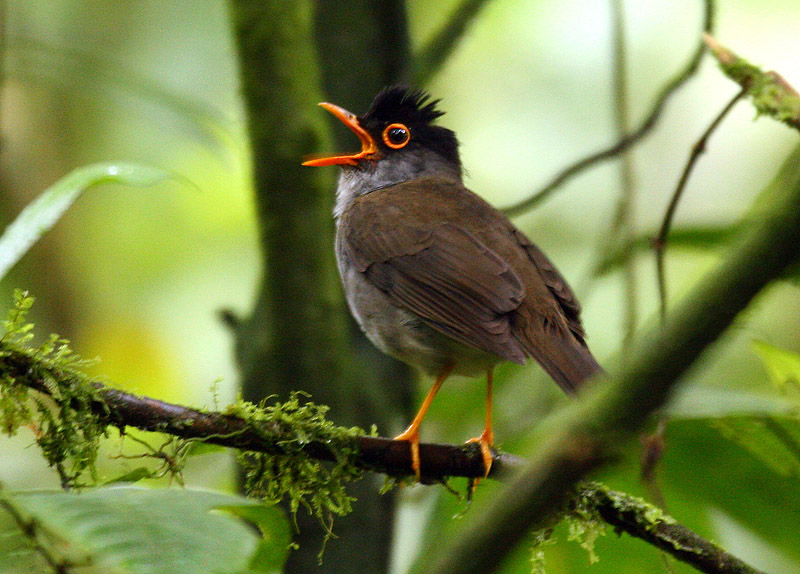
Slaty-backed Nightingale-Thrush
Catharus fuscater
Order: Passeriformes / Family: Turdidae

Wikimedia Commons
About the Slaty-backed Nightingale-Thrush
The Slaty-backed Nightingale-Thrush, scientifically named Catharus fuscater, is a medium-sized thrush that captivates bird watchers across its range with its charming appearance and melodious song. This bird belongs to the Turdidae family, a group known for their vocalization skills. The species is chiefly found in the mountainous regions of Central and South America, primarily inhabiting cloud forests and subtropical montane forests. These regions provide the cool, moist environment that the species prefers, contributing to its ecological role as a seed disperser and insect predator. The Slaty-backed Nightingale-Thrush plays a significant role in maintaining the health of its forest habitats by controlling insect populations and aiding in plant regeneration. The bird's presence is indicative of a healthy ecosystem, as it thrives in undisturbed forest areas. Seasonally, the Slaty-backed Nightingale-Thrush exhibits altitudinal migration, moving to lower elevations during colder months to escape harsher weather conditions. Observers often note the species descending into lower montane forests and even into more open woodland areas during the non-breeding season. This migration pattern helps the bird to exploit different food resources throughout the year, maintaining its role in the ecological balance of its habitat. The Slaty-backed Nightingale-Thrush is also noted for its adaptability to slight habitat changes, although it remains sensitive to severe deforestation. Its ability to shift slightly in range in response to environmental conditions demonstrates a flexible ecological strategy that supports its survival in the face of habitat alteration.
The Slaty-backed Nightingale-Thrush belongs to the family Turdidae, within the order Passeriformes. These birds typically live average 5-8 years with a maximum recorded of 12 years..
How to Identify a Slaty-backed Nightingale-Thrush
The Slaty-backed Nightingale-Thrush is easily recognized by its predominantly slaty-gray plumage, which gives it a distinctive appearance among the thrushes. Adults typically display a rich gray coloration on their backs and wings, while their underparts are slightly paler, providing a subtle contrast. The bird's face is marked by a slight white eye-ring, which enhances its expressive appearance. In contrast, juveniles exhibit a more mottled pattern, with brownish tones interspersed amongst the gray, a trait that helps them blend into their surroundings. Both males and females share similar plumage, making them difficult to differentiate in the field. However, keen observers may note that males tend to have slightly more vibrant plumage during the breeding season. The Slaty-backed Nightingale-Thrush can sometimes be confused with other thrush species, such as the Black-headed Nightingale-Thrush. However, its uniform gray coloring and lack of distinct head markings help distinguish it from its relatives. In flight, the bird presents a compact silhouette with rapid wing beats, characteristic of many forest thrushes. When perching, it often adopts an upright posture, occasionally flicking its wings and tail, a behavior that further aids in its identification.
Having trouble telling birds apart? Upload a photo to our bird identification tool for an instant species match.
Slaty-backed Nightingale-Thrush Habitat and Range
Preferred Habitat
The Slaty-backed Nightingale-Thrush is primarily associated with montane and cloud forests, typically found at elevations ranging from 1,500 to 3,000 meters. These habitats provide the dense understory and humidity levels that the species prefers. In regions such as the Andean slopes of Colombia, Ecuador, and Peru, the bird thrives in the lush, moss-laden forests that characterize these areas. The species shows some adaptability to secondary growth forests, provided they maintain sufficient cover and food resources. During the non-breeding season, the thrush may venture into slightly lower elevations, where subtropical forests and even open woodland areas provide suitable habitats. Despite its adaptability, the Slaty-backed Nightingale-Thrush is rarely found in urban environments, as it favors the seclusion of dense forest canopies over the open spaces of human-altered landscapes.
Geographic Range
The Slaty-backed Nightingale-Thrush has a range that extends across the mountainous regions of Central and South America. It breeds primarily in the high-altitude forests of the Andes, from Colombia and Venezuela southward through Ecuador, Peru, and into Bolivia. During the breeding season, the bird is commonly found in elevations ranging from 1,500 to 3,000 meters, where cloud forests provide ideal conditions. In the non-breeding season, the species may exhibit altitudinal migration, descending to lower montane and subtropical forests. While not considered migratory in the traditional sense, these altitudinal movements allow the thrush to exploit various habitats throughout the year. Population density is highest in areas with extensive, undisturbed forest cover, such as the cloud forests of Ecuador and Colombia, where the species finds abundant food and nesting opportunities.
Want to know which birds visit your area? Browse our backyard birds by location guides for region-specific species lists.
What Does the Slaty-backed Nightingale-Thrush Eat?
The diet of the Slaty-backed Nightingale-Thrush primarily consists of insects and small invertebrates, which it actively forages for on the forest floor. The bird uses a combination of sight and sound to detect prey, often flicking through leaf litter and probing the soil with its beak. During the breeding season, when the demand for protein is high, the thrush may focus more on capturing caterpillars, beetles, and ants. Seasonal variations in food availability can lead to shifts in diet; in the non-breeding season, the bird may consume more fruit and berries, taking advantage of the abundant plant resources in its habitat. This dietary flexibility supports the bird's survival through different environmental conditions. The Slaty-backed Nightingale-Thrush typically forages during the early morning and late afternoon, periods when insect activity is high and competition for food resources is lower.
Slaty-backed Nightingale-Thrush Behavior and Social Structure
The Slaty-backed Nightingale-Thrush exhibits a largely solitary lifestyle, with birds typically seen alone or in pairs outside of the breeding season. During the breeding season, the species becomes more territorial, with males establishing and defending territories through song displays and occasional physical confrontations. Courtship involves the male performing a series of song bouts to attract a mate, often accompanied by subtle displays of plumage. Flocking behavior is rare, although the species may occasionally join mixed-species foraging flocks in search of food, particularly in the non-breeding season. The bird exhibits diurnal activity patterns, with peak activity occurring around dawn and dusk. When faced with predators, the Slaty-backed Nightingale-Thrush may employ a range of strategies, from remaining motionless to avoid detection to emitting alarm calls to warn conspecifics. Despite its elusive nature, the bird's vocalizations often betray its presence, making it more frequently heard than seen.
Slaty-backed Nightingale-Thrush Nesting and Reproduction
The nesting habits of the Slaty-backed Nightingale-Thrush reflect its preference for well-concealed locations within dense forest understories. The species constructs a cup-shaped nest using a variety of materials, including twigs, moss, and leaves, which provide excellent camouflage. Nests are typically situated low to the ground, often in a shrub or small tree, ensuring protection from predators and the elements. A typical clutch consists of 2 to 3 eggs, with both parents sharing incubation duties over a period of about 14 to 16 days. Once hatched, the chicks remain in the nest for approximately 14 days before fledging. During this time, both parents are actively involved in feeding and protecting the young. The species generally produces one brood per year, although favorable conditions may occasionally lead to a second breeding attempt.
Slaty-backed Nightingale-Thrush Sounds and Vocalizations
The song of the Slaty-backed Nightingale-Thrush is a series of clear, melodious whistles, often described as flute-like in quality. These vocalizations serve primarily in territorial defense and mate attraction, with males singing most frequently at dawn and dusk. The song's rhythm is typically slow and deliberate, with each phrase consisting of a series of notes that rise and fall in pitch. Beyond its primary song, the species also emits a variety of call notes, including short, sharp chips used in communication between mates and family groups. When alarmed, the bird may produce a harsh, rattling call to alert others to potential danger. Despite its varied vocal repertoire, the Slaty-backed Nightingale-Thrush's distinctive song remains a key feature for identification in the field, often echoing through its forest habitat.
Interesting Facts About the Slaty-backed Nightingale-Thrush
- 1The Slaty-backed Nightingale-Thrush's song is so melodious that it has been likened to the sound of a flute, enchanting listeners across its range.
- 2This species exhibits altitudinal migration, moving to lower elevations during colder months to escape harsh weather conditions.
- 3The Slaty-backed Nightingale-Thrush is a member of the Turdidae family, which includes some of the most accomplished songbirds in the world.
- 4Despite its name, the Slaty-backed Nightingale-Thrush is not nocturnal but is diurnal, with peak activity at dawn and dusk.
- 5Its distinctive slaty-gray plumage sets the Slaty-backed Nightingale-Thrush apart from other thrushes, making it a favorite among birdwatchers.
- 6The species is an effective seed disperser, aiding in the regeneration of its forest habitats by consuming and distributing fruit seeds.
- 7Though primarily solitary, the Slaty-backed Nightingale-Thrush may join mixed-species flocks during the non-breeding season to enhance foraging success.
Slaty-backed Nightingale-Thrush Conservation Status
The Slaty-backed Nightingale-Thrush is currently listed as Least Concern by the IUCN, with a population trend that appears stable. However, ongoing threats such as habitat loss due to deforestation pose significant challenges to its long-term survival. Conservation efforts primarily focus on preserving and restoring its natural habitat, particularly the cloud forests and montane regions it depends on. Protected areas in countries like Ecuador, Colombia, and Peru play a crucial role in safeguarding the species' habitat. Historical data suggests that while the species has maintained stable numbers in some regions, localized declines have occurred in areas where forest clearance has been most severe. Continued monitoring and habitat conservation are vital to ensuring the species' future.
Other Turdidae Species


Birds Similar to the Slaty-backed Nightingale-Thrush
These species are often confused with the Slaty-backed Nightingale-Thrush due to similar appearance or overlapping range.