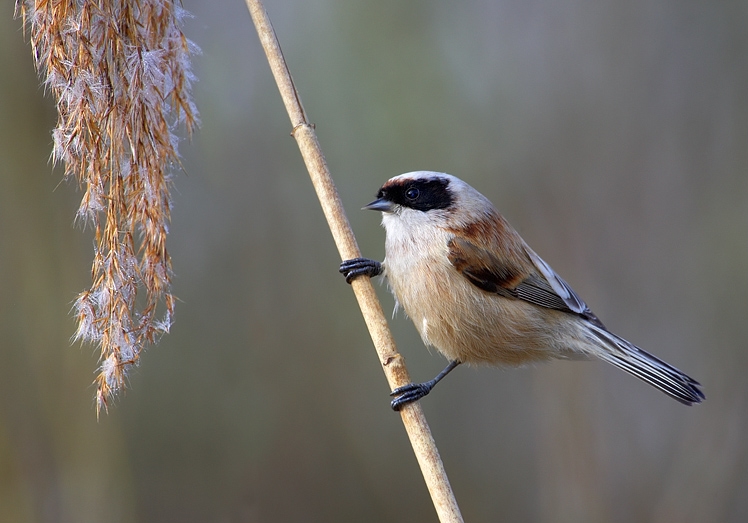
Black-headed Penduline-Tit
Remiz macronyx
Order: Passeriformes / Family: Remizidae

Wikimedia Commons
About the Black-headed Penduline-Tit
The Black-headed Penduline-Tit, Remiz macronyx, is a small passerine bird belonging to the family Remizidae. This bird is known for its distinctive black head, which contrasts sharply with its brown upperparts and white underparts. Its presence is most notable in the wetlands and reed beds across Asia and parts of Eastern Europe. This species plays a vital role in its ecosystem by controlling insect populations and serving as prey for larger birds and mammals.
This bird's significance extends beyond its ecological role. It is often studied for its remarkable nest-building abilities. The Black-headed Penduline-Tit constructs complex, dome-shaped nests suspended from tree branches using plant fibers and spider silk. These nests serve as a testament to the bird's architectural skills and adaptability. The bird's presence in wetland habitats often indicates a healthy ecosystem, as they require specific conditions to thrive.
The Black-headed Penduline-Tit is found in countries like Kazakhstan, Russia, and China, preferring habitats with a rich supply of reeds and willow trees. Its seasonal behaviors include migration patterns that vary by region. In colder climates, they may move to milder areas during winter months, while in more temperate regions, they remain year-round. This adaptability ensures their survival across various landscapes and climates.
The Black-headed Penduline-Tit belongs to the family Remizidae, within the order Passeriformes. These birds typically live average 2-3 years with a max recorded of 5 years.
How to Identify a Black-headed Penduline-Tit
The Black-headed Penduline-Tit is a small bird, measuring around 11 centimeters in length. Adults exhibit a striking black head and face, which contrast with their brownish upperparts and white, buff-colored underparts. The wings are brown with lighter edges, and the tail is relatively short. The black head is a key field mark, helping to distinguish it from other penduline-tits.
Juvenile Black-headed Penduline-Tits lack the bold black head found in adults, instead displaying a more subdued brownish coloration across their head and body. This difference in plumage can be helpful for birdwatchers trying to identify younger birds. Males and females look similar, though males may have slightly more vivid coloration.
In flight, the Black-headed Penduline-Tit exhibits rapid, shallow wingbeats and a distinctive bouncing flight pattern. When perched, it often clings to reeds or small branches, showcasing its agility and adaptability. This species can be confused with the Eurasian Penduline-Tit, but the latter lacks the entirely black head, making identification straightforward with close observation.
Having trouble telling birds apart? Upload a photo to our bird identification tool for an instant species match.
Black-headed Penduline-Tit Habitat and Range
Preferred Habitat
The Black-headed Penduline-Tit inhabits wetlands, marshes, and reed beds, often found near rivers and lakes in Eurasia. It thrives in environments where willow trees and dense reed beds are prevalent, offering both food and nesting materials. These habitats provide the cover and resources necessary for foraging and reproduction.
This species typically occupies lowland areas but can be found at elevations up to 1,500 meters, especially in regions with suitable wetland conditions. Black-headed Penduline-Tits are primarily found in rural and semi-rural settings, rarely venturing into urban areas unless suitable habitat exists.
Seasonal habitat shifts occur as they migrate to milder climates during colder months. In winter, they may be found in slightly drier habitats, though they always remain close to sources of water and dense vegetation.
Geographic Range
The Black-headed Penduline-Tit breeds across a wide range in Eurasia, with significant populations in Kazakhstan, Russia, and parts of China. During the breeding season, it can be found in expansive reed beds and marshes across these regions.
In winter, some populations migrate southward, reaching parts of the Middle East and South Asia, including Iran and northern India. Migration corridors are primarily within Eurasia, with birds following river valleys and wetland networks.
Population density hotspots include the lower Volga River basin and the wetlands of Xinjiang in China. These areas provide ideal conditions for breeding and foraging, supporting large numbers of Black-headed Penduline-Tits during key times of the year.
Want to know which birds visit your area? Browse our backyard birds by location guides for region-specific species lists.
What Does the Black-headed Penduline-Tit Eat?
The diet of the Black-headed Penduline-Tit primarily consists of insects and other small invertebrates. It feeds on beetles, caterpillars, and spiders, which it gleans from reeds and shrubs in its wetland habitat. This insectivorous diet plays a crucial role in controlling pest populations, benefiting the ecosystem as a whole.
Seasonally, the bird's diet may shift to include more seeds and plant materials, especially in winter when insects are less abundant. During these times, they may forage in slightly drier areas where seeds are more accessible.
Foraging techniques include hovering near plants to pick off insects and using their sharp beaks to probe crevices in bark and foliage. Black-headed Penduline-Tits typically feed during daylight hours, with peak activity occurring in the early morning and late afternoon when insect activity is highest.
Black-headed Penduline-Tit Behavior and Social Structure
The Black-headed Penduline-Tit is a social bird, often seen in small flocks outside the breeding season. These flocks, typically comprising 10-20 individuals, move through reed beds and wetlands, foraging together. During the breeding season, they become more territorial, with pairs defending nesting sites vigorously.
Courtship behaviors involve males displaying their nest-building skills. They begin constructing a nest to attract a mate, showcasing their ability to provide a secure environment for raising young. Once paired, both male and female participate in nest building.
In response to predators, the Black-headed Penduline-Tit emits a series of sharp calls to alert others and may engage in mobbing behavior, especially against smaller avian threats. Daily activity patterns are crepuscular, with heightened activity at dawn and dusk when they feed and engage in social interactions.
Black-headed Penduline-Tit Nesting and Reproduction
The Black-headed Penduline-Tit's nest is an architectural marvel, resembling a small, enclosed pouch made from plant fibers, wool, and spider silk. Nests are often suspended from the tips of thin branches, usually over water, providing protection from ground predators.
Nesting sites are chosen for their proximity to food sources and the availability of nesting materials. Clutch sizes typically range from 5 to 8 eggs, with incubation lasting about 13 to 15 days. Both parents share incubation duties, ensuring the eggs remain at optimal temperature.
After hatching, chicks fledge in approximately 18 to 21 days. Parental roles are shared, with both male and female feeding and tending to the young. The species typically raises one brood per year, though favorable conditions may allow for a second.
Black-headed Penduline-Tit Sounds and Vocalizations
The Black-headed Penduline-Tit's primary song is a series of soft, whistled notes that rise and fall in pitch, creating a melodic and somewhat plaintive quality. These songs are often heard during the breeding season as males attempt to attract mates.
Call notes are short and sharp, used for communication between flock members and alerting others to potential threats. Alarm calls are more urgent and harsh, signaling the presence of predators.
During the dawn chorus, the Black-headed Penduline-Tit participates with vigor, its song blending with the calls of other wetland birds. The tonal quality of its song is reminiscent of a small flute, adding a gentle musicality to its wetland environment.
Interesting Facts About the Black-headed Penduline-Tit
- 1The Black-headed Penduline-Tit constructs nests that can take up to three weeks to complete, showcasing its dedication and skill.
- 2Despite its small size, the Black-headed Penduline-Tit's nests can measure up to 20 centimeters in length, providing ample space for its young.
- 3The species' name, 'macronyx,' refers to its relatively large claws, which aid in gripping reeds and branches.
- 4Black-headed Penduline-Tits use spider silk to reinforce their nests, making them both strong and flexible.
- 5The bird's presence in a wetland is often an indicator of a healthy ecosystem, as they are sensitive to environmental changes.
- 6Studies have shown that their intricate nests can deter some predators due to their complexity and suspended nature.
- 7The Black-headed Penduline-Tit is one of the few bird species known to use wool as a primary nesting material, giving its nests a unique texture.
Black-headed Penduline-Tit Conservation Status
The IUCN currently lists the Black-headed Penduline-Tit as a species of Least Concern, with stable population trends across its range. However, habitat loss due to wetland drainage and agricultural expansion poses significant threats to its long-term survival. Conservation efforts include protecting wetland habitats and implementing measures to prevent further degradation. In certain regions, conservation organizations actively monitor populations to ensure that they remain healthy. Historically, population changes have correlated with wetland availability, highlighting the importance of these ecosystems. Continued preservation of natural habitats remains crucial for maintaining stable populations of the Black-headed Penduline-Tit.
Other Remizidae Species


Birds Similar to the Black-headed Penduline-Tit
These species are often confused with the Black-headed Penduline-Tit due to similar appearance or overlapping range.