
Eurasian Penduline-Tit
Remiz pendulinus
Order: Passeriformes / Family: Remizidae
Wikimedia Commons
About the Eurasian Penduline-Tit
The Eurasian Penduline-Tit (Remiz pendulinus) is a small passerine bird known for its remarkable nest-building skills, which contribute significantly to its ecological role. This bird inhabits a range of wetland environments, including reed beds and willow thickets, often near rivers and lakes. Its geographic distribution spans from the Iberian Peninsula across central Europe to western Asia, extending into parts of Russia and even the Middle East. During the breeding season, the Eurasian Penduline-Tit is a conspicuous presence in these lush aquatic habitats.
The significance of the Eurasian Penduline-Tit lies not only in its ecological contributions but also in its role as an indicator species for wetland health. Its presence often signifies a rich and diverse ecosystem, as it relies on abundant insect life and appropriate nesting materials. The bird's seasonal behaviors further highlight its adaptability. In spring, the male Penduline-Tit selects nest sites and begins the intricate construction process, weaving a hanging nest from plant fibers and spider silk. This nest offers insight into the bird's survival strategies, as it provides protection from predators and harsh weather conditions.
In addition to its ecological importance, the Eurasian Penduline-Tit captivates birdwatchers and naturalists with its intricate vocalizations and complex social behaviors. Its role in the ecosystem extends beyond nesting, as it contributes to insect population control and seed dispersal. Throughout the year, the Penduline-Tit's movements and behaviors shift in response to environmental changes, making it a dynamic subject of study for ornithologists. Overall, the Eurasian Penduline-Tit serves as a vital component of wetland ecosystems and a species of interest for conservationists.
The Eurasian Penduline-Tit belongs to the family Remizidae, within the order Passeriformes. These birds typically live average 3-4 years with a max recorded of 6 years.
How to Identify a Eurasian Penduline-Tit
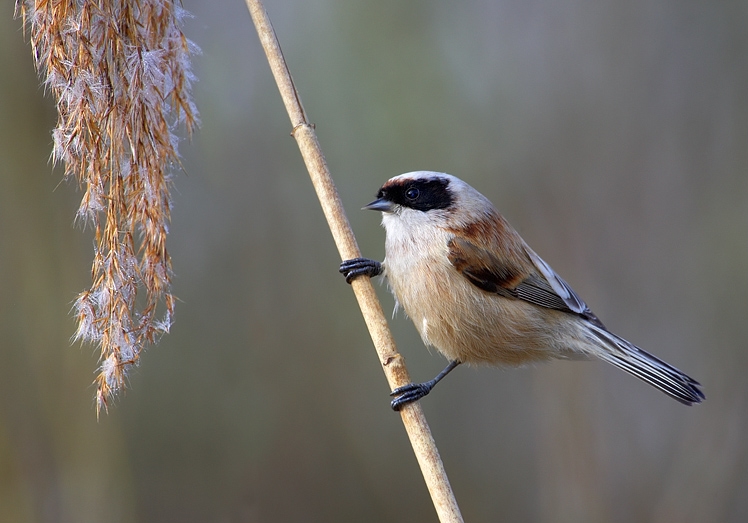
The Eurasian Penduline-Tit is a small bird, measuring approximately 11 cm in length, with a wingspan of around 16-18 cm. Its plumage is characterized by a blend of muted brown, gray, and white tones. The upperparts are predominantly brown, while the underparts are lighter, often showing a whitish or buff hue. One of the key identifying features is the black mask-like pattern across its face, reminiscent of a bandit, which provides a stark contrast to its pale head.
Male and female Penduline-Tits exhibit similar plumage, making them difficult to distinguish in the field. However, juveniles tend to have a less pronounced facial mask and a more uniformly brown appearance. The Eurasian Penduline-Tit can be confused with similar species such as the Bearded Tit (Panurus biarmicus), but the latter has more prominent facial markings and a longer tail.
In flight, the Penduline-Tit displays a rapid, bounding flight pattern typical of many small passerines. When perched, it often clings to vertical reeds or branches, showcasing its agility and preference for dense vegetation. Observers should note the bird's penchant for clinging to vertical surfaces, which is less common in similar species, aiding in its identification.
Having trouble telling birds apart? Upload a photo to our bird identification tool for an instant species match.
Eurasian Penduline-Tit Habitat and Range
Preferred Habitat
The Eurasian Penduline-Tit primarily inhabits wetlands, including marshes, reed beds, and areas with abundant willow growth. These environments provide essential resources such as nesting materials and food. The bird often prefers lowland regions with easy access to water sources, although it may also be found at elevations up to 1,000 meters in some parts of its range.
Throughout the year, the Penduline-Tit's habitat preferences may shift slightly. During the breeding season, it focuses on areas rich in suitable nesting materials and insect life. In winter, it may venture into more open spaces or even urban parks if food resources become scarce, demonstrating its adaptability to varying environmental conditions.
While primarily a rural species, the Eurasian Penduline-Tit occasionally appears in suburban areas with appropriate vegetation, reflecting its ability to utilize human-altered landscapes. However, the presence of dense wetland vegetation remains a key factor in its habitat selection.
Geographic Range
The Eurasian Penduline-Tit's breeding range extends across much of Europe and into western Asia. It can be found in countries such as Spain, France, Germany, Poland, and Ukraine, stretching eastward through Russia and into Kazakhstan and parts of Iran. During the breeding season, these regions host significant populations focused around wetland habitats.
In winter, the population exhibits partial migratory behavior. Some individuals migrate to southern Europe, including Italy and Greece, while others travel farther to North Africa and the Middle East. Key wintering areas include the Nile Delta, the coastlines of the Mediterranean, and the wetlands of Iran.
Migration corridors often follow major river systems and coastlines, providing essential stopover sites where the birds can rest and refuel. Population density hotspots typically occur in regions where extensive wetland habitats are preserved, such as the Danube Delta and the Volga River basin, where the Eurasian Penduline-Tit remains a common and widespread sight.
Want to know which birds visit your area? Browse our backyard birds by location guides for region-specific species lists.
What Does the Eurasian Penduline-Tit Eat?
The Eurasian Penduline-Tit primarily feeds on a diverse array of insects and arachnids, which form the bulk of its diet during the breeding season. It actively forages in reed beds and among willow branches, using its slender bill to extract insects from crevices and foliage. Common prey items include caterpillars, beetles, and small spiders.
As the seasons change, so does the bird's diet. In autumn and winter, when insect availability declines, the Penduline-Tit supplements its diet with seeds and small fruits, taking advantage of the seasonal abundance of plant resources. This dietary flexibility enables the bird to endure seasonal fluctuations in food availability.
Foraging techniques often involve acrobatic maneuvers, as the Penduline-Tit clings to vertical surfaces and moves nimbly among branches. This behavior not only aids in prey capture but also reduces competition with ground-foraging birds. Feeding occurs throughout the day, with peak activity in the early morning and late afternoon when insect activity is highest.
Eurasian Penduline-Tit Behavior and Social Structure
The Eurasian Penduline-Tit exhibits a complex social structure, often forming small family groups during the breeding season. These groups typically consist of a breeding pair and their offspring, which remain together until fledging. The bird displays territorial behavior, especially during nest building, with males vigorously defending their chosen nesting sites from intruders.
Courtship displays involve males presenting potential nest sites to females, accompanied by vocalizations and displays of nest construction prowess. Flocking behavior becomes more pronounced outside the breeding season, with individuals occasionally joining mixed-species flocks in search of food.
In response to predators, such as sparrowhawks and crows, Penduline-Tits exhibit alarm calls and rapid evasive flight. The bird's daily activity patterns include periods of intense foraging interspersed with rest during the midday heat. Such behavior is typical of small passerines, balancing energy expenditure with the need for sustenance.
Eurasian Penduline-Tit Nesting and Reproduction
The nesting behavior of the Eurasian Penduline-Tit is particularly fascinating due to its intricately woven nests. The male begins by selecting a site in dense vegetation, often a willow or reed, and constructs an initial framework of plant fibers and spider silk. This framework evolves into a complex, bag-like structure with a concealed entrance, offering protection against predators and adverse weather.
Females contribute to finalizing the nest, which may take several weeks to complete. Clutch size varies from 4 to 7 eggs, with incubation lasting around 13 to 15 days. Both parents participate in feeding and caring for the young, although the male often takes a more active role in the later stages.
Fledging occurs approximately 18 to 20 days after hatching, with young birds remaining in the vicinity of the nest for several weeks as they learn to forage independently. The Eurasian Penduline-Tit typically raises one or two broods per year, depending on environmental conditions and resource availability.
Eurasian Penduline-Tit Sounds and Vocalizations
The primary song of the Eurasian Penduline-Tit is a soft, melodious series of high-pitched whistles, often described as 'tsee-tsee-tsee'. The rhythm is steady, with each note delivered in rapid succession. This song serves both as a territorial call and a means of attracting a mate during the breeding season.
In addition to its song, the Penduline-Tit produces various call notes, including a sharp 'tsip' used in alarm situations. These calls are less melodious but serve as effective communication tools within family groups.
During the dawn chorus, the Eurasian Penduline-Tit contributes to the early morning symphony with its persistent whistling, a sound that birdwatchers and naturalists find both enchanting and distinctive. The bird's vocal repertoire, while not extensive, is an integral part of its social interactions and territorial defense.
Interesting Facts About the Eurasian Penduline-Tit
- 1The Eurasian Penduline-Tit constructs one of the most elaborate nests among birds, using up to 2,000 plant fibers.
- 2Despite its small size, this bird can travel over 1,000 km during migration, showcasing remarkable endurance.
- 3The name 'Penduline' refers to its pendulum-like nest, which hangs from branches in a distinctive way.
- 4In some cultures, the bird's nest is considered a symbol of craftsmanship and ingenuity.
- 5Young Penduline-Tits stay near their natal area for several weeks post-fledging, learning vital survival skills.
- 6The bird's diet shifts with the seasons, highlighting its adaptability to changing environmental conditions.
- 7The Eurasian Penduline-Tit's black facial mask resembles that of a raccoon, making it easy to identify.
Eurasian Penduline-Tit Conservation Status
The Eurasian Penduline-Tit is currently classified as Least Concern by the IUCN, with stable population trends across most of its range. However, localized threats exist, particularly habitat loss due to wetland drainage, agricultural expansion, and pollution. Conservation efforts focus on preserving wetland habitats, crucial for the bird's breeding and foraging needs. Protected areas and restoration projects play a significant role in maintaining suitable environments for the Penduline-Tit. Historically, populations have fluctuated with changes in land use and climate, but ongoing conservation work aims to mitigate these impacts. Continued monitoring and habitat management are essential to safeguard this species and ensure its continued presence across Europe and Asia.
Other Remizidae Species


Birds Similar to the Eurasian Penduline-Tit
These species are often confused with the Eurasian Penduline-Tit due to similar appearance or overlapping range.

