
Black-naped Oriole
Oriolus chinensis
Order: Passeriformes / Family: Oriolidae
Wikimedia Commons
About the Black-naped Oriole
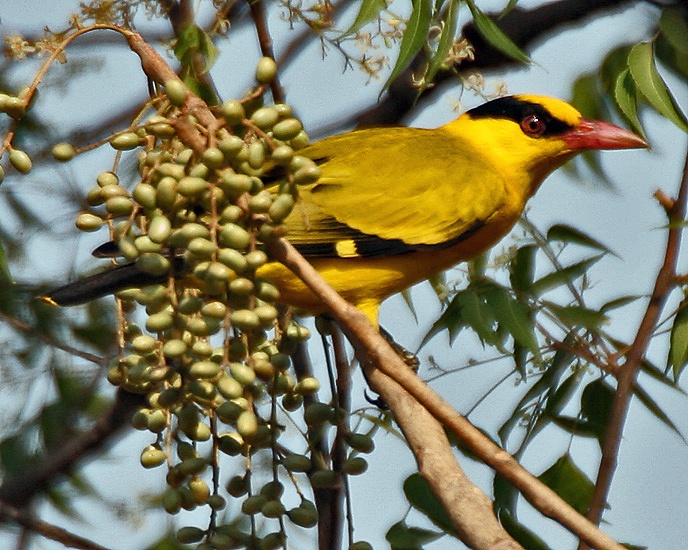
The Black-naped Oriole (Oriolus chinensis) is a visually stunning bird, characterized by its vivid yellow body contrasted by a conspicuous black nape and lores. This member of the Oriolidae family is a widespread resident of South and Southeast Asia, found from India and Sri Lanka through to the Philippines and Indonesia. Known for its striking appearance and melodious calls, the Black-naped Oriole plays a significant role in its ecosystem as both a predator of insects and a disperser of seeds. The species inhabits a range of environments, favoring open woodlands, forest edges, and urban gardens. It is particularly prevalent in areas where trees such as figs are abundant, as these provide both food and nesting sites. During the breeding season, the Black-naped Oriole displays heightened activity and vocalizations. Males engage in complex songs to establish territories and attract mates. The breeding season varies across its range, typically aligning with local rainy seasons which ensure an ample food supply. In regions like the Indian subcontinent, breeding starts with the pre-monsoon showers in April, continuing through July. The bird's ecological role extends beyond predation and seed dispersal; it also controls pest populations, feeding on caterpillars and beetles. Additionally, the Black-naped Oriole's presence in urban areas highlights its adaptability, as it exploits human-altered landscapes for food and shelter. Its ability to thrive in varied habitats underscores its resilience and ecological significance.
The Black-naped Oriole belongs to the family Oriolidae, within the order Passeriformes. These birds typically live average 7-10 years, with a max recorded of 15 years..
How to Identify a Black-naped Oriole
Adult Black-naped Orioles are unmistakable with their bright yellow plumage, a jet-black nape, and lores that extend around the eyes. The wings and tail are marked with black, offering a stark contrast to their otherwise vivid yellow body. Juveniles resemble adults but have duller plumage and lack the fully developed black nape, often displaying a more mottled appearance. There is little sexual dimorphism in this species, making males and females similar in appearance. However, females may appear slightly duller. In flight, the Black-naped Oriole exhibits a steady, undulating pattern, with its broad, rounded wings and long tail offering a distinctive silhouette. When perched, the bird's upright posture and long tail make it easily identifiable, even from a distance. Occasionally, it may be confused with the similarly colored Eurasian Golden Oriole, but the latter lacks the prominent black nape and is more uniformly yellow.
Having trouble telling birds apart? Upload a photo to our bird identification tool for an instant species match.
Black-naped Oriole Habitat and Range
Preferred Habitat
The Black-naped Oriole is adaptable, inhabiting a variety of environments ranging from open woodlands and forest edges to urban parks and gardens. It is commonly found at elevations up to 1,500 meters, although it is more frequent in lowland areas. In the Philippines, it thrives in both primary and secondary forests, while in urban areas like Singapore, it is a familiar sight in parks and gardens. During the non-breeding season, it may venture into more open habitats, including agricultural lands. Its presence in urban areas demonstrates its adaptability to human environments, exploiting the resources available in such settings.
Geographic Range
The Black-naped Oriole's range extends across much of South and Southeast Asia. It breeds from the Indian subcontinent, including Bangladesh and Sri Lanka, eastwards to the Philippines and Indonesia. In China, it is a common summer visitor, migrating southwards during the winter months. The bird is a resident breeder in much of its range, though populations in the northern areas may undertake short-distance migrations, moving southward to escape colder climates. Notably, the species is found throughout the islands of Indonesia, making it one of the more widespread orioles in Asia.
Want to know which birds visit your area? Browse our backyard birds by location guides for region-specific species lists.
What Does the Black-naped Oriole Eat?
The Black-naped Oriole has a varied diet, primarily consuming fruits and insects. Figs and berries constitute a significant portion of its diet, supplemented by caterpillars, beetles, and other small invertebrates. During the breeding season, protein-rich insects become vital to support the energy demands of raising young. Foraging typically occurs in the canopy, where the oriole uses its strong bill to glean insects and peck at fruit. It may also hover to pick off insects from leaves, demonstrating agility and precision. Feeding typically occurs during the early morning and late afternoon, aligning with peak insect activity.
Black-naped Oriole Behavior and Social Structure
Black-naped Orioles are generally solitary or found in pairs, particularly during the breeding season. Territorial behavior is pronounced, with males singing complex, flute-like songs to establish and defend their territories. During courtship, males engage in aerial displays and present food to potential mates as part of their courtship ritual. The species is diurnal, with peak activity occurring in the morning and late afternoon. When faced with predators, the oriole emits sharp alarm calls and may mob the intruder with the help of other birds. Outside the breeding season, they may join mixed-species flocks, benefiting from the collective vigilance against predators.
Black-naped Oriole Nesting and Reproduction
The Black-naped Oriole constructs a cup-shaped nest, woven meticulously from grass, twigs, and other plant fibers. Typically, nests are placed high in the forks of tree branches, providing protection from ground predators and a vantage point for observing threats. The female lays a clutch of 2 to 3 eggs, which are creamy white with dark speckles. Incubation lasts about 14 to 16 days, predominantly performed by the female, while the male assists by bringing food. After hatching, both parents take part in feeding the chicks, which fledge approximately 14 to 18 days post-hatching. The species may raise one to two broods per year, depending on environmental conditions.
Black-naped Oriole Sounds and Vocalizations
The primary song of the Black-naped Oriole is a series of melodious, flute-like notes, often described as liquid and rich. These songs serve to establish territories and attract mates. Call notes include a range of whistles and harsher, scolding notes used in alarm situations. During the dawn chorus, the oriole's song is a prominent and delightful feature of the soundscape in regions where it is common.
Interesting Facts About the Black-naped Oriole
- 1The Black-naped Oriole's song is so melodious that it is often compared to the sound of a flute, making it a favorite among birdwatchers.
- 2Despite its vibrant yellow plumage, the Black-naped Oriole can be surprisingly difficult to spot when perched among sunlit leaves.
- 3Oriolus chinensis is known to mimic the calls of other bird species, showcasing its vocal versatility.
- 4In some cultures, the Black-naped Oriole is considered an omen of good fortune due to its striking appearance and melodious song.
- 5This bird species is known to exhibit urban adaptability, often seen in city parks and gardens where it thrives alongside human activity.
Black-naped Oriole Conservation Status
Currently, the Black-naped Oriole is listed as Least Concern by the IUCN. Its population appears stable due to its adaptability and wide distribution. However, habitat destruction and fragmentation pose potential threats, particularly in rapidly developing regions. Conservation efforts focus on preserving natural habitats and maintaining urban green spaces, which serve as important refuges for this adaptable species. Historical records indicate a stable or slightly increasing population trend, reflecting its resilience in the face of environmental changes.

