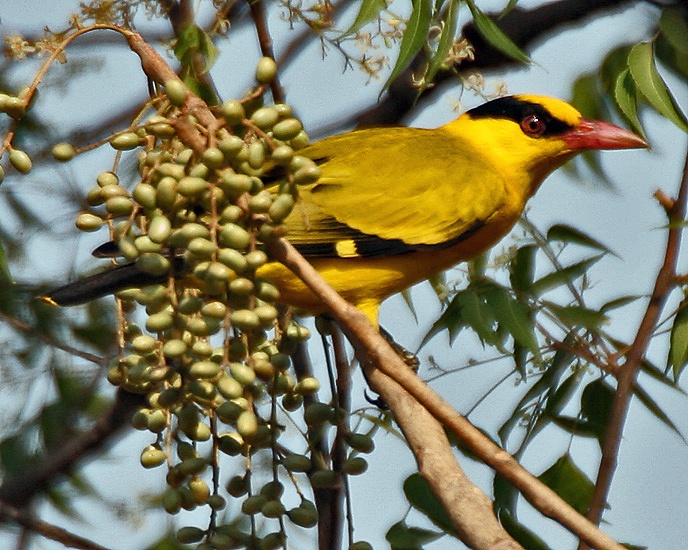
White-lored Oriole
Oriolus albiloris
Order: Passeriformes / Family: Oriolidae

Wikimedia Commons
About the White-lored Oriole
The White-lored Oriole, scientifically known as Oriolus albiloris, is a visually captivating bird that belongs to the family Oriolidae and order Passeriformes. This songbird is native to the tropical forests and woodlands of Central America, predominantly found in countries like Mexico, Guatemala, and Honduras. Characterized by its vivid yellow plumage and distinctive white lore, the White-lored Oriole plays a crucial role in its ecosystem as both a predator and a pollinator. Its bright coloration not only serves as a means of communication during mating season but also plays a part in its interactions within its habitat. As a mid-sized bird, the White-lored Oriole averages about 22 cm in length and utilizes its robust bill to forage for a diverse diet of fruits, insects, and nectar. During the breeding season, which typically occurs from April to July, this oriole becomes more active, participating in complex courtship displays. These displays involve a combination of vocalizations and aerial acrobatics aimed at attracting mates. Outside of the breeding season, the White-lored Oriole is often found in small flocks or pairs, exhibiting a relatively social nature. Its ecological role extends beyond feeding habits, as the species contributes to seed dispersal and pest control within its environment. Its presence in both primary and secondary forests makes it an important indicator of forest health. Despite facing threats such as habitat destruction and fragmentation, the White-lored Oriole continues to thrive in suitable habitats, although conservation efforts remain critical to ensure its long-term survival.
The White-lored Oriole belongs to the family Oriolidae, within the order Passeriformes. These birds typically live average 5-7 years with a maximum recorded of 10 years..
How to Identify a White-lored Oriole
The adult White-lored Oriole is a predominantly yellow bird with a strong contrast between its bright yellow body and the white lore, or area between the eye and bill. The wings and tail are black with yellow edges, providing a striking appearance when in flight. Males and females are similar in plumage, although males may appear slightly brighter. Juveniles, however, tend to have duller plumage with less distinct markings. The oriole's robust, slightly curved bill is well-suited for its varied diet, and its strong legs are adapted for perching. In flight, the White-lored Oriole exhibits a swift, direct flight pattern, often accompanied by clear vocal calls. When perched, it maintains an upright posture, frequently observed in the upper canopy. Confusion with similar species, such as the Black-vented Oriole, is possible, but the White-lored Oriole's unique white lore is a reliable distinguishing feature.
Having trouble telling birds apart? Upload a photo to our bird identification tool for an instant species match.
White-lored Oriole Habitat and Range
Preferred Habitat
The White-lored Oriole inhabits tropical and subtropical forests, often preferring the edges and clearings of lowland evergreen forests. It thrives in elevations ranging from sea level up to about 1500 meters. This oriole is adaptable, residing in both primary and secondary growth areas, including disturbed habitats such as plantations and gardens. Seasonal shifts in habitat are minimal, as the White-lored Oriole is largely sedentary, though it may move locally in response to food availability. Urban areas with sufficient tree cover can occasionally host this species, but it predominantly remains in rural and semi-urban regions where natural forest patches are accessible.
Geographic Range
The breeding range of the White-lored Oriole is primarily confined to Mexico and extends into parts of Guatemala and Honduras. This species does not undertake long-distance migrations; instead, it remains in its breeding range year-round. Population density tends to be higher in regions where forested landscapes provide ample food and nesting opportunities. The oriole's presence is less common in heavily urbanized or deforested areas, as it relies on the availability of natural habitats for survival. Local movements within its range are influenced by seasonal changes in food abundance, leading to temporary increases in visibility in certain areas.
Want to know which birds visit your area? Browse our backyard birds by location guides for region-specific species lists.
What Does the White-lored Oriole Eat?
The diet of the White-lored Oriole is diverse, primarily consisting of fruit and insects. This oriole feeds on a variety of fruits, including berries and figs, which provide essential nutrients and energy. Insects such as caterpillars, beetles, and grasshoppers form an important part of its protein intake. Additionally, the White-lored Oriole consumes nectar, contributing to pollination while foraging. Its foraging technique involves gleaning from leaves and branches, sometimes hanging upside down to reach food. Seasonal changes in diet occur as different food sources become available, with a preference for fruits during the wet season and a shift towards insects in drier periods.
White-lored Oriole Behavior and Social Structure
The White-lored Oriole is a socially inclined species, often seen in pairs or small family groups outside of the breeding season. It exhibits strong territorial behavior during the breeding period, with males defending their nesting areas through vocalizations and displays. Courtship involves complex songs and aerial maneuvers, with pairs forming monogamous bonds for the season. The species is diurnal, with peak activity occurring in the early morning and late afternoon. Its response to predators includes alarm calls and rapid flight to dense cover. Flocking behavior is more pronounced in non-breeding months, where small groups may be observed foraging together, enhancing their collective vigilance against threats.
White-lored Oriole Nesting and Reproduction
The White-lored Oriole constructs a suspended nest, typically high in the canopy, woven from plant fibers, grasses, and twigs. It prefers sites with dense foliage to provide concealment from predators. The female primarily builds the nest, although the male may assist. Clutch size ranges from 2 to 4 eggs, with an incubation period of approximately 14 days. Both parents share in feeding and caring for the chicks, which fledge about 15 days after hatching. The species usually raises one brood per year, although favorable conditions may lead to a second brood in some cases.
White-lored Oriole Sounds and Vocalizations
The primary song of the White-lored Oriole is a melodious sequence of whistles and fluty notes, often heard at dawn and dusk. These songs serve to establish territory and attract mates. Alarm calls are sharp and repetitive, alerting others to potential dangers. The oriole's calls are distinctive, yet they can sometimes be confused with the songs of other sympatric orioles. Its vocal repertoire is rich, with variations in pitch and rhythm that are used in different social contexts.
Interesting Facts About the White-lored Oriole
- 1The White-lored Oriole's white lore is a distinguishing feature, rare among orioles, making it easier to identify.
- 2This species is known for its role in pollination, as it feeds on nectar and inadvertently transfers pollen.
- 3The White-lored Oriole's song repertoire is complex, with variations used for different social interactions.
- 4Despite its bright coloration, the White-lored Oriole effectively blends with the dappled light of its forest habitat.
- 5It often associates with mixed-species flocks, enhancing its foraging efficiency and predator detection.
- 6The oriole's nest is a well-engineered structure, suspended like a hammock, providing safety from ground predators.
- 7Studies have shown that the White-lored Oriole can adapt to secondary forests, highlighting its resilience.
White-lored Oriole Conservation Status
Currently, the White-lored Oriole is not listed as threatened, with its population considered stable. However, ongoing habitat destruction poses a significant threat. Deforestation for agriculture and urban development reduces viable habitats. Conservation efforts focus on habitat preservation and restoration, particularly in regions with high biodiversity. Historical data suggest fluctuations in population linked to habitat changes, emphasizing the need for continued monitoring.
Other Oriolidae Species


Birds Similar to the White-lored Oriole
These species are often confused with the White-lored Oriole due to similar appearance or overlapping range.