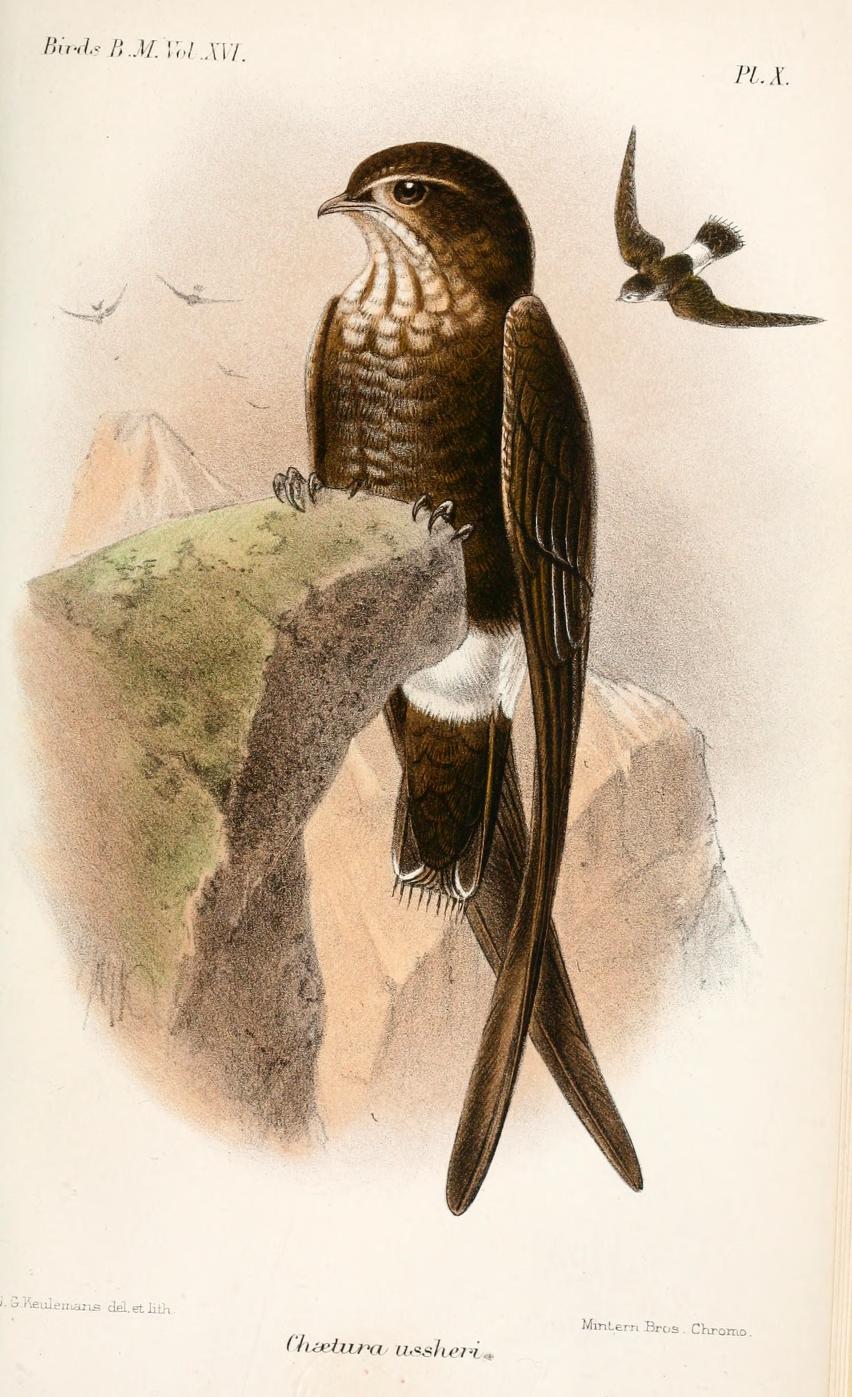
Black Spinetail
Telacanthura melanopygia
Order: Apodiformes / Family: Apodidae

Wikimedia Commons
About the Black Spinetail
The Black Spinetail (Telacanthura melanopygia) is a remarkable member of the swift family, Apodidae, known for its streamlined body, adapted perfectly for a life in the skies. This bird inhabits a variety of forested regions across central Africa, demonstrating a preference for dense tropical forests and occasionally venturing into open woodland edges. Its presence is significant as it plays a crucial role in controlling insect populations, contributing to the ecological balance within its habitat. In terms of geographical distribution, the Black Spinetail is found predominantly in countries such as Ghana, Nigeria, Cameroon, and extending into the Democratic Republic of the Congo. During the dry season, it may exhibit some local movement, following the abundance of aerial insects. These birds are not strictly migratory but may shift slightly in range to exploit seasonal food resources. As a canopy-dweller, the Black Spinetail often remains unseen, blending seamlessly with the foliage and shadows of the forest canopy. Its ecological role extends beyond pest control, as it also serves as a prey species for larger raptors, thus contributing to the trophic dynamics of its environment. The Black Spinetail is a testament to the intricate web of life within tropical ecosystems, demonstrating the interconnectedness of species and the importance of conserving such habitats.
The Black Spinetail belongs to the family Apodidae, within the order Apodiformes. These birds typically live average 5 years with a maximum recorded of 10 years..
How to Identify a Black Spinetail
The Black Spinetail is a medium-sized swift with a length ranging from 15 to 18 centimeters. Its plumage is predominantly black with a contrasting white rump patch, easily observable when the bird is in flight. Adults typically possess a forked tail, which aids in their agile aerial maneuvers. Juvenile birds appear similar to adults but may exhibit less pronounced white markings, and their tail feathers can be slightly shorter and less forked. Males and females are similar in appearance, making sex differentiation in the field challenging without close observation. The Black Spinetail can be confused with other swift species like the White-rumped Swift; however, the latter typically shows a more extensive white area on the rump and a slightly different flight pattern. In flight, the Black Spinetail displays a distinctive silhouette, characterized by long, narrow wings and a compact body, allowing it to execute rapid, acrobatic turns. When perched, which is a rare sight, these swifts cling vertically to surfaces, using their strong feet and claws to hold onto rough tree bark or cliff faces.
Having trouble telling birds apart? Upload a photo to our bird identification tool for an instant species match.
Black Spinetail Habitat and Range
Preferred Habitat
The Black Spinetail thrives in tropical and subtropical forests, particularly favoring lowland rainforests and occasionally montane forests up to 2,000 meters. It is primarily found in regions with high insect activity, which is crucial for its diet. These swifts may also occupy forest edges and clearings where insect prey is more accessible. Urban presence is rare, as they are more adapted to forest ecosystems. During the wet season, the Black Spinetail may extend its range slightly into drier areas if insect populations are sufficient to support foraging. Despite being forest-dependent, they can sometimes be seen soaring over open areas adjacent to forests during foraging flights.
Geographic Range
The Black Spinetail's range encompasses parts of West and Central Africa, with notable populations in Ghana, Nigeria, and Cameroon, extending into the Democratic Republic of the Congo. Although not migratory, these swifts may exhibit local movements driven by changes in food availability. They are more concentrated in areas where forest habitats remain intact, such as reserves and national parks. The species tends to avoid heavily degraded or deforested regions, which lack the necessary structural complexity and food resources. While their overall distribution is stable, local population densities can fluctuate based on habitat conditions and environmental pressures.
Want to know which birds visit your area? Browse our backyard birds by location guides for region-specific species lists.
What Does the Black Spinetail Eat?
The diet of the Black Spinetail primarily consists of small flying insects, such as flies, beetles, and moths. They forage on the wing, capturing prey with swift, agile maneuvers. During the wet season, when insect populations peak, these birds can be seen feeding more actively, taking advantage of the abundance. In contrast, during drier periods, they may need to roam wider areas to locate sufficient food. The size of their prey usually ranges from a few millimeters to about a centimeter, with a preference for softer-bodied insects. Feeding often occurs in loose flocks, allowing individuals to locate and exploit insect swarms more efficiently. Their daily feeding schedule aligns with insect activity, typically more intense during early morning and late afternoon.
Black Spinetail Behavior and Social Structure
Black Spinetails exhibit a highly social structure, often seen flying in small groups or loose flocks. These swifts are territorial, defending their preferred foraging areas from other flocks. During courtship, males perform dynamic aerial displays, including rapid dives and twists to attract females. Flocking patterns vary with food availability, and these birds may join mixed-species flocks during periods of high insect abundance. When threatened by predators, such as larger raptors, Black Spinetails use their speed and agility to evade capture, often performing erratic flight patterns to confuse attackers. Their daily activities revolve around foraging and aerial displays, with peak activity observed during cooler parts of the day.
Black Spinetail Nesting and Reproduction
The Black Spinetail nests in tree cavities or crevices in cliffs, utilizing natural nooks that provide shelter and protection. They build nests using materials like feathers, leaves, and small twigs, which are bound together with saliva to form a secure structure. Clutch size typically consists of two to three eggs, with both parents sharing incubation duties over a period of approximately 18 to 20 days. After hatching, young spinetails remain in the nest for about 30 days before fledging. Parental roles are shared, with both males and females involved in feeding and caring for the chicks. The species generally produces one brood per year, although in optimal conditions, a second brood is possible.
Black Spinetail Sounds and Vocalizations
The primary song of the Black Spinetail is a series of rapid, high-pitched trills and chirps, reminiscent of other swift species. These vocalizations serve as communication within flocks and during courtship displays. Call notes are sharp and piercing, often delivered in rapid succession. Alarm calls are louder and more urgent, alerting flock members to potential dangers. During dawn, their vocalizations can be heard more prominently as they engage in social interactions and prepare for the day's activities. The sound is often compared to the whistling of wind through a narrow gap, adding a unique acoustic presence to their habitats.
Interesting Facts About the Black Spinetail
- 1The Black Spinetail can reach speeds of up to 112 kilometers per hour, making it one of the fastest birds in its habitat.
- 2Despite their name, Black Spinetails are not related to true swallows but share similar aerial feeding habits.
- 3These swifts have specialized saliva that hardens into a glue-like substance, perfect for nest construction.
- 4A Black Spinetail's wings can span up to 40 centimeters, allowing for excellent maneuverability in flight.
- 5They can consume hundreds of insects daily, playing a vital role in controlling insect populations in their ecosystems.
- 6The species is known to form mixed-species flocks with other swifts and swallows, enhancing their foraging efficiency.
- 7Black Spinetails rarely perch during the day, spending most of their time on the wing unless nesting.
Black Spinetail Conservation Status
The Black Spinetail currently holds a status of Least Concern according to the IUCN Red List, with populations considered stable. The primary threats to this species include habitat destruction due to logging and agricultural expansion. Conservation efforts focus on preserving forest habitats and creating protected areas to ensure the survival of this and other forest-dependent species. Historically, the Black Spinetail has maintained stable populations, though localized declines have occurred in areas where habitat loss is most severe. Continued monitoring and habitat protection are crucial for sustaining healthy populations.
Other Apodidae Species


Birds Similar to the Black Spinetail
These species are often confused with the Black Spinetail due to similar appearance or overlapping range.