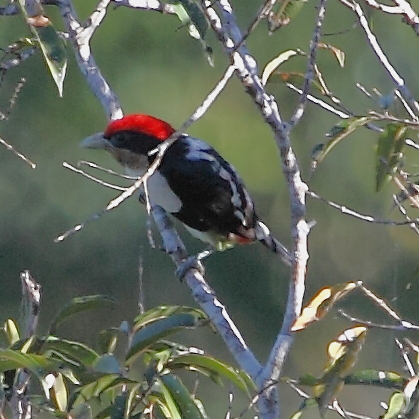
Black-spotted Barbet
Capito niger
Order: Piciformes / Family: Capitonidae

Wikimedia Commons
About the Black-spotted Barbet
The Black-spotted Barbet, known by its scientific name Capito niger, is a captivating bird belonging to the family Capitonidae. This species enchants observers with its vivid colors and intricate patterns. It is native to the tropical regions of South America, specifically thriving in the Amazon Basin, which spans countries such as Brazil, Peru, and Ecuador. The Black-spotted Barbet plays a crucial role in rainforest ecosystems as both a pollinator and seed disperser, contributing to the rich biodiversity of its habitat.
A key feature of the Black-spotted Barbet's ecology is its role in maintaining the health and diversity of tropical forests. As it feeds on fruits, the bird disperses seeds across vast areas, facilitating the regeneration of plant species. This seed dispersal is vital for the survival of many plant species, some of which rely heavily on this bird for propagation. Additionally, the Black-spotted Barbet is an essential pollinator for certain flowering plants, including some species of figs.
The bird's presence signifies a healthy ecosystem, as it relies on a variety of fruiting plants for sustenance. It also attracts ecotourists and birdwatchers, drawn to its vibrant appearance and unique behaviors. During the breeding season, typically from December to May, the Black-spotted Barbet engages in elaborate courtship displays. These displays often involve both vocalizations and physical movements, showcasing the bird's dynamic role in its environment. Its ecological interactions highlight the importance of preserving its natural habitat, as deforestation and habitat fragmentation threaten its survival.
The Black-spotted Barbet belongs to the family Capitonidae, within the order Piciformes. These birds typically live average lifespan is 7-10 years in the wild..
How to Identify a Black-spotted Barbet
Adult Black-spotted Barbets display a striking combination of colors and patterns. Their plumage features a bright yellow underside contrasted by a black crown and nape. The black spots that give the bird its name are prominently visible on its chest and upper flanks. The bird's back and wings are a vivid green, while the rump is red, providing a lush visual palette.
Juvenile Black-spotted Barbets differ from adults with their more muted coloration and less defined black spotting. These young birds lack the full vibrancy of their mature counterparts, often appearing more brownish with a less distinct pattern. Males and females of the species exhibit similar plumage, making them difficult to distinguish in the field based solely on appearance.
In flight, the Black-spotted Barbet has a distinctive silhouette, characterized by broad wings and a relatively short tail. When perched, this bird often adopts an upright posture, its robust bill held prominently forward. The Black-spotted Barbet can be confused with other barbet species, but its unique combination of yellow, black, and green, along with its eponymous spots, sets it apart.
Having trouble telling birds apart? Upload a photo to our bird identification tool for an instant species match.
Black-spotted Barbet Habitat and Range
Preferred Habitat
The Black-spotted Barbet inhabits tropical rainforests, particularly thriving in lowland and foothill forests. These birds are most commonly found at elevations ranging from sea level to 1,200 meters. They prefer dense, humid environments where fruiting trees are abundant.
During the dry season, the Black-spotted Barbet may frequent riverine forests, drawn by the availability of food resources along watercourses. While primarily a forest dweller, it occasionally ventures into secondary forests and forest edges, adapting to areas where human activities have altered the landscape.
The species exhibits a preference for undisturbed habitats, but its ability to exploit secondary growth areas suggests some resilience to habitat changes. Nevertheless, it remains less common in urban areas, where its specialized diet and habitat preferences limit its presence.
Geographic Range
The Black-spotted Barbet's range is confined to the northern and western parts of the Amazon Basin, predominantly within Brazil, Peru, and Ecuador. Its presence is also noted in southeastern Colombia and northern Bolivia, where suitable habitats are available.
This species does not undertake long migrations, as it resides year-round in its tropical forest habitats. However, it may exhibit altitudinal movements in response to food availability, occasionally shifting to higher elevations during certain seasons.
Within its range, population densities vary, with hotspots found in regions where fruiting trees are plentiful and human disturbance is minimal. Conservation of these areas is critical to maintaining healthy populations of the Black-spotted Barbet.
Want to know which birds visit your area? Browse our backyard birds by location guides for region-specific species lists.
What Does the Black-spotted Barbet Eat?
The Black-spotted Barbet primarily consumes a diet rich in fruits, relying heavily on the diverse array of fruiting trees found in its tropical forest habitat. Figs and berries form the bulk of its diet, but it also consumes small insects and arthropods, particularly during the breeding season when protein demand increases.
This barbet exhibits a unique foraging technique, often plucking fruit while hanging upside down or hopping from branch to branch in search of ripe offerings. Its strong, curved bill is well-adapted to breaking into tough-skinned fruits, and its agile movements allow it to access food in dense foliage.
Feeding occurs throughout the day, with peaks in activity typically observed during the early morning and late afternoon. Seasonal variations in fruit availability can influence the bird's diet composition, making it a key indicator of ecosystem health.
Black-spotted Barbet Behavior and Social Structure
Black-spotted Barbets exhibit a social structure characterized by monogamous pair bonds, often observed foraging and nesting cooperatively. Territorial behavior is evident during the breeding season, as pairs defend their chosen nesting sites with vigor.
Courtship displays form a significant part of the barbet's behavioral repertoire, involving synchronized movements and vocalizations. These displays serve to strengthen pair bonds and communicate readiness for breeding.
While generally solitary or found in pairs, the Black-spotted Barbet may occasionally join mixed-species foraging flocks, benefiting from the collective vigilance against predators. These flocks facilitate greater foraging efficiency and predator detection.
In response to predators, the barbet employs alarm calls to alert conspecifics of potential threats. Such calls are typically sharp and repetitive, serving as a warning to nearby individuals. Daily activity patterns revolve around foraging and social interactions, with periods of rest during the hottest parts of the day.
Black-spotted Barbet Nesting and Reproduction
The Black-spotted Barbet constructs its nest in tree cavities, often selecting sites in dead or decaying trees. This choice provides the necessary protection from predators and environmental elements. The bird excavates the cavity itself using its powerful bill, creating a snug chamber for its eggs.
Clutch size for the Black-spotted Barbet typically ranges from two to four eggs. Both parents share responsibilities in incubating the eggs, which hatch after an incubation period of approximately 14 to 17 days. The chicks are altricial, requiring significant parental care and feeding.
Fledging occurs around 30 days post-hatching, with both parents contributing to feeding and protecting the young. The species generally raises one brood per year, though favorable conditions may allow for a second. Parental roles are shared, with both male and female barbet taking turns in feeding and defending the nest.
Black-spotted Barbet Sounds and Vocalizations
The primary song of the Black-spotted Barbet is a series of melodious notes delivered in a rhythmic pattern. These notes are clear and flute-like, rising and falling in pitch to create a harmonious sequence. Call notes are often shorter, more staccato, and used in communication between mates or to alert others to potential threats.
Alarm calls are sharp and repetitive, designed to convey urgency and mobilize fellow barbets in the area. During the dawn chorus, the Black-spotted Barbet participates actively, its song contributing to the symphony of the tropical forest.
The bird's vocalizations, reminiscent of a piccolo, play a vital role in territory establishment and mate attraction. These sounds are crucial for maintaining social bonds within pairs and for the coordination of breeding activities.
Interesting Facts About the Black-spotted Barbet
- 1The Black-spotted Barbet can consume more than 100 different fruit types in its tropical habitat, showcasing its dietary flexibility.
- 2This species plays a crucial role in seed dispersal, aiding the regeneration of over 50 plant species within the rainforest.
- 3The barbet's unique ability to extract insects from tree bark helps control pest populations, benefiting forest health.
- 4The Black-spotted Barbet's song can travel distances of up to 500 meters, making it easily heard within dense forest environments.
- 5Despite its vivid colors, the Black-spotted Barbet can remain remarkably camouflaged against the lush green foliage of its forest home.
- 6The species' cavity-nesting behavior provides shelter for other organisms, including various insect species, once the barbets vacate the nest.
- 7Their strong, chisel-like bills allow them to excavate nest cavities in trees, a skill shared with few other bird species in their range.
Black-spotted Barbet Conservation Status
The Black-spotted Barbet is currently classified as Least Concern by the IUCN, with populations considered stable across its range. However, habitat destruction due to deforestation poses a significant threat to its future prospects. Conservation efforts focus on protecting the Amazon Basin's rainforests, crucial to the survival of this and many other species. Protected areas and sustainable forestry practices contribute to preserving its habitat. Historical population data indicate relative stability, though ongoing monitoring remains essential. Efforts to curb illegal logging and promote awareness of the species' ecological importance are critical to ensuring its continued survival in the wild.