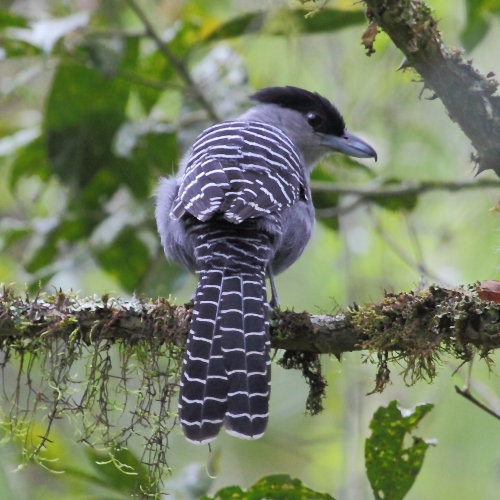
Black-spotted Bare-eye
Phlegopsis nigromaculata
Order: Passeriformes / Family: Thamnophilidae

Wikimedia Commons
About the Black-spotted Bare-eye
The Black-spotted Bare-eye, known scientifically as Phlegopsis nigromaculata, is a captivating species within the Thamnophilidae family. It primarily inhabits the Amazon Basin, a region renowned for its rich biodiversity. This bird plays a crucial role in the ecosystem as an insectivore, often following army ant swarms to catch fleeing insects. Its presence contributes significantly to maintaining the balance in the rainforest's complex food web. Found mainly in countries like Brazil, Colombia, Peru, and Ecuador, the Black-spotted Bare-eye thrives in lowland tropical forests, particularly those with dense understory vegetation. Unlike many birds, it does not migrate seasonally but remains a year-round resident of the rainforest, where it can exploit the abundant food sources. The Black-spotted Bare-eye's ecological role extends beyond its diet, as it influences the behavior of other animals within its habitat. By consuming a variety of insects, it helps control populations of potentially harmful species, thus promoting forest health. The bird's reliance on army ant swarms for feeding also illustrates a unique ecological partnership. As the ants move through the forest floor, they disturb numerous invertebrates, which the bare-eye and other ant-following birds quickly capitalize on. This relationship highlights the bird's adaptability and the intricate connections within its environment. Throughout the year, the Black-spotted Bare-eye remains largely sedentary, relying on its specialized foraging strategies to survive. Its non-migratory nature allows it to exploit the rainforest's resources efficiently, ensuring its continued presence in this vital biome. Despite being a small bird, it is a key player in the Amazon's ecological theater, showcasing the interdependence of species within this lush habitat.
The Black-spotted Bare-eye belongs to the family Thamnophilidae, within the order Passeriformes. These birds typically live average 5-7 years, with a maximum recorded of 10 years..
How to Identify a Black-spotted Bare-eye
Identifying the Black-spotted Bare-eye involves observing its unique plumage and physical characteristics. Adult birds showcase a predominantly black and brown body, with distinct black spots that give the bird its name. The bare skin around its eyes sets it apart from other antbirds, offering a striking contrast to its otherwise muted tones. Males and females appear similar, although males may show slightly more vibrant plumage. Juveniles, on the other hand, exhibit a duller coloration, lacking the pronounced black spots of adults, which they develop as they mature. In comparison to similar species, such as the Spot-backed Antbird, the Black-spotted Bare-eye's bare facial skin and specific spotting pattern serve as key differentiators. When perched, it often maintains a low profile, blending into the shadowy undergrowth of its forest home. In flight, this bird exhibits a rapid, fluttering motion, staying close to the ground, which is typical of many forest-dwelling species. Its perching posture is often upright, allowing for quick movements as it follows its primary food source, army ant swarms.
Having trouble telling birds apart? Upload a photo to our bird identification tool for an instant species match.
Black-spotted Bare-eye Habitat and Range
Preferred Habitat
The Black-spotted Bare-eye inhabits the dense, humid forests of the Amazon Basin. It thrives in lowland tropical forests, particularly areas with thick understory vegetation. This habitat preference allows the bird to remain inconspicuous while navigating the complex forest floor. Typically found at elevations below 500 meters, the Black-spotted Bare-eye is a specialist in these environments. It avoids urban areas, preferring the undisturbed wilderness of regions like the Amazon Rainforest in Brazil, Colombia, Peru, and Ecuador. Seasonal habitat changes are minimal, as the bird remains a consistent inhabitant of its chosen environment throughout the year. Its reliance on the dense forest understory provides both camouflage and access to its primary food sources.
Geographic Range
The range of the Black-spotted Bare-eye is primarily confined to the Amazon Basin. It is a resident breeder in several countries, including Brazil, Colombia, Peru, and Ecuador, where it occupies the vast expanse of lowland rainforests. Unlike many other bird species, the Black-spotted Bare-eye does not undertake long migrations, instead remaining within the forests of the Amazon throughout the year. This bird is not evenly distributed across its range; instead, it tends to be more concentrated in areas with the most dense and undisturbed forest cover. Within these regions, population densities can vary, with some areas hosting significant numbers while others may see only sporadic individuals.
Want to know which birds visit your area? Browse our backyard birds by location guides for region-specific species lists.
What Does the Black-spotted Bare-eye Eat?
The Black-spotted Bare-eye primarily feeds on insects, playing a crucial role as an insectivore in its ecosystem. It frequently follows army ant swarms, relying on the ants to flush out prey such as beetles, spiders, and other arthropods. This bird exhibits a highly specialized foraging technique, moving swiftly along the forest floor to catch insects dislodged by the advancing ants. Seasonal diet changes are minimal, as the rainforest provides a consistent supply of prey throughout the year. The size of prey typically ranges from small beetles to medium-sized spiders. Feeding usually occurs during the day when army ant swarms are most active, allowing the bird to maximize its intake.
Black-spotted Bare-eye Behavior and Social Structure
The Black-spotted Bare-eye exhibits fascinating behavioral traits that reflect its specialized lifestyle. Typically solitary or found in pairs, this bird maintains a low profile in the dense undergrowth of the Amazon rainforest. Its territory is often centered around the home ranges of army ant swarms, which it follows to capitalize on the abundance of insects disturbed by the ants. Courtship displays are subtle, involving soft calls and mutual foraging between potential mates. During the day, the Black-spotted Bare-eye is most active, aligning its foraging activities with the movement patterns of the army ants. Its response to predators includes remaining motionless or retreating into thicker vegetation. The bird's daily activities are largely dictated by the availability of food, leading it to move frequently in search of the next ant swarm.
Black-spotted Bare-eye Nesting and Reproduction
Nesting for the Black-spotted Bare-eye involves constructing a well-hidden structure in the dense understory of the rainforest. Nests are typically cup-shaped and consist of woven plant materials, leaves, and spider silk, providing camouflage and stability. Located low to the ground, often in dense thickets or near tree roots, these nests offer protection from predators. The typical clutch size ranges from two to three eggs, which both parents incubate. The incubation period lasts about two weeks, with both male and female sharing responsibilities. After hatching, the fledging period extends for another two weeks, during which the parents are highly attentive, feeding the chicks a steady diet of insects. Generally, the Black-spotted Bare-eye produces one brood per year, timed to coincide with peak insect availability in the rainforest.
Black-spotted Bare-eye Sounds and Vocalizations
The Black-spotted Bare-eye is not particularly vocal, but its primary song consists of a series of short, sharp notes delivered in quick succession. The rhythm is steady, and the pitch is moderately high, with a slightly nasal quality. These calls are often used for communication between mates or to signal territory presence. Alarm calls are more frantic, featuring a rapid, chattering sequence that alerts other birds to potential threats. Although not a prominent participant in the dawn chorus, the Black-spotted Bare-eye does contribute its calls during the early morning hours when foraging begins. The sound is distinct yet subtle, blending into the ambient noise of the rainforest.
Interesting Facts About the Black-spotted Bare-eye
- 1Black-spotted Bare-eyes are part of a unique group of birds known as ant-followers, relying on army ants to flush out prey.
- 2Unlike many birds, the Black-spotted Bare-eye remains within the rainforest year-round, taking advantage of the constant food supply.
- 3The bird’s bare skin around its eyes is a distinct feature, helping differentiate it from other similar antbirds.
- 4A Black-spotted Bare-eye’s territory is often centered around the movement patterns of army ant swarms.
- 5These birds use spider silk to help construct their nests, providing strength and elasticity to the structure.
- 6The species plays a crucial ecological role by helping control insect populations within its rainforest habitat.
- 7Despite its reliance on insects, the Black-spotted Bare-eye can adapt its foraging strategy based on the availability of army ant swarms.
Black-spotted Bare-eye Conservation Status
The Black-spotted Bare-eye currently holds a status of Least Concern according to the IUCN Red List. However, its population is suspected to be decreasing, primarily due to habitat loss from deforestation in the Amazon Basin. The bird's dependence on primary forest habitats makes it vulnerable to logging and land conversion. Conservation efforts focus on preserving large tracts of undisturbed forest, which are crucial for maintaining viable populations. Historical data suggest a stable population in protected areas, but ongoing deforestation poses a significant threat. Additional measures, including expanded protected areas and sustainable forestry practices, are vital to ensure the species' long-term survival.