
Blue-backed Parrot
Tanygnathus everetti
Order: Psittaciformes / Family: Psittacidae
Wikimedia Commons
About the Blue-backed Parrot
The Blue-backed Parrot, scientifically known as Tanygnathus everetti, is a medium-sized parrot endemic to the Philippines. It holds a significant place within the bird communities of these islands. This species primarily inhabits lowland forests but can also be found in secondary forests and sometimes in plantations. The Blue-backed Parrot plays a crucial ecological role, contributing to seed dispersal through its feeding habits. Throughout the year, these parrots show some seasonal behaviors, often forming larger flocks during the non-breeding season. This social structure helps them locate food sources and evade predators more effectively.
This parrot's range is limited to the Philippines, with notable populations on islands such as Mindanao and Mindoro. Its presence across these islands highlights its adaptability to different forest types, although it shows a preference for areas with dense foliage. The Blue-backed Parrot is not just a strikingly beautiful bird but also a key species in maintaining the health of its forested environment. By aiding in seed dispersal, it helps regenerate forest areas that might otherwise struggle to recover after natural disturbances like typhoons.
Ecologically, the Blue-backed Parrot serves as both a seed disperser and a part of the prey base for larger predators. Its interactions within the ecosystem help maintain the balance of the forest habitat. Despite its vibrant appearance, the Blue-backed Parrot can be surprisingly elusive, often heard more than seen due to its ability to blend into the canopy. As a result of habitat loss and other environmental pressures, conservation efforts are crucial to ensuring the ongoing survival of this captivating species.
The Blue-backed Parrot belongs to the family Psittacidae, within the order Psittaciformes. These birds typically live average 10-15 years in the wild, up to 20 years in captivity..
How to Identify a Blue-backed Parrot
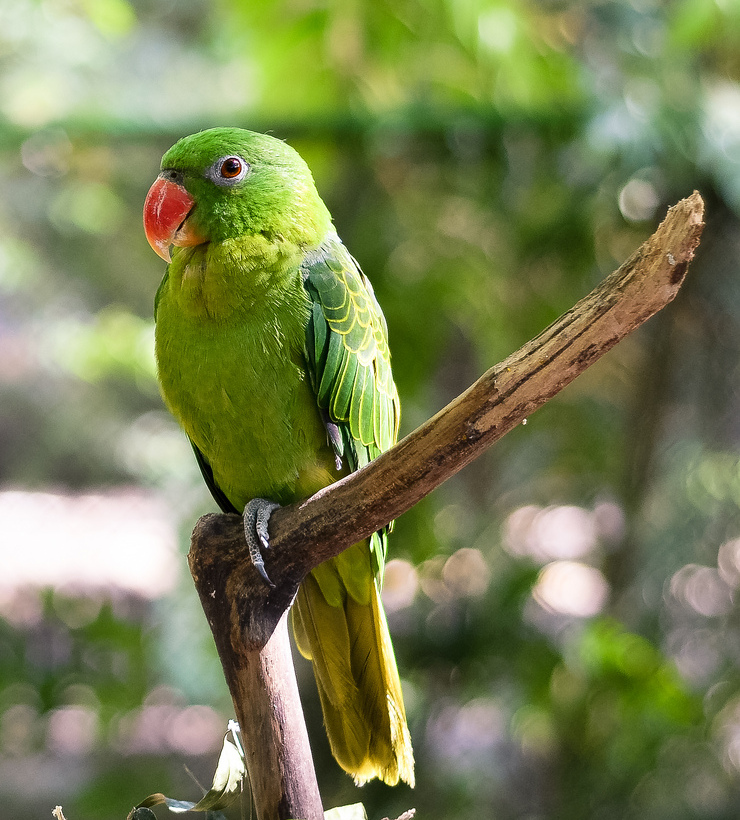
The Blue-backed Parrot is easily identifiable by its vivid blue plumage on the back and wings, contrasting with a predominantly green body. Adults display a blue crown and nape, with subtle differences between the sexes, such as a slightly brighter blue in males. Juveniles resemble adults but have duller coloration, with less pronounced blue hues. The parrot's bill is robust and pale, typically whitish, providing a stark contrast to its colorful feathers.
In flight, the Blue-backed Parrot exhibits a distinctive silhouette, with broad wings and a short tail. Its flight pattern is characterized by rapid wingbeats, followed by brief glides, which can make it difficult to spot against the forest canopy. When perched, the parrot maintains a slightly hunched posture, often blending into the surrounding foliage despite its vibrant coloration.
The Blue-backed Parrot can sometimes be confused with other parrot species in the region, such as the Blue-naped Parrot. However, its more extensive blue coverage and shorter tail help distinguish it from similar species. Observers should note its unique call, which can aid in identification even when the bird is not visible.
Having trouble telling birds apart? Upload a photo to our bird identification tool for an instant species match.
Blue-backed Parrot Habitat and Range
Preferred Habitat
The Blue-backed Parrot predominantly inhabits lowland tropical forests, thriving in both primary and secondary growth. It is often found at elevations up to 1000 meters, where it favors dense canopies for foraging and roosting. While it primarily resides in forested areas, it can occasionally be observed in plantations or cultivated lands, particularly where fruit trees are present.
Seasonally, these parrots may shift their habitat preferences slightly, moving towards areas that provide abundant food resources. While not typically urban-dwelling, the Blue-backed Parrot can sometimes be spotted on the outskirts of rural communities, especially in regions where forest edges meet agricultural lands.
The parrot's reliance on forested environments makes it sensitive to deforestation and habitat destruction, highlighting the importance of preserving these ecosystems for its continued survival.
Geographic Range
The Blue-backed Parrot is endemic to the Philippines, with its distribution primarily concentrated on several key islands. Notably, it inhabits Mindanao, Mindoro, and a few smaller islands in the region. Within these islands, it occupies suitable forested habitats, making it a relatively localized species rather than broadly distributed across the archipelago.
During the breeding season, the parrot's range remains consistent, as it does not undertake long migratory journeys. However, some local movements may occur in response to food availability, leading to temporary range expansions or contractions within its home islands.
Population density tends to be higher in areas with intact forest cover, where food resources are plentiful. On islands where deforestation has been more extensive, the Blue-backed Parrot faces greater challenges, and its populations are often more fragmented.
Want to know which birds visit your area? Browse our backyard birds by location guides for region-specific species lists.
What Does the Blue-backed Parrot Eat?
The diet of the Blue-backed Parrot mainly consists of fruits, seeds, and nuts, making it an important seed disperser within its habitat. Primary food sources include figs and other native fruiting trees, which provide both sustenance and crucial nutrients.
Seasonal changes in food availability can lead to slight dietary shifts. During periods when fruit is less abundant, the parrot may supplement its diet with flowers and nectar. The Blue-backed Parrot employs a foraging technique that involves using its powerful bill to manipulate and crack open tough shells, allowing it access to seeds and nuts that might be inaccessible to other species.
Typically, these parrots feed in the early morning and late afternoon, taking advantage of the cooler parts of the day. They often forage in small groups, which can increase the efficiency of locating food while also providing some protection against predators.
Blue-backed Parrot Behavior and Social Structure
The Blue-backed Parrot exhibits a complex social structure, often seen in small groups or pairs, particularly during the breeding season. Outside of this period, larger flocks may form as birds gather in areas with abundant food resources. These flocks can be noisy, with several individuals calling to one another as they move through the forest canopy.
Territorial behavior is most pronounced during the breeding season, with pairs defending their chosen nesting sites against intruders. Courtship displays involve vocalizations and mutual preening, strengthening pair bonds. The Blue-backed Parrot tends to be more active during the cooler parts of the day, engaging in feeding and social interactions during the morning and late afternoon.
In response to predators, the parrot relies on its ability to blend into the canopy and its agile flight to evade capture. Alarm calls are used to alert other members of the group to potential threats, with birds often taking to the air in response to disturbances.
Blue-backed Parrot Nesting and Reproduction
The Blue-backed Parrot nests in tree cavities, typically selecting sites high in the canopy to avoid ground predators. These cavities are often natural hollows, though the parrot may occasionally modify them to suit its needs. Nest materials are minimal, as the cavity provides the primary structure.
The typical clutch size ranges from two to four eggs, with the female primarily responsible for incubation over approximately 24-26 days. During this period, the male provides food for the female and later for the chicks. Once hatched, the young remain in the nest for about 8-10 weeks before fledging.
Parental care continues even after fledging, with both parents involved in feeding and protecting the young until they are independent. The Blue-backed Parrot typically raises one brood per year, although in favorable conditions, a second brood may be attempted.
Blue-backed Parrot Sounds and Vocalizations
The Blue-backed Parrot's primary song consists of a series of harsh, repeated squawks, typically delivered from a prominent perch. These vocalizations, while not melodious, are distinctive and carry well across the forest landscape.
Call notes include sharp, clipped sounds used in social interactions and to maintain contact with flock members. Alarm calls are more urgent and can incite a flurry of activity among nearby birds.
During the dawn chorus, the Blue-backed Parrot's calls contribute to the cacophony of sounds as birds announce their presence and stake out territories. Its calls are often compared to those of other large parrots, though with a slightly harsher quality.
Interesting Facts About the Blue-backed Parrot
- 1The Blue-backed Parrot is named for Alfred Everett, a British naturalist who collected specimens in the Philippines in the 19th century.
- 2Despite its bright colors, the Blue-backed Parrot's plumage provides effective camouflage in the dense forest canopy.
- 3This parrot's strong bill allows it to crack open even the toughest seeds and nuts, a skill essential for its diet.
- 4The species is monogamous, with pairs often remaining together for life, strengthening their bond through mutual preening.
- 5Blue-backed Parrots are known for their loud, raucous calls, which can be heard echoing through the forest.
- 6These parrots are not migratory, but they may move locally within islands to find food, particularly during fruiting seasons.
- 7In Philippine folklore, parrots like the Blue-backed Parrot are often associated with wisdom and are featured in traditional stories.
Blue-backed Parrot Conservation Status
The Blue-backed Parrot is currently listed as Near Threatened by the IUCN, with its population trend decreasing. Primary threats include habitat loss due to deforestation and the illegal pet trade, which targets this attractive species. Conservation efforts focus on habitat preservation and legal protection to reduce poaching. There is an ongoing need for more comprehensive surveys to better understand population dynamics and inform conservation strategies. Historically, the population of the Blue-backed Parrot has faced fluctuations due to human activities, making conservation efforts vital to its future survival.
Other Psittacidae Species


Birds Similar to the Blue-backed Parrot
These species are often confused with the Blue-backed Parrot due to similar appearance or overlapping range.

