Blue-lored Antbird
Hafferia immaculata
Order: Passeriformes / Family: Thamnophilidae

Wikimedia Commons
About the Blue-lored Antbird
The Blue-lored Antbird (Hafferia immaculata) thrives in the dense understory of tropical forests, primarily found in the Andean foothills of Colombia and Ecuador. This bird plays a crucial role in the ecosystem by controlling insect populations, particularly ants, which it follows during foraging. Unlike many tropical birds, it displays a relatively sedentary lifestyle, often remaining within a small range throughout the year. The Blue-lored Antbird is particularly significant for its niche adaptation to ant swarms, making it an integral part of the ecological balance. As an antbird, it exhibits specialized behaviors and feeding strategies that contribute to the health of its habitat. Seasonal changes have a minimal impact on the Blue-lored Antbird's behavior, as it does not engage in long-distance migrations. Instead, it adjusts its foraging strategies to the availability of prey within its home range. This species is an essential component of the forest ecosystem, aiding in the control of insect populations and serving as prey for larger avian predators. Its presence is a reliable indicator of healthy forest environments. The Blue-lored Antbird also participates in mixed-species foraging flocks, which enhances its foraging efficiency. During the breeding season, which varies slightly depending on the geographical location, the bird becomes more vocal, using its distinctive calls to establish and defend its territory. This antbird contributes to the rich biodiversity of its habitats by maintaining insect population dynamics, providing a vital service to the forest ecosystem.
The Blue-lored Antbird belongs to the family Thamnophilidae, within the order Passeriformes. These birds typically live typically 4-6 years, with some individuals living up to 8 years..
How to Identify a Blue-lored Antbird
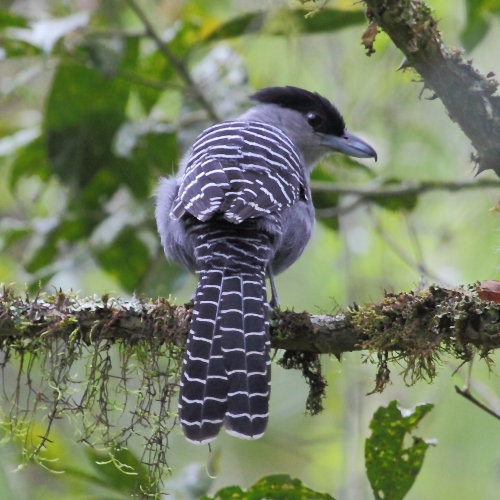
The Blue-lored Antbird is a medium-sized bird, measuring approximately 14 to 15 cm in length. Adults exhibit a striking plumage with a primarily black body, accentuated by a vivid blue lore, which is the area between the eye and the bill. This feature serves as a key identification mark. The bird's wings and tail are a darker shade of black, providing contrast with the blue lore. Juvenile Blue-lored Antbirds resemble adults but with slightly duller plumage, lacking the full vibrancy of the blue lore. Males and females appear similar, with slight variations in the intensity of the blue coloration, males typically showcasing a more prominent blue. Confusion may arise with the closely related Black-faced Antbird, but the Blue-lored's distinctive lore coloration aids in differentiation. In-flight, the Blue-lored Antbird exhibits a rapid, fluttering wingbeat, characteristic of the Thamnophilidae family. When perching, it often adopts a horizontal posture, maintaining a low profile within dense vegetation. Observing the bird in its natural habitat requires patience, as it frequently remains hidden in the understory.
Having trouble telling birds apart? Upload a photo to our bird identification tool for an instant species match.
Blue-lored Antbird Habitat and Range
Preferred Habitat
The Blue-lored Antbird inhabits lowland and foothill tropical forests, thriving at elevations ranging from 100 to 1,500 meters. It favors dense understory vegetation, often near water sources or in areas with abundant leaf litter. Its habitat includes primary and secondary forests, where it finds ample cover and feeding opportunities. Unlike many other antbirds, it shows little preference for open areas, instead favoring the dense, tangled foliage that provides protection and supports its insectivorous diet. Seasonal shifts in habitat are minimal, given its reliance on consistent forest environments. While urban presence is uncommon, it may occasionally venture into degraded habitats near forest edges.
Geographic Range
The Blue-lored Antbird's range is confined to the tropical regions of South America, with its primary distribution in the western slopes of the Andes in Colombia and the northwestern regions of Ecuador. It occupies a relatively narrow altitudinal and geographical range, reflecting its specialized habitat requirements. The bird is non-migratory, remaining within its established range throughout the year. Its population densities are highest in areas of undisturbed forest, where it can effectively forage and breed. While not widespread across the continent, it can be locally abundant in suitable habitats.
Want to know which birds visit your area? Browse our backyard birds by location guides for region-specific species lists.
What Does the Blue-lored Antbird Eat?
Primarily insectivorous, the Blue-lored Antbird's diet consists predominantly of ants, beetles, and other arthropods. It employs a foraging strategy known as 'ant-following,' where it trails swarms of army ants that flush out prey from the forest floor. This symbiotic relationship allows the antbird to capture insects that attempt to escape the advancing swarm. The bird exhibits remarkable agility, picking off prey with swift, precise movements. Seasonal diet changes are minimal, although availability of certain prey species may influence foraging patterns. The Blue-lored Antbird tends to feed during the cooler morning and late afternoon hours, avoiding the midday heat.
Blue-lored Antbird Behavior and Social Structure
The Blue-lored Antbird exhibits a solitary or paired lifestyle, often seen in monogamous pairs. Territorial behavior is pronounced, especially during the breeding season, when males sing to establish and defend their territory. Its courtship displays involve vocalizations and subtle movements to attract females. The species rarely forms large flocks, although it may join mixed-species foraging groups to increase foraging success. Its response to predators includes remaining motionless or retreating into dense vegetation. Daily activity peaks in the morning and late afternoon, coinciding with optimal foraging conditions.
Blue-lored Antbird Nesting and Reproduction
The Blue-lored Antbird constructs cup-shaped nests using twigs, leaves, and fibers. Nests are typically located low in shrubs or small trees, often concealed within dense foliage. The clutch size generally consists of two to three eggs, which are white with speckled markings. Both parents participate in incubation, lasting approximately 14-16 days. After hatching, both parents continue to feed and care for the chicks until they fledge, usually within 10-12 days. The species may produce one to two broods per year, depending on environmental conditions.
Blue-lored Antbird Sounds and Vocalizations
The primary song of the Blue-lored Antbird is a series of clear, resonant whistles, each phrase lasting about two seconds. Its call notes are sharp and metallic, serving as contact calls between pairs. Alarm calls are harsh and rapid, alerting conspecifics to potential threats. The bird participates actively in the dawn chorus, its whistles blending with the symphony of forest sounds. Its vocalizations are distinctive, aiding in identification even when the bird remains hidden.
Interesting Facts About the Blue-lored Antbird
- 1The Blue-lored Antbird is named for its vibrant blue lore, a unique feature among antbirds.
- 2It primarily feeds by following army ant swarms, capturing insects that attempt to escape.
- 3Despite its striking appearance, the Blue-lored Antbird is more often heard than seen in dense forests.
- 4It plays a key role in its ecosystem by regulating insect populations, particularly ants.
- 5The species is non-migratory, remaining in its preferred habitat throughout the year.
- 6Both male and female Blue-lored Antbirds participate equally in raising their young.
- 7Its dawn chorus is a distinctive part of the soundscape in Andean tropical forests.
Blue-lored Antbird Conservation Status
Currently classified as Least Concern by the IUCN, the Blue-lored Antbird faces challenges primarily from habitat destruction due to deforestation. While its populations are stable in protected areas, ongoing habitat loss poses a significant threat. Conservation efforts focus on preserving its forest habitats and maintaining ecological integrity. Historical population trends have remained relatively stable, yet vigilance is necessary to ensure continued survival. Conservationists emphasize the importance of maintaining large, contiguous forest tracts to support its specialized lifestyle.