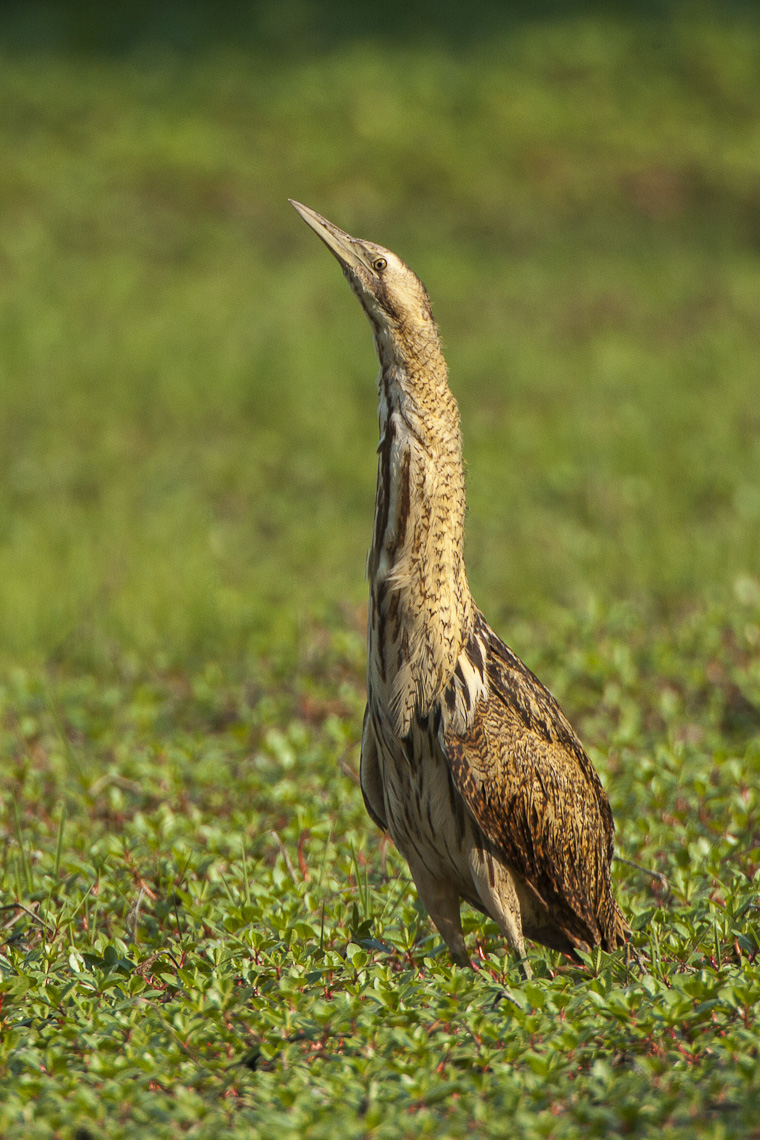
American Bittern
Botaurus lentiginosus
Order: Pelecaniformes / Family: Ardeidae

Wikimedia Commons
About the American Bittern
The American Bittern, scientifically known as Botaurus lentiginosus, is a medium-sized heron that thrives in North America's freshwater wetlands. With a mastery of camouflage, it blends seamlessly into the marshy vegetation, making it a challenge to spot. These birds are especially significant in the ecosystems they inhabit, serving as both predator and prey in the delicate wetland food web. Found predominantly in the northern United States and southern Canada, the American Bittern plays a crucial role in controlling populations of amphibians and insects. The species often remains hidden in dense reeds and cattails, where it can spot its prey while remaining concealed from predators. During the breeding season, which occurs between April and July, this solitary bird becomes more vocal, emitting a distinctive booming call that echoes across marshlands. This sound, reminiscent of a water pump, is a primary tool for males to establish territory and attract mates. As seasons change, the American Bittern migrates to more temperate wetlands in the southern United States and Central America, exhibiting remarkable adaptability in its search for suitable habitats. This seasonal movement underscores the bird's ecological significance, as it connects disparate wetland ecosystems across the continent. In its wintering grounds, the American Bittern continues its role as an apex wetland predator, maintaining the balance of its environment. Despite its elusive nature, conservationists hold the American Bittern in high regard as an indicator species. Its presence or absence in a wetland can signify the health of the ecosystem. The bird's reliance on well-preserved wetland habitats highlights the importance of conserving these areas, which are under threat from development and climate change. Through its life cycle, the American Bittern exemplifies the interconnectedness of species and habitats, reminding us of the intricate balance that governs natural ecosystems.
The American Bittern belongs to the family Ardeidae, within the order Pelecaniformes. These birds typically live average 8 years with a max recorded of 11 years.
How to Identify a American Bittern
The American Bittern is a brown and buff-colored bird with a stout body and a long neck. Its plumage features a complex pattern of brown, buff, and black streaks, providing excellent camouflage among reeds. Adult American Bitterns typically measure between 58 and 85 centimeters in length with a wingspan of 90 to 115 centimeters. Males and females appear similar in plumage, though females are slightly smaller. Juveniles resemble adults but may show lighter streaking on the underside. In flight, the American Bittern's broad, rounded wings and a deliberate, slow wingbeat silhouette are unmistakable. On the ground, its upright posture with a thick neck often extended skyward enhances its reed-like appearance, a behavior used to avoid detection. When startled, the bird freezes with its bill pointed upward, further blending into its surroundings. This cryptic strategy makes it challenging to distinguish the American Bittern from similar species like the Least Bittern. However, the American Bittern is larger and lacks the more pronounced chestnut tones of the latter. Observing the bird in flight or during its distinctive vocalizations can aid in positive identification.
Having trouble telling birds apart? Upload a photo to our bird identification tool for an instant species match.
American Bittern Habitat and Range
Preferred Habitat
American Bitterns primarily inhabit freshwater marshes and wetlands with dense emergent vegetation such as cattails and bulrushes. These habitats provide both coverage and ample feeding opportunities. While they prefer large, undisturbed marshes, they can also be found in smaller, fragmented wetlands, provided there is sufficient cover. During the breeding season, they occupy marshes across the northern United States and southern Canada. In winter, they migrate to more temperate wetlands, occupying southern states like Florida, Texas, and parts of Central America. Although they are predominantly rural birds, they may occasionally be found in urban wetland parks if the conditions are suitable. Their presence at elevations up to 2,000 meters indicates some adaptability to varied environments. However, they are rarely found in coastal or saltwater environments, favoring freshwater habitats instead.
Geographic Range
The breeding range of the American Bittern extends from the northern United States into southern Canada, particularly in areas like the Great Plains, Great Lakes, and the northeastern United States. During winter, the bittern migrates to the southern United States, including states such as Louisiana, Texas, and Florida, as well as parts of Central America. Migration corridors often follow major river systems and valleys that provide suitable stopover habitats. The American Bittern is uncommon in densely populated areas, preferring remote wetlands where human disturbance is minimal. Population densities are generally higher in regions with extensive wetland systems, such as the Prairie Pothole Region of the northern Midwest. While the bird is widespread, its presence is often patchy, depending on the availability of appropriate habitats.
Want to know which birds visit your area? Browse our backyard birds by location guides for region-specific species lists.
What Does the American Bittern Eat?
The American Bittern primarily feeds on small fish, amphibians, insects, and crustaceans, making full use of its wetland environment. Fish and frogs form the bulk of its diet, with prey sizes generally ranging from five to fifteen centimeters. During the breeding season, the bird's diet shifts slightly to include more insects and invertebrates, capitalizing on their increased availability. As a patient hunter, the American Bittern employs a 'stand and wait' tactic, remaining motionless until unsuspecting prey ventures within striking distance. It then uses its sharp bill to deliver a quick jab, a technique efficient in capturing slippery fish and amphibians. Feeding typically occurs during dawn and dusk, periods when prey is most active. In winter, when aquatic prey becomes less abundant, the American Bittern may adapt by including more terrestrial insects in its diet.
American Bittern Behavior and Social Structure
The American Bittern is largely solitary, with each bird occupying its own territory during the breeding season. Males establish and defend territories through vocalizations and displays, creating a buffer zone that can range from three to six hectares. Courtship involves the male performing a ritualized display, raising its feathers and producing a series of booming calls to attract a mate. While generally solitary, American Bitterns may be seen in loose groups during migration or in wintering grounds, though they do not form cohesive flocks. When threatened by predators, such as raccoons or large birds of prey, the bittern relies on its camouflage and stealth, often remaining motionless with its neck extended upward, mimicking surrounding vegetation. Routine activities include foraging during early morning and late afternoon while resting in concealed spots during the hottest parts of the day.
American Bittern Nesting and Reproduction
American Bitterns build their nests in dense vegetation, typically over shallow water to protect from ground predators. The nest, a platform of reeds and grasses, is constructed by the female, who selects sites with ample cover and proximity to feeding areas. Clutch size usually ranges from three to five eggs, with each egg measuring around 4.5 centimeters in length. The female incubates the eggs for about 24 to 28 days, rarely leaving the nest to feed. Once hatched, the chicks are attended to by the female, while the male defends the territory. The young fledge approximately 30 to 35 days after hatching, though they typically remain near the nest site until they are fully independent. American Bitterns usually raise one brood per year, although they may attempt a second if the first is unsuccessful.
American Bittern Sounds and Vocalizations
The American Bittern's most characteristic sound is its booming call, often described as 'pump-er-lunk,' which carries well over water and is used primarily by males during the breeding season. The call is low-pitched and resonant, created through a combination of air sacs and vocal cords. Besides the booming call, American Bitterns also produce shorter calls and grunts, often heard during interactions between individuals or as alarm signals. Unlike songbirds, their vocal repertoire is limited, focusing more on brief calls than elaborate songs. The booming call, audible at dawn and dusk, serves as an essential tool for territory establishment and mate attraction.
Interesting Facts About the American Bittern
- 1The American Bittern's call resembles the sound of a water pump, earning it the nickname 'thunder-pumper.'
- 2Despite its elusive nature, the American Bittern can be surprisingly bold, allowing close approach if it believes it's well-camouflaged.
- 3The bittern's camouflage is so effective that it can remain unseen even at close range, blending perfectly with cattails.
- 4American Bitterns can 'freeze' with their bills pointed upward, mimicking reeds and becoming nearly invisible to predators.
- 5Their eyes are positioned to provide excellent binocular vision, crucial for judging distances while hunting.
- 6Unlike many birds, the American Bittern's vocalizations are produced with the aid of a modified esophagus, enhancing resonance.
- 7In some regions, the American Bittern is considered a barometer of wetland health due to its sensitivity to habitat changes.
American Bittern Conservation Status
The American Bittern is currently listed as Least Concern by the IUCN, though its population trends are a cause for some concern due to habitat loss. Wetland drainage and conversion for agriculture and development pose the most significant threats to its habitats. Conservation efforts focus on wetland preservation and restoration, ensuring the availability of suitable breeding and wintering grounds. Historically, populations have fluctuated with wetland availability, but recent initiatives have stabilized numbers in some regions. Monitoring programs continue to track population changes, providing data essential for adaptive conservation strategies.
Other Ardeidae Species


Birds Similar to the American Bittern
These species are often confused with the American Bittern due to similar appearance or overlapping range.