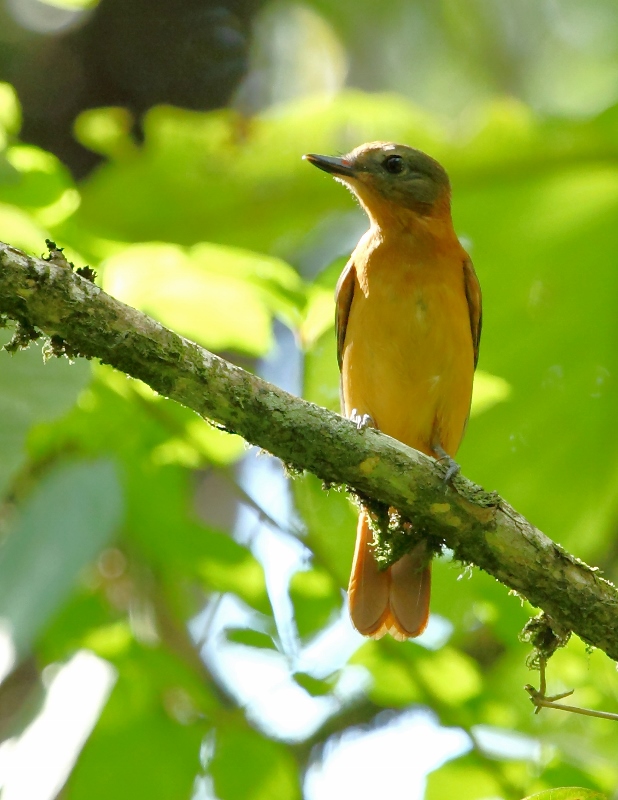
Bright-rumped Attila
Attila spadiceus
Order: Passeriformes / Family: Tyrannidae

Wikimedia Commons
About the Bright-rumped Attila
The Bright-rumped Attila (Attila spadiceus) is a medium-sized bird belonging to the Tyrannidae family, known for its vibrant yellow rump which provides a stark contrast against its otherwise brown and olive plumage. This bird inhabits a wide range of tropical and subtropical regions, primarily across Central and South America. It is frequently found in countries such as Mexico, Costa Rica, and Brazil, thriving in dense forests and woodland edges. Its preference for lush habitats underlines its role as a vital component of tropical ecosystems, contributing to seed dispersal and insect population control.
This bird plays a significant role in its ecological niche. As a part of the diverse avian community in the neotropical forests, the Bright-rumped Attila occupies a mid-level trophic position, preying on a variety of insects and small invertebrates, thus helping maintain ecological balance. During the breeding season, which typically spans from March to June, this species becomes more vocal and territorial, asserting its presence through its distinct calls. The Bright-rumped Attila's adaptability to various forest types, from lowland rainforests to montane cloud forests, highlights its ecological versatility.
Seasonally, the Bright-rumped Attila displays some behavioral changes. While generally non-migratory, individuals may exhibit altitudinal movements in response to climatic variations or food availability. During the wet season, when insect populations burgeon, the Attila's feeding activities intensify, allowing it to exploit the abundance of prey. Conversely, in the dry season, the bird may rely more on fruits, thus aiding in seed dispersal across its habitat. This seasonal dietary shift underscores its adaptability and resilience in fluctuating environmental conditions.
The Bright-rumped Attila belongs to the family Tyrannidae, within the order Passeriformes. These birds typically live average 5 years, with a maximum recorded of 8 years..
How to Identify a Bright-rumped Attila
The Bright-rumped Attila is a robust bird, measuring approximately 18 to 20 cm in length. Its most distinctive feature is the bright yellow rump, which stands out against the bird's primarily olive-brown upperparts and rufous underparts. The wings and tail are darker, edged with faint rufous tones that enhance its overall striking appearance. Its head is adorned with a subtle yet noticeable olive crown, and the face is marked by a pale eye-ring that contrasts with its dark, expressive eyes.
In terms of sexual dimorphism, males and females appear similar, making visual sex differentiation challenging. Juveniles resemble adults but may have duller plumage with less pronounced yellow rumps. When perched, the Bright-rumped Attila often adopts an upright posture, showcasing its characteristic color pattern to full effect. In flight, its rounded wings and moderately long tail contribute to a flight silhouette that is typical of the Tyrannidae family, facilitating identification even at a distance.
The Bright-rumped Attila may be confused with similar species such as the Rufous Mourner (Rhytipterna holerythra) due to overlapping ranges and similar sizes. However, the yellow rump of the Attila is a key distinguishing feature, as the Rufous Mourner lacks this coloration. Careful observation of the rump and attention to vocalizations can help prevent misidentification during field observations.
Having trouble telling birds apart? Upload a photo to our bird identification tool for an instant species match.
Bright-rumped Attila Habitat and Range
Preferred Habitat
The Bright-rumped Attila predominantly inhabits tropical and subtropical forests, favoring dense undergrowth and forest edges. It is commonly found at elevations ranging from sea level up to 1,500 meters, although it can occasionally be observed at higher altitudes in montane cloud forests. This species thrives in a variety of forest types, including lowland rainforests, secondary forests, and even plantations with ample tree cover.
Unlike some other members of the Tyrannidae family, the Bright-rumped Attila tends to avoid open areas, preferring the cover and resources provided by thick vegetation. It demonstrates some adaptability to urban environments when nearby natural habitats are present, though it remains more common in rural and forested regions. Seasonal habitat shifts are primarily driven by food availability rather than migration, with the bird adjusting its range within the forest to optimize access to resources.
Geographic Range
The Bright-rumped Attila's range extends across a significant portion of Central and South America. It is a resident breeder from southern Mexico through Central America, including countries such as Belize, Guatemala, and Honduras. In South America, its range continues through Colombia, Venezuela, and into the Amazon Basin, reaching as far south as Bolivia and Paraguay.
While the Bright-rumped Attila is primarily sedentary, some evidence suggests minor altitudinal movements in response to seasonal food availability. These movements are generally limited to shifts within its established range rather than long-distance migrations. Population density is highest in regions with extensive forest cover, particularly in the Amazonian lowlands and Central American rainforests, where it benefits from abundant insect prey and favorable breeding conditions.
Want to know which birds visit your area? Browse our backyard birds by location guides for region-specific species lists.
What Does the Bright-rumped Attila Eat?
The Bright-rumped Attila is an opportunistic forager, with a diet primarily composed of insects and other small invertebrates. Its feeding behavior is characterized by sallying from a perch to catch prey mid-air or snatching insects from foliage. Common prey items include beetles, caterpillars, and spiders, which it skillfully captures using its broad, hooked bill.
Seasonal changes influence its diet, with the bird consuming a higher proportion of fruits during periods when insect abundance declines. This dietary flexibility aids in sustaining its energy needs year-round and plays a role in seed dispersal, particularly in fruit-rich habitats. The Bright-rumped Attila's feeding activity peaks during the early morning and late afternoon, aligning with the periods when insect activity is highest, ensuring efficient energy acquisition.
Bright-rumped Attila Behavior and Social Structure
The Bright-rumped Attila exhibits solitary and territorial behavior, particularly during the breeding season. Males vigorously defend their territories through vocalizations and physical displays, ensuring access to resources and attracting potential mates. Courtship involves a combination of song displays and aerial maneuvers, with males showcasing their agility and plumage to entice females.
This species generally avoids forming large flocks, although it may join mixed-species foraging groups outside the breeding season. Such associations enable it to exploit a wider range of food resources while benefiting from the collective vigilance against predators. The Bright-rumped Attila maintains a diurnal activity pattern, with peak activities occurring during the cooler parts of the day. In the presence of predators, it employs alarm calls to alert nearby birds, sometimes engaging in mobbing behavior to deter threats.
Bright-rumped Attila Nesting and Reproduction
The Bright-rumped Attila constructs a cup-shaped nest using a variety of plant materials such as twigs, leaves, and grasses. These nests are typically situated in the forks of small trees or shrubs, well-concealed within dense foliage to protect against predators. Nesting sites are usually located at heights ranging from 1.5 to 5 meters above the ground, providing security and accessibility.
The typical clutch size consists of two to three eggs, which both parents incubate for approximately 14 to 16 days. After hatching, the chicks remain in the nest for about 18 to 20 days before fledging. Both parents participate in feeding and caring for the young, ensuring their development and survival. The Bright-rumped Attila generally raises one to two broods per year, depending on environmental conditions and food availability.
Bright-rumped Attila Sounds and Vocalizations
The Bright-rumped Attila is known for its distinctive and varied vocal repertoire. Its primary song consists of a series of loud, melodious whistles that crescendo in pitch and intensity. This song is often delivered from prominent perches, serving both territorial and mate-attraction functions.
In addition to its song, the bird produces a range of call notes, including sharp 'chip' and 'peep' sounds used in communication with conspecifics. Alarm calls are harsh and abrupt, designed to alert others to potential dangers in the environment. During the dawn chorus, the Bright-rumped Attila's song contributes to the vibrant soundscape of the forest, often standing out due to its clarity and volume.
Interesting Facts About the Bright-rumped Attila
- 1The Bright-rumped Attila's song is so distinct that it has been likened to the sound of a flute, making it easy to identify even without visual confirmation.
- 2Despite its name, the Bright-rumped Attila's vivid rump is often hidden by its wings when not in flight, making it a surprise for those who first spot it.
- 3The species was named after the Attila the Hun, reflecting its commanding presence and bold behavior within its territory.
- 4The Bright-rumped Attila is one of the few birds capable of rotating its head nearly 180 degrees, allowing it to spot prey from various angles.
- 5This bird's striking coloration serves as a warning signal to potential predators, indicating its agility and readiness to defend its territory.
- 6During courtship, male Bright-rumped Attilas perform a unique wing-fluttering display to attract females, showcasing their strength and vigor.
- 7The Bright-rumped Attila participates in mixed-species flocks, benefiting from the increased foraging efficiency and predator detection afforded by group living.
Bright-rumped Attila Conservation Status
The Bright-rumped Attila currently holds a status of Least Concern according to the IUCN Red List, with population trends considered stable. Despite its relatively secure status, habitat destruction poses a significant threat, particularly in regions where deforestation rates are high. Conservation efforts focusing on habitat preservation and sustainable forestry practices are crucial for ensuring the long-term survival of this species. Historically, the Bright-rumped Attila has maintained a stable population across its range, benefiting from its adaptability to various forest types and its flexible diet. However, ongoing monitoring is necessary to detect any potential declines due to environmental changes or anthropogenic pressures.
Other Tyrannidae Species


Birds Similar to the Bright-rumped Attila
These species are often confused with the Bright-rumped Attila due to similar appearance or overlapping range.