
Bronze-tailed Plumeleteer
Chalybura urochrysia
Order: Apodiformes / Family: Trochilidae
Wikimedia Commons
About the Bronze-tailed Plumeleteer
The Bronze-tailed Plumeleteer (Chalybura urochrysia) is an eye-catching hummingbird species belonging to the family Trochilidae, well-known for its vibrant plumage and energetic foraging behavior. This bird is predominantly found in the tropical regions of Central and South America, specifically from southern Nicaragua through Costa Rica and into western Panama, extending to Colombia and Ecuador. Its preference for humid lowland forests and secondary growth areas highlights its adaptability to diverse forested habitats.
As a significant pollinator, the Bronze-tailed Plumeleteer plays a vital role in its ecosystem. It feeds on a wide array of nectar-producing flowers, effectively contributing to the pollination of numerous plant species. This mutualistic relationship aids in maintaining the biodiversity of the forest ecosystems it inhabits. The plumeleteer's seasonal behaviors include minor altitudinal migrations, especially during the dry season, when it may move to wetter areas in search of abundant food sources.
Ecologically, the Bronze-tailed Plumeleteer is a part of a complex food web, interacting with both flora and fauna. It competes for nectar with other hummingbird species, like the Rufous-tailed Hummingbird and Violet-crowned Woodnymph, while also serving as prey for larger avian predators. The presence of this hummingbird often indicates a healthy, biodiverse habitat, making its conservation important both for its survival and the broader ecological communities it supports.
The Bronze-tailed Plumeleteer belongs to the family Trochilidae, within the order Apodiformes. These birds typically live typically 4-5 years, with some individuals living up to 6 years..
How to Identify a Bronze-tailed Plumeleteer
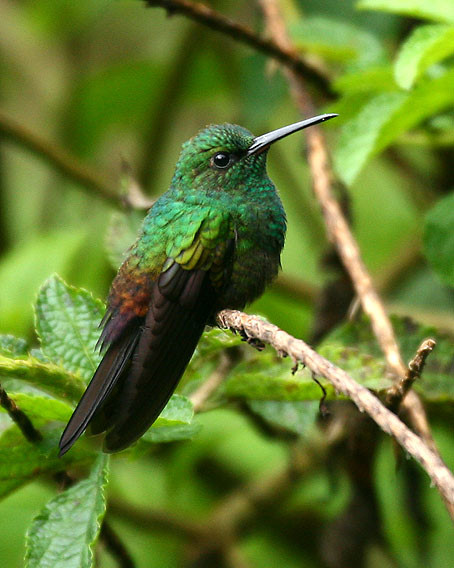
The Bronze-tailed Plumeleteer is medium-sized for a hummingbird, with males exhibiting a striking bronze-colored tail that is a key identifying feature. Adult males boast an iridescent green body, particularly on the back and crown, while their underparts are slightly less vibrant but still greenish. Females, on the other hand, have a more subdued coloration, with duller green upperparts and grayish-white underparts. Juvenile birds resemble the females but may have faint streaks on their throats.
This species can be confused with other hummingbirds in its range, such as the Rufous-tailed Hummingbird, due to overlapping territories and similar size. However, the Bronze-tailed Plumeleteer's distinct tail color provides a reliable distinguishing mark. In flight, the plumeleteer displays a rapid wingbeat typical of hummingbirds, and its tail appears slightly fanned with a bronze sheen catching the light.
When perched, the Bronze-tailed Plumeleteer often holds a straight posture, perched on thin branches or twigs. Its beak is long and slightly decurved, adapted for reaching deep into flowers. The bird's agility and quick movements during foraging are notable, often seen darting from flower to flower with remarkable precision.
Having trouble telling birds apart? Upload a photo to our bird identification tool for an instant species match.
Bronze-tailed Plumeleteer Habitat and Range
Preferred Habitat
The Bronze-tailed Plumeleteer primarily inhabits tropical and subtropical moist lowland forests, although it also thrives in secondary growth areas and forest edges. It prefers elevations ranging from sea level up to about 1,200 meters, where dense understory and abundant flowering plants are present. This species demonstrates some adaptability to habitat changes, regularly seen in gardens and coffee plantations where flowering shrubs provide ample nectar.
During the dry season, the plumeleteer may shift to areas with more consistent floral resources, highlighting its ability to navigate various microhabitats within its range. In urban settings, it is less common but can occasionally be observed in well-vegetated parks and gardens, particularly those rich in native flowering species.
Despite its adaptability, the Bronze-tailed Plumeleteer is primarily associated with forest habitats, where the complex structure supports its feeding and breeding requirements. Conservation of these habitats is crucial for maintaining healthy populations, as deforestation poses a significant threat.
Geographic Range
The Bronze-tailed Plumeleteer's range is primarily concentrated in Central and South America. It breeds from southern Nicaragua, across Costa Rica, and into western Panama, with its distribution extending into the humid lowland forests of Colombia and Ecuador. This species does not undertake long-distance migrations, although it may perform local movements to exploit flowering peaks and nectar abundance.
In regions like Costa Rica, the plumeleteer is particularly common in the Caribbean lowlands, with higher population densities reported in areas like the Sarapiquí region. In Panama, it frequents the Chiriquí highlands' forested areas, while in Colombia and Ecuador, it is found in both Andean foothills and coastal lowlands.
Within its range, the bird is relatively widespread, although its exact density can vary based on habitat quality and availability. Despite its broad range, the Bronze-tailed Plumeleteer is considered uncommon in heavily urbanized or deforested areas, where suitable habitat is limited.
Want to know which birds visit your area? Browse our backyard birds by location guides for region-specific species lists.
What Does the Bronze-tailed Plumeleteer Eat?
The primary diet of the Bronze-tailed Plumeleteer consists of nectar from a wide range of flowering plants. It favors species such as heliconias, bromeliads, and various tubular flowers that complement its long bill, which has evolved to access nectar deep within blossoms. This hummingbird adapts to seasonal changes in floral availability by expanding its diet to include insects and spiders, providing essential proteins, particularly during breeding seasons.
Foraging techniques include hovering in front of flowers, often using rapid wingbeats to maintain stability while feeding. The plumeleteer displays remarkable agility and precision, moving quickly between feeding stations and defending rich nectar sources from competitors. It often feeds during the early morning and late afternoon when nectar production peaks.
During the dry season, when flower availability may decrease, the Bronze-tailed Plumeleteer exhibits opportunistic feeding behavior, taking advantage of alternative nectar sources in nearby gardens and plantations. This flexibility ensures a steady food intake throughout the year, supporting its energetic lifestyle.
Want to attract Bronze-tailed Plumeleteers to your yard? See our recommended feeders and seed types for the best results.
Bronze-tailed Plumeleteer Behavior and Social Structure
The Bronze-tailed Plumeleteer is primarily solitary, with individuals often seen foraging alone, though they may tolerate the presence of others in areas with abundant food. Territorial behavior is pronounced, with males aggressively defending prime feeding territories against intruders. During these encounters, the plumeleteer exhibits aerial displays, including impressive chases and vocalizations to assert dominance.
Courtship involves elaborate displays where the male Bronze-tailed Plumeleteer performs aerial maneuvers and vocalizations to attract a mate. These displays emphasize the vibrant tail and iridescent plumage, crucial for successful mating. Once paired, the male's role diminishes as the female takes primary responsibility for nesting and rearing young.
Daily activity patterns include early morning and late afternoon foraging, aligning with peak nectar availability. The plumeleteer's rapid flight and adept maneuvering between flowers are a testament to its highly specialized feeding adaptations. In the presence of predators, such as hawks and snakes, the bird relies on its agility and speed to escape, often retreating to dense vegetation for cover.
Bronze-tailed Plumeleteer Nesting and Reproduction
The Bronze-tailed Plumeleteer's nesting habits are characterized by the construction of small, cup-shaped nests made from plant fibers, lichens, and spider silk. These nests are typically located on low branches or shrubs, often well camouflaged by surrounding foliage. The female is solely responsible for nest building, incubation, and caring for the young.
Clutch size usually consists of two white eggs, which the female incubates for about 15 to 18 days. After hatching, the fledglings are altricial, requiring significant parental care. The mother feeds the chicks by regurgitating partially digested food, primarily nectar and insects, to provide necessary nutrients.
Fledging occurs approximately 20 to 25 days post-hatching, during which time the young birds develop the strength and coordination needed for independent flight. The Bronze-tailed Plumeleteer typically raises one to two broods per year, depending on environmental conditions and food availability.
Bronze-tailed Plumeleteer Sounds and Vocalizations
The Bronze-tailed Plumeleteer's vocalizations are relatively simple compared to songbirds, consisting primarily of high-pitched chips and trills. These sounds serve various functions, from territorial calls to mate attraction. The plumeleteer's primary song includes a series of quick, repetitive notes that rise and fall in pitch, creating a rhythmic pattern easily recognizable within its habitat.
Call notes are sharp and brief, often used in territorial disputes or when communicating with potential mates. Alarm calls are more intense and rapid, serving to alert other plumeleteers of nearby threats. During the dawn chorus, the Bronze-tailed Plumeleteer’s calls blend with those of other forest inhabitants, contributing to the symphony of tropical birdlife.
While their vocal repertoire is not as complex as that of true songbirds, these vocalizations play a critical role in the plumeleteer's social interactions and territory management.
Interesting Facts About the Bronze-tailed Plumeleteer
- 1The Bronze-tailed Plumeleteer can beat its wings up to 50 times per second, allowing it to hover with incredible precision.
- 2Despite their small size, Bronze-tailed Plumeleteers can travel over 1,000 miles when they move between feeding territories.
- 3These hummingbirds can consume up to twice their body weight in nectar and insects daily, fueling their high-energy lifestyle.
- 4The Bronze-tailed Plumeleteer's heart beats at a staggering rate of 1,200 beats per minute during flight.
- 5They often feed 5 to 8 times an hour, visiting hundreds of flowers each day to meet their energy needs.
- 6The Bronze-tailed Plumeleteer uses spider silk in nest construction, providing flexibility and strength to the nest structure.
- 7Male plumeleteers engage in aerial displays to defend their territory, showcasing their agility and speed.
Bronze-tailed Plumeleteer Conservation Status
The IUCN lists the Bronze-tailed Plumeleteer as Least Concern, with its population considered stable. However, habitat loss due to deforestation and land conversion poses significant threats to its long-term survival. Conservation efforts focus on protecting primary forest areas and promoting reforestation projects to ensure the availability of suitable habitats. Historically, the population has fluctuated in response to habitat availability, with declines noted in regions experiencing extensive deforestation. Current conservation strategies include habitat restoration and legal protections for critical areas, aiming to maintain and enhance populations across its range. The bird's adaptability to secondary growth areas provides some resilience against habitat changes, yet the preservation of primary forests remains crucial for sustaining healthy populations.
Attracting Bronze-tailed Plumeleteers to Your Feeder
The Bronze-tailed Plumeleteer is a regular visitor to backyard bird feeders across its range. At the Eye On The Fly feeding station, we observe Bronze-tailed Plumeleteers regularly and capture footage with our feeder cameras.
Other Trochilidae Species


Birds Similar to the Bronze-tailed Plumeleteer
These species are often confused with the Bronze-tailed Plumeleteer due to similar appearance or overlapping range.

