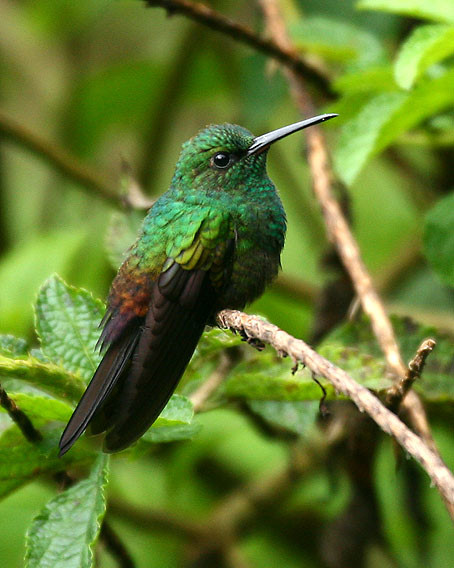
White-vented Plumeleteer
Chalybura buffonii
Order: Apodiformes / Family: Trochilidae

Wikimedia Commons
About the White-vented Plumeleteer
The White-vented Plumeleteer (Chalybura buffonii) is a medium-sized hummingbird residing prominently in the tropical regions of Central and South America. This species is particularly significant due to its role as a pollinator within its ecosystem. Found primarily in Colombia, Venezuela, and parts of Panama, the White-vented Plumeleteer prefers the humid lowland and montane forests, where it plays a crucial part in maintaining the ecological balance by facilitating plant reproduction. Its ecological role extends beyond pollination, as it also helps in controlling insect populations, thus contributing to the health of its habitat. During the breeding season, which coincides with the rainy periods, these birds are highly active, engaging in more territorial displays and frequent feeding to prepare for the energy demands of reproduction. The seasonal behaviors of the White-vented Plumeleteer are closely linked with the availability of floral resources, which peak during the wet season, ensuring ample nectar supply. This bird adapts to seasonal changes by shifting feeding strategies, consuming more insects during leaner times to meet its nutritional needs. As a critical component of the avian community in its range, the White-vented Plumeleteer exemplifies the interconnectedness of species within tropical ecosystems.
The White-vented Plumeleteer belongs to the family Trochilidae, within the order Apodiformes. These birds typically live typically 3-4 years, with some individuals reaching up to 6 years..
How to Identify a White-vented Plumeleteer
The White-vented Plumeleteer can be identified by its vibrant green plumage and characteristic white vent, which is visible when the bird is in flight or perched. Adult males boast a brilliant metallic green hue covering their body, accented by darker green wings and tail. Females and juveniles display slightly duller plumage, with more muted green tones and a less pronounced white vent. The bird's straight black bill is another reliable field mark, aiding in nectar feeding. When observing the White-vented Plumeleteer in flight, its rapid wingbeats and agile maneuvers are characteristic of many hummingbirds. Perched, it maintains an upright posture, often flicking its tail. Though similar in appearance to the Bronze-tailed Plumeleteer, the White-vented Plumeleteer can be distinguished by its definitive white vent and the absence of bronze on the tail.
Having trouble telling birds apart? Upload a photo to our bird identification tool for an instant species match.
White-vented Plumeleteer Habitat and Range
Preferred Habitat
The White-vented Plumeleteer inhabits a range of tropical forest environments, including primary and secondary growth forests, forest edges, and clearings. It thrives at elevations from sea level to 1,800 meters, showing adaptability to varying forest densities. The bird prefers regions with abundant flowering plants, which provide essential nectar resources. During certain times of the year, particularly in the dry season, it may be found in more open areas or even urban gardens where flowering shrubs are present. Its presence in both rural and semi-urban locales demonstrates its adaptability to human-altered landscapes.
Geographic Range
The breeding range of the White-vented Plumeleteer spans Colombia, Venezuela, and Panama. Within these countries, the bird is commonly found in lowland and montane forests. It does not undertake long migrations but may exhibit local movements in response to flowering cycles and nectar availability. In regions like the Colombian Andes and the Venezuelan Coastal Range, population density can be higher due to the abundance of preferred habitats. The species is largely non-migratory, remaining in its core range year-round, though some altitudinal movements may occur.
Want to know which birds visit your area? Browse our backyard birds by location guides for region-specific species lists.
What Does the White-vented Plumeleteer Eat?
The White-vented Plumeleteer primarily feeds on nectar from a variety of flowering plants, favoring species such as Heliconia and Costus. Its diet shifts seasonally, with an increased reliance on insects and spiders during times when floral resources are scarce. This hummingbird employs a hovering technique to feed, allowing it to access nectar while remaining airborne. It also engages in occasional gleaning behavior to capture small arthropods from leaves. Foraging typically occurs throughout the day, with peak activity in the early morning and late afternoon when flowers are most productive.
White-vented Plumeleteer Behavior and Social Structure
The White-vented Plumeleteer exhibits solitary and territorial behaviors, particularly during the breeding season. Males engage in aerial displays to defend feeding territories and attract mates, often chasing intruders with rapid, darting flights. Courtship may involve elaborate flight patterns and vocalizations. While generally solitary outside of breeding, these birds may form loose flocks when migrating locally or when exploiting a rich food source. They have a pronounced dawn and dusk activity pattern, with increased vocalizations during these times. In response to predators, the White-vented Plumeleteer relies on its agile flight to evade capture, often retreating to dense foliage.
White-vented Plumeleteer Nesting and Reproduction
Nesting for the White-vented Plumeleteer involves the construction of a small cup-shaped nest, typically placed on a horizontal branch or in the fork of a tree. The nest is composed of plant fibers, spider silk, and lined with soft materials for insulation. Clutch sizes usually consist of two eggs, which the female incubates alone for about 16-19 days. Once hatched, the young are fed a diet rich in protein from insects to fuel their rapid growth. Fledging occurs approximately 22-26 days after hatching, with the female continuing to care for the chicks for a short period. This species commonly produces one to two broods per year.
White-vented Plumeleteer Sounds and Vocalizations
The vocal repertoire of the White-vented Plumeleteer includes a series of sharp, metallic chips, often repeated in rapid succession. These calls serve as contact notes and territorial signals. The primary song, delivered by males during the breeding season, consists of a series of high-pitched, staccato notes that rise and fall in pitch. Compared to other hummingbirds, the song is less melodious but serves its purpose in mate attraction and territorial defense. Alarm calls are sharper and more insistent, signaling the presence of potential threats.
Interesting Facts About the White-vented Plumeleteer
- 1The White-vented Plumeleteer can hover in place for up to 30 seconds, an ability critical for nectar feeding.
- 2This hummingbird's heart can beat up to 1,260 times per minute during flight, showcasing its high-energy lifestyle.
- 3The iridescence of its plumage is due to microscopic feather structures, not pigments, reflecting light uniquely.
- 4White-vented Plumeleteers often return to the same feeding territories year after year, displaying site fidelity.
- 5Despite their small size, these birds can travel up to 20 kilometers in a single day searching for food.
White-vented Plumeleteer Conservation Status
Currently, the White-vented Plumeleteer is classified as Least Concern by the IUCN, with stable populations across its range. However, ongoing habitat loss due to deforestation and agricultural expansion poses a threat to its long-term survival. Conservation efforts focus on preserving critical habitats and promoting sustainable land use practices. Historically, the species has maintained a stable population, but continued monitoring is essential to detect any future declines.
Other Trochilidae Species


Birds Similar to the White-vented Plumeleteer
These species are often confused with the White-vented Plumeleteer due to similar appearance or overlapping range.