Buteo dananus
Buteo dananus
Order: Accipitriformes / Family: Accipitridae
About the Buteo dananus
The Buteo dananus, commonly known as the Danaan hawk, is a fascinating bird of prey from the Accipitridae family, renowned for its adaptability and predatory skills. This raptor inhabits a variety of ecosystems, showcasing a remarkable capacity to thrive in diverse environments. The Danaan hawk plays a significant role in controlling rodent populations, thus maintaining the balance of its ecosystems. Observers often find this bird in the open landscapes of sub-Saharan Africa, where it effortlessly glides across the sky. Its presence symbolizes the health of the habitats it occupies, as it preys primarily on small mammals, birds, and reptiles. The Danaan hawk displays a preference for open woodlands, savannas, and even some mountainous areas, adapting its hunting techniques to the specific characteristics of these terrains. Seasonal behaviors include migratory movements within its range, often dictated by food availability and climatic conditions. During the breeding season, which generally aligns with the onset of the rainy season, the Buteo dananus becomes more territorial, engaging in aerial displays to establish dominance and attract mates. Its ecological role extends beyond predation; by scavenging occasionally, it contributes to the ecosystem's nutrient cycle. The Danaan hawk's adaptability, combined with its formidable hunting prowess, underscores its importance as both a predator and a cultural icon in various African traditions.
The Buteo dananus belongs to the family Accipitridae, within the order Accipitriformes. These birds typically live average lifespan is 8-12 years, with a maximum recorded of 18 years..
How to Identify a Buteo dananus
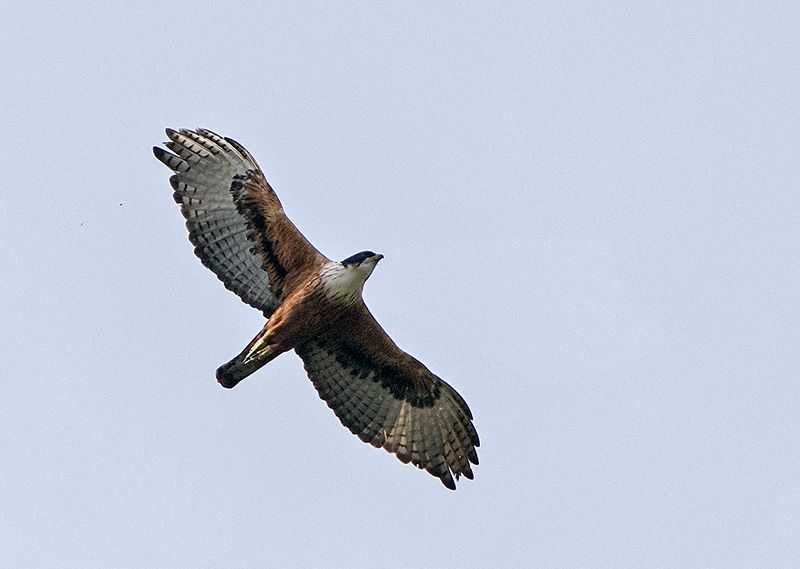
The Buteo dananus, or Danaan hawk, presents a robust silhouette characterized by broad wings and a relatively short tail. Adults typically display a rich brown plumage on their upperparts, with a lighter, often streaked, breast. Juveniles, on the other hand, sport a more mottled appearance with paler underparts, which gradually darken as they mature. Males and females appear similar in plumage, though females are generally larger, a common trait among raptors. The Danaan hawk's flight silhouette is unmistakable due to its broad wings and a tendency to soar with little wing movement. When perched, it displays a powerful posture, often on a prominent vantage point. Confusion may arise with other Buteo species, such as the common buzzard, but the Danaan hawk can usually be distinguished by its larger size and distinct geographical range.
Having trouble telling birds apart? Upload a photo to our bird identification tool for an instant species match.
Buteo dananus Habitat and Range
Preferred Habitat
The Danaan hawk primarily inhabits open woodlands and savannas, favoring areas that provide ample hunting opportunities and suitable nesting sites. It can be found at elevations ranging from sea level to 2,500 meters, particularly in areas with scattered trees and open spaces. During the dry season, it might venture closer to water sources, while in wetter months, it stays in areas with abundant prey. Although not typically urban, it occasionally appears in agricultural landscapes where prey is plentiful.
Geographic Range
The Buteo dananus breeds in sub-Saharan Africa, with a range extending from Senegal and Gambia in the west to Ethiopia and Kenya in the east, and southwards to Namibia and South Africa. Its non-breeding range overlaps significantly with its breeding range, as it tends to remain within the same general areas year-round. Migration corridors exist within its range, often influenced by prey availability and seasonal changes. Population density is highest in regions with abundant prey and suitable nesting sites, such as the savannas of East Africa.
Want to know which birds visit your area? Browse our backyard birds by location guides for region-specific species lists.
What Does the Buteo dananus Eat?
The diet of the Danaan hawk consists mainly of small mammals, such as rodents and lagomorphs, supplemented by birds, reptiles, and insects. It exhibits opportunistic feeding behavior, adjusting its diet based on seasonal prey availability. During the breeding season, it may hunt more intensively, providing for its young. The hawk employs a sit-and-wait strategy, perching high to spot prey before making a swift, calculated strike. Prey size varies, but it generally targets animals that it can carry easily.
Buteo dananus Behavior and Social Structure
The Buteo dananus demonstrates a solitary and territorial nature, particularly evident during the breeding season when it engages in aerial displays and vocalizations to assert dominance and attract a mate. Courtship involves spectacular flights and mutual feeding. Outside the breeding season, the Danaan hawk may be seen in loose associations, especially when migrating or exploiting a common food source. Its response to predators includes loud alarm calls and aggressive aerial maneuvers to deter intruders. Typically diurnal, the hawk hunts primarily during the early morning and late afternoon to capitalize on optimal thermal currents.
Buteo dananus Nesting and Reproduction
The Danaan hawk constructs its nest high in trees, using sticks and lining it with softer materials. Preferred locations are often secluded, providing safety from predators. A typical clutch consists of 2-3 eggs, which the female primarily incubates over approximately 30-35 days. Both parents participate in feeding the young, which fledge about 45-50 days post-hatching. The species generally produces one brood per year, although in times of abundant food, a second brood is possible.
Buteo dananus Sounds and Vocalizations
The primary call of the Buteo dananus is a high-pitched, descending whistle, often described as eerie yet melodious. This call serves multiple purposes: establishing territory, attracting a mate, and communicating with young. Alarm calls are sharper and more urgent, signaling potential threats. During the dawn chorus, its calls resonate across its territory, adding to the soundscape of its habitat.
Interesting Facts About the Buteo dananus
- 1The Danaan hawk can spot prey from a distance of over a kilometer thanks to its exceptional eyesight.
- 2Unlike many raptors, the Danaan hawk occasionally scavenges, demonstrating its adaptability.
- 3A mated pair of Danaan hawks may reuse the same nesting site for several years if conditions remain favorable.
- 4During courtship, male Danaan hawks perform spectacular aerial displays, including stoops and loops.
- 5The Danaan hawk's call can be heard up to 500 meters away, serving as an effective territorial marker.
- 6Juvenile Danaan hawks practice hunting by observing and mimicking adult behaviors before becoming independent.
- 7The Danaan hawk has a wingspan reaching up to 1.2 meters, aiding its skillful soaring and gliding.
Buteo dananus Conservation Status
Currently, the Danaan hawk is not classified as threatened by the IUCN. Its populations remain stable, benefiting from its adaptability to various habitats. However, threats such as habitat destruction, pesticide use, and human disturbance could impact future populations. Conservation efforts focus on habitat preservation and monitoring population trends. Historical data suggest fluctuations in population sizes, often linked to environmental changes and human activities.
Other Accipitridae Species


Birds Similar to the Buteo dananus
These species are often confused with the Buteo dananus due to similar appearance or overlapping range.