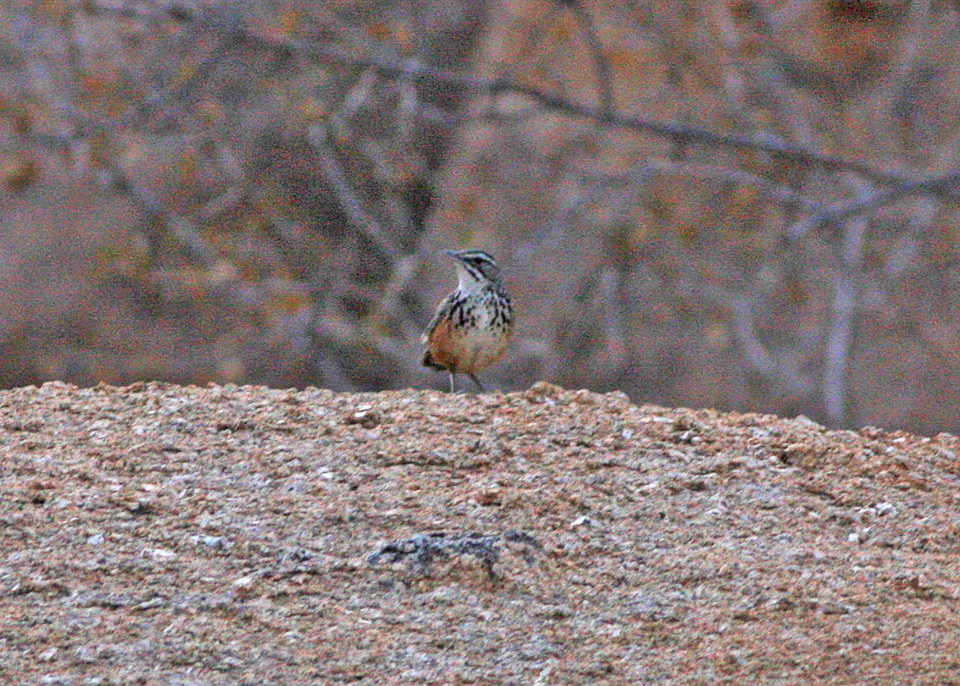
Cape Grassbird
Sphenoeacus afer
Order: Passeriformes / Family: Macrosphenidae

Wikimedia Commons
About the Cape Grassbird
The Cape Grassbird (Sphenoeacus afer) is a small, elusive bird that plays a significant role in the ecosystems of southern Africa. Primarily found in South Africa, Lesotho, and Eswatini, this species thrives in montane grasslands and fynbos regions. It has adapted to habitats at elevations ranging from sea level to about 2,000 meters. The bird's presence in these areas helps maintain the ecological balance by controlling insect populations and dispersing seeds. Observers often encounter the Cape Grassbird in dense vegetation, where it skillfully maneuvers through reeds and grasses.
The Cape Grassbird is an important member of the Macrosphenidae family. Its ecological role extends beyond insect control; it also acts as a prey species for larger birds and mammals. This bird's preference for dense brush and tangled undergrowth means it is often heard more than seen. Its melodious song adds to the soundscape of its habitat, especially during the breeding season from September to March. As a resident bird, it does not migrate, but shows some altitudinal movements in response to seasonal changes in temperature and food availability.
The Cape Grassbird's significance extends to local culture and birdwatching communities. Ornithologists and birdwatchers value it for its unique behaviors and vocalizations. The bird's adaptability to various grassland and shrubby environments demonstrates its resilience in the face of habitat changes, although ongoing conservation efforts are essential to ensure its populations remain stable. By understanding the Cape Grassbird's habits and habitats, conservationists can better protect these environments, which are vital for numerous other species as well.
The Cape Grassbird belongs to the family Macrosphenidae, within the order Passeriformes. These birds typically live average 5 years, with a maximum recorded of 7 years..
How to Identify a Cape Grassbird
Identifying the Cape Grassbird involves observing its distinctive plumage and behavior. The adult bird displays a rich brown coloration with heavy streaking on the upperparts. Its underparts are buff with fine streaks on the breast. A prominent feature is its long tail, which it often flicks while perched. This tail is darker with paler edges, contributing to its unique silhouette.
Males and females appear similar, making visual sex differentiation challenging. Juveniles, however, can be distinguished by their slightly duller plumage and less pronounced streaking. In flight, the Cape Grassbird presents a graceful, undulating motion, with the long tail trailing prominently behind. Perched, it adopts a horizontal posture, often remaining concealed within dense vegetation.
Confusion may arise with other small, brown, streaked birds, such as certain cisticolas. However, the Cape Grassbird's larger size, longer tail, and distinctive vocalizations set it apart. Its call is a series of melodious, whistling notes that crescendo, a sound that becomes familiar to those who frequent its natural habitats.
Having trouble telling birds apart? Upload a photo to our bird identification tool for an instant species match.
Cape Grassbird Habitat and Range
Preferred Habitat
The Cape Grassbird inhabits primarily grassland and fynbos ecosystems. It shows a preference for dense, shrubby areas within these habitats, often along riverbanks or hillsides. The bird is commonly found at elevations ranging from sea level up to 2,000 meters, with a marked presence in the Drakensberg range and the Cape Fold Mountains. While it is less common in urban areas, it can occasionally be observed in peri-urban fringes where suitable vegetation persists.
Seasonal shifts may influence its habitat preferences, with altitudinal movements occurring as it seeks out optimal conditions for feeding and nesting. Despite its adaptability, the Cape Grassbird remains largely absent from heavily cultivated or degraded landscapes, indicating its reliance on intact natural environments.
Geographic Range
The Cape Grassbird is a resident species with a range confined to southern Africa. It predominantly occurs in South Africa, Lesotho, and Eswatini. Within this range, its population density is higher in areas like the Drakensberg mountains and the Cape Fold Belt, where suitable grassland and fynbos habitats abound. This bird does not undertake long migrations, but it may move vertically to adapt to changing environmental conditions.
In terms of distribution, the Cape Grassbird is widespread but not uniformly distributed. Populations are denser in regions where its preferred habitats are intact, while fragmented or degraded areas see fewer individuals. Its presence across a limited geographic range underscores the importance of targeted conservation efforts to safeguard its habitat and ensure its continued survival in these regions.
Want to know which birds visit your area? Browse our backyard birds by location guides for region-specific species lists.
What Does the Cape Grassbird Eat?
The Cape Grassbird primarily feeds on insects, which it actively forages in dense grass and shrubs. Its diet consists of ants, beetles, caterpillars, and other small invertebrates. During the breeding season, the bird's dietary intake shifts slightly to include more protein-rich insects to support the energy demands of raising young.
In addition to insects, the Cape Grassbird may consume seeds and other plant materials, particularly in the non-breeding season when invertebrate availability decreases. Its foraging technique involves moving through vegetation in a deliberate, almost creeping manner, using its beak to probe and pick at potential prey. It typically forages alone or in pairs, with peak feeding activity occurring during the early morning and late afternoon.
Cape Grassbird Behavior and Social Structure
Cape Grassbirds exhibit a range of interesting behaviors. They are generally solitary or found in pairs, displaying territorial behavior, especially during the breeding season. Males establish and defend territories through song, using their melodious calls to ward off rivals and attract mates.
Courtship displays involve a series of flights and vocalizations, with the male often performing a fluttering display, showing off its plumage and agility. These birds are also known for their secretive nature, often remaining hidden in dense vegetation, only emerging to sing or forage. Cape Grassbirds are primarily active during the day, with peak periods in the early morning and late afternoon.
In response to predators, the Cape Grassbird relies on its camouflage and dense cover for protection. When disturbed, it may freeze or retreat into thick underbrush, making it difficult for predators to follow. Its vocalizations, while an important part of territory defense, also serve as an alert to potential threats.
Cape Grassbird Nesting and Reproduction
Cape Grassbirds build their nests low to the ground, concealed within dense vegetation. Nests are typically cup-shaped structures made from grass, reeds, and other plant materials, lined with finer materials for insulation. They prefer to nest in areas with ample cover, such as tall grasses or shrubs, which provide protection from predators.
The typical clutch consists of 2 to 4 eggs, which both parents incubate for about 14 days. After hatching, chicks remain in the nest for an additional 12 to 14 days, during which both parents share feeding and brooding duties. Cape Grassbirds typically raise one or two broods per year, depending on environmental conditions and food availability. The cooperative parenting strategy of the species ensures high survival rates for the fledglings.
Cape Grassbird Sounds and Vocalizations
The Cape Grassbird's song is a melodious sequence of whistling notes. The rhythm is lively and can be characterized by a series of sharp, ascending whistles that crescendo and then descend. This song, often heard during the breeding season, plays a key role in territory establishment and mate attraction.
Aside from its primary song, the Cape Grassbird produces a variety of call notes, including sharp 'chip' sounds used as contact calls. Its alarm call is a rapid, chattering sequence that serves as a warning to other birds of potential danger. During the early morning dawn chorus, the Cape Grassbird's song contributes to the vibrant auditory landscape of its habitat, signaling the start of a new day.
Interesting Facts About the Cape Grassbird
- 1The Cape Grassbird's song can often be heard before dawn, adding to the early morning chorus of its habitat.
- 2Despite its small size, the Cape Grassbird is an important seed disperser in its ecosystem, aiding in plant regeneration.
- 3Cape Grassbirds are known to use their long tails for balance when navigating through dense vegetation.
- 4These birds can be quite elusive, often hiding in shrubs and grasses, making them a rewarding find for birdwatchers.
- 5The Cape Grassbird shares its habitat with several other endemic bird species, highlighting the rich biodiversity of southern Africa.
- 6During courtship, males perform elaborate song displays to attract females, showcasing their vocal prowess.
- 7The Cape Grassbird's preference for dense cover makes it less susceptible to predation compared to other open-habitat species.
Cape Grassbird Conservation Status
The Cape Grassbird is currently listed as Least Concern by the IUCN, reflecting stable population trends across its range. However, habitat loss due to agriculture, urbanization, and invasive plant species poses ongoing threats. Conservation efforts focus on protecting and restoring natural grasslands and fynbos habitats, crucial for the bird's survival. Historical population levels have remained relatively stable, but localized declines in fragmented habitats are a concern. Continued habitat management and restoration efforts are essential to maintain healthy populations. By ensuring the protection of its natural environment, conservationists aim to mitigate the impacts of human activity and safeguard the future of the Cape Grassbird.