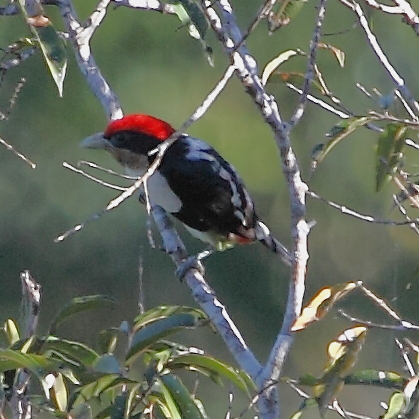
Capito lineatus
Capito lineatus
Order: Piciformes / Family: Capitonidae
About the Capito lineatus
The Lineated Barbet (Capito lineatus) is a captivating bird native to the tropical regions of South America. This species plays a significant ecological role as both a seed disperser and an insect control agent within its habitat. Found predominantly in the dense lowland rainforests and secondary growth woodlands of the Amazon Basin, the Lineated Barbet is an integral part of the avian community. Its presence in countries like Brazil, Colombia, and Peru highlights its wide distribution across the continent. The bird thrives in humid environments with plenty of fruiting trees, which are essential to its diet. Beyond its ecological contributions, the Lineated Barbet is known for its role in the indigenous cultures of the region, often being featured in local folklore and traditional stories as a symbol of alertness and vigilance. During the breeding season, which typically spans from December to March, these barbets engage in elaborate courtship displays and vocalizations that fill the forest canopy with sound. Their distinctive calls serve not only as a mating ritual but also play a role in maintaining territory boundaries among pairs. The Lineated Barbet’s adaptability to both primary and secondary forests showcases its resilience, yet it remains sensitive to habitat loss due to deforestation. This bird’s ability to thrive in various layers of the forest, from the understory to the canopy, allows it to exploit a range of food sources and nesting sites. Furthermore, its seasonal behaviors reflect its adaptability, as it may shift its foraging habits and territory boundaries to align with fruiting patterns and insect abundance throughout the year.
The Capito lineatus belongs to the family Capitonidae, within the order Piciformes. These birds typically live typically lives 7-10 years in the wild..
How to Identify a Capito lineatus
The Lineated Barbet stands out with its bold black and white stripe pattern across its head, resembling lines drawn with precision, which is a key feature for identification. Adults typically have a vibrant combination of olive-green plumage on their backs and wings, contrasted with a white or pale yellow underbelly. Juveniles, meanwhile, are often duller with less distinct striping, making them harder to identify at a glance. Males and females appear similar, though males can sometimes be slightly more vibrant in coloration. Confusion may arise with other barbet species within the same range, but the Lineated Barbet’s unique head pattern and its vocalizations help distinguish it. When perched, its upright posture and thick-set body are characteristic, giving it a robust silhouette against the foliage. In flight, the bird displays a rapid wingbeat interspersed with short glides, a pattern typical of many barbet species. This flight silhouette, coupled with its size (around 20-25 cm in length), aids in identification even from a distance.
Having trouble telling birds apart? Upload a photo to our bird identification tool for an instant species match.
Capito lineatus Habitat and Range
Preferred Habitat
The Lineated Barbet predominantly inhabits tropical lowland rainforests, often found within the lush, humid environments of the Amazon Basin. It thrives in both primary forests with dense canopies and secondary growth areas where fruiting trees are abundant. This species is also known to adapt to forest edges and clearings, where it can access a variety of fruits and insects. Typically found at elevations ranging from sea level up to 1,500 meters, the Lineated Barbet exhibits flexibility in its habitat preferences. Unlike some other species, it does not frequently venture into urban areas, remaining more of a forest specialist. Seasonal shifts in habitat use are minimal, as the bird generally remains within its established territories, exploiting seasonal fruiting patterns and insect abundance in its tropical home.
Geographic Range
The Lineated Barbet is endemic to the northern regions of South America, with a range that encompasses several key countries within the Amazon Basin. It is a resident bird in Brazil, Colombia, Peru, Ecuador, and Venezuela, favoring the expansive tracts of rainforest found in these countries. Unlike migratory species, the Lineated Barbet maintains a relatively stable range throughout the year, with little to no long-distance movement observed. Population density is higher in areas with abundant fruiting trees, such as the Amazon River's floodplain forests. While it does not engage in significant migration, localized movements may occur in response to food availability, particularly during the breeding season when resource demands increase.
Want to know which birds visit your area? Browse our backyard birds by location guides for region-specific species lists.
What Does the Capito lineatus Eat?
As an omnivorous species, the Lineated Barbet's diet primarily consists of fruits, berries, and insects, which it forages within its lush rainforest habitat. Its strong, curved beak is ideally suited for plucking fruit from trees, a primary food source that constitutes a substantial part of its diet year-round. During certain times of the year, particularly when fruit abundance declines, the barbet shifts its focus to insects, including beetles, caterpillars, and ants, which it skillfully captures with its agile movements. This dietary flexibility allows the Lineated Barbet to adapt to seasonal changes in food availability. Foraging typically occurs during the cooler hours of the morning and late afternoon, taking advantage of the reduced heat. The bird often employs a 'sit-and-wait' strategy, watching for movement before darting to snatch its prey.
Capito lineatus Behavior and Social Structure
The Lineated Barbet exhibits a complex social structure, often seen in pairs or small family groups outside the breeding season. Territorial by nature, these barbets vigorously defend their chosen feeding and nesting areas through vocalizations and displays. During the breeding season, which peaks between December and March, courtship displays become particularly pronounced, involving fluttering flights and rhythmic calls. Flocking behavior is uncommon, as the species tends to maintain relatively small social units. When faced with potential threats, the Lineated Barbet relies on its sharp vocal warnings and dense foliage for protection, often retreating to the safety of the canopy. Daily activity patterns show a preference for dawn and dusk, which are the primary times for feeding and social interactions. The bird's alertness and keen senses make it a challenging target for predators, which mainly include larger birds of prey and arboreal snakes.
Capito lineatus Nesting and Reproduction
Lineated Barbets prefer cavity nesting, often utilizing natural tree holes or abandoned woodpecker nests. Nest sites are usually located in trees with thick trunks, providing protection and insulation for the developing young. The female lays a clutch of 2-4 eggs, which she incubates for about 14-16 days. Both parents share responsibilities in feeding and caring for the chicks, which fledge approximately 30-35 days post-hatching. The species typically raises one brood per year, although, in optimal conditions, a second brood might be attempted. Nest construction involves minimal material, relying on the natural cavity to provide structural integrity. The chicks remain dependent on parental care for an additional few weeks post-fledging, during which time they learn essential survival skills.
Capito lineatus Sounds and Vocalizations
The primary song of the Lineated Barbet is a series of resonant, rhythmic notes often described as 'too-too-too', delivered with a steady tempo and rising pitch. This vocalization serves as both a territorial marker and a mating call, particularly prominent during the breeding season. In addition to its song, the barbet emits sharp, repetitive call notes that resemble a metallic 'chip-chip', used to maintain contact with its mate or alert to potential threats. Alarm calls are quicker and more intense, often escalating in volume and frequency in response to predators. At dawn, the Lineated Barbet participates in a chorus of forest sounds, contributing its distinctive voice to the symphony of the rainforest.
Interesting Facts About the Capito lineatus
- 1The Lineated Barbet's unique vocalizations can be heard up to half a kilometer away in dense forest.
- 2Despite its vibrant appearance, the Lineated Barbet is adept at camouflage, blending seamlessly with canopy foliage.
- 3The Lineated Barbet is one of the few bird species that can consume fruits toxic to other animals, aiding in seed dispersal.
- 4Lineated Barbets have a specialized tongue that helps them extract insects and nectar from tight spaces.
- 5The bird's strong, curved beak is not only for feeding but also for chiseling nest cavities in softer wood.
Capito lineatus Conservation Status
Currently classified as Least Concern by the IUCN, the Lineated Barbet's population remains stable across its extensive range. However, habitat destruction due to deforestation poses a significant threat to its long-term survival. Conservation efforts focus on preserving large tracts of rainforest and establishing protected areas to safeguard its natural habitat. Historical population trends indicate resilience despite regional habitat loss, attributed to the bird's adaptability and varied diet. Continued monitoring and habitat protection are crucial to ensure the Lineated Barbet's ongoing stability and ecological contributions.