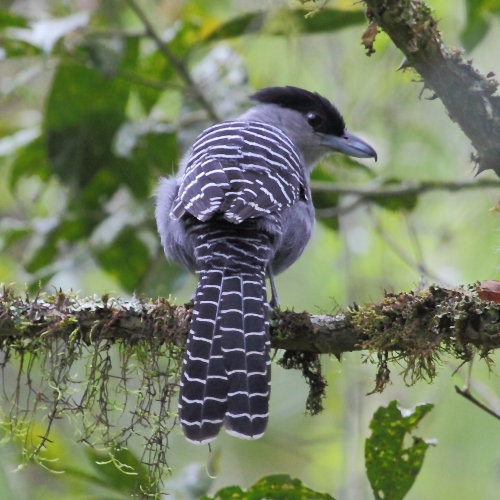
Caura Antbird
Schistocichla caurensis
Order: Passeriformes / Family: Thamnophilidae

Wikimedia Commons
About the Caura Antbird
The Caura Antbird, known scientifically as Schistocichla caurensis, inhabits the dense, humid tropical forests of northern South America, particularly in Venezuela's Caura River basin. This bird plays a vital role in its ecosystem by controlling insect populations, acting as both a predator and prey within its food web. Its presence reflects the health of its habitat, as it relies on intact forest understory for survival. The Caura Antbird's significance extends to its contribution to biodiversity, serving as an indicator species for conservation efforts in its native regions. These birds thrive in lowland tropical forests, where humidity and thick foliage provide ideal conditions for their lifestyle. Typically non-migratory, the Caura Antbird's seasonal behaviors revolve around breeding and foraging rather than long-distance movement. During the breeding season, which occurs in the wet months, both males and females become more territorial and vocal, establishing and defending their nesting sites. The Caura Antbird's ecological role is multifaceted, with its foraging habits helping to control insect populations and its interactions with other species, such as army ants, highlighting its niche within the forest community. As a year-round resident, this antbird is an integral part of the forest ecosystem, influencing the structure of the insect community and providing food for higher predators. The Caura Antbird's presence in the forest shades and its dependence on specific ecological conditions make it a focal point for ornithologists and conservationists aiming to preserve the unique biodiversity of South America's tropical forests.
The Caura Antbird belongs to the family Thamnophilidae, within the order Passeriformes. These birds typically live typically 4-6 years, occasionally up to 7 years..
How to Identify a Caura Antbird
The Caura Antbird is a medium-sized bird, measuring approximately 14-15 cm in length. Adults display a striking black plumage with conspicuous white wing coverts that contrast sharply against their dark feathers. This feature makes them relatively easy to identify among the dense forest understory. Males and females are similar in appearance, although females may exhibit slightly duller plumage. Juveniles can be distinguished by their brownish tones and less defined wing markings, which they lose as they mature. The bird's silhouette is compact, with a short tail and rounded wings, typical of antbirds. When perched, the Caura Antbird maintains an upright posture, often clinging to vertical branches as it forages or observes its surroundings. Unlike some similar species, such as the Spot-winged Antbird, Schistocichla caurensis lacks any spots or streaks on its body, aiding in its identification. Its flight is characterized by short, rapid bursts interspersed with gliding, allowing it to navigate the dense foliage effectively. While confusion with other antbirds can occur, particularly in poor lighting, the distinct wing coverts and overall dark plumage of the Caura Antbird are reliable field marks for birders.
Having trouble telling birds apart? Upload a photo to our bird identification tool for an instant species match.
Caura Antbird Habitat and Range
Preferred Habitat
The Caura Antbird thrives in the humid and dense lowland tropical forests of northern South America. Its preference for shaded, thickly vegetated understory habitats is well-documented, with sightings frequently reported along the forest floor and lower strata. This bird favors areas near water bodies, such as rivers and streams, where the humidity level remains high. Typically found at elevations ranging from sea level to about 500 meters, the Caura Antbird seldom ventures into higher altitudes. Unlike some forest species, it shows little inclination towards urban environments, remaining firmly rooted in its natural habitat. Seasonal habitat shifts are minimal, as the bird remains in the same regions year-round, taking advantage of the consistent availability of its insect prey. The Caura Antbird's reliance on pristine forest conditions makes habitat preservation crucial for its continued survival.
Geographic Range
The Caura Antbird is primarily found in northern South America, with a significant concentration in Venezuela's Caura River basin. Its range extends into neighboring regions of Brazil and Guyana, although sightings outside Venezuela are less frequent. This bird is non-migratory, residing in its tropical forest habitat throughout the year. Within its range, population densities vary, with the highest concentrations observed in areas of undisturbed forest. The Caura Antbird does not engage in long-distance migrations or seasonal movements, which underscores the importance of local habitat conditions for its survival. Its limited range and specific habitat requirements make it vulnerable to environmental changes, highlighting the need for targeted conservation efforts in the regions it inhabits.
Want to know which birds visit your area? Browse our backyard birds by location guides for region-specific species lists.
What Does the Caura Antbird Eat?
The Caura Antbird's diet primarily consists of insects and other arthropods, making it an adept forager in its forest habitat. It primarily preys on ants, beetles, and spiders, which it gleans from the forest floor and understory foliage. During the wet season, when insect populations peak, the Caura Antbird may expand its diet to include larger prey items, such as caterpillars and small crustaceans found near water bodies. Foraging typically occurs in the morning and late afternoon, capitalizing on the increased activity of its prey during these times. The bird employs a methodical foraging technique, moving slowly and deliberately through the understory, using its sharp bill to probe leaf litter and bark crevices. Occasionally, the Caura Antbird follows swarms of army ants, capturing insects that flee from the advancing ant columns. This behavior not only allows it to exploit a rich food source but also positions it within the complex web of forest symbioses.
Caura Antbird Behavior and Social Structure
The Caura Antbird exhibits territorial behavior, especially during the breeding season, when pairs vigorously defend their nesting areas from intruders. Socially, these birds are monogamous, forming stable pairs that often remain together throughout the year. Courtship involves vocal displays and mutual preening, strengthening the pair bond. Outside of the breeding season, the Caura Antbird may join mixed-species foraging flocks, benefiting from the increased foraging efficiency and predator detection that such groups provide. These flocks typically consist of various insectivorous birds that inhabit the same forest strata. When confronted by predators, the Caura Antbird relies on its agility and the dense forest cover for protection, often freezing in place or retreating to thicker vegetation. Daily activity patterns include early morning and late afternoon foraging, with a period of rest during the hottest part of the day. This schedule aligns with the activity patterns of its prey, allowing the antbird to maximize foraging success.
Caura Antbird Nesting and Reproduction
The Caura Antbird constructs its nest in the dense understory of its forest habitat, often selecting low shrubs or small trees as nesting sites. The nest is typically a cup-shaped structure made from twigs, leaves, and plant fibers, providing camouflage and protection for the eggs. A typical clutch consists of two to three eggs, which both parents incubate over a period of 14 to 16 days. Post-hatching, both male and female share in feeding and caring for the chicks. The fledging period lasts about 12 to 14 days, after which the young birds leave the nest but remain under parental supervision for several weeks. The Caura Antbird generally produces one brood per year, although favorable conditions may result in a second brood. The selection of nesting sites near water sources ensures a steady supply of food for the growing chicks. Parental roles are well-defined, with both partners equally involved in all stages of rearing the young.
Caura Antbird Sounds and Vocalizations
The Caura Antbird's primary song is a series of sharp, metallic notes delivered in quick succession, each phrase lasting several seconds. This song is both a territorial marker and a means of communication between mates. Call notes consist of short, sharp chips used to maintain contact within pairs or flocks. Alarm calls, louder and more urgent, alert others to the presence of predators and are crucial for survival in the dense forest. During the dawn chorus, the Caura Antbird's song stands out, cutting through the cacophony of other forest sounds with its distinctive rhythm and pitch. The bird's vocalizations, while not as melodious as some songbirds, are essential for maintaining social bonds and territory.
Interesting Facts About the Caura Antbird
- 1The Caura Antbird is named after its primary location, the Caura River basin in Venezuela, highlighting its geographic specificity.
- 2Despite its name, the Caura Antbird does not solely rely on ants for food, demonstrating a versatile diet that includes a wide range of insects.
- 3These birds are often seen following army ant swarms, a behavior known as 'ant-following,' which is common among certain forest bird species.
- 4The Caura Antbird's ability to blend into its environment is a key survival trait, with its plumage providing excellent camouflage against predators.
- 5Unlike many tropical birds, the Caura Antbird does not migrate, instead adapting its behavior to the seasonal changes within its home range.
Caura Antbird Conservation Status
Currently classified as Least Concern by the IUCN, the Caura Antbird faces threats primarily from habitat loss and degradation due to logging and agricultural expansion. While its population is considered stable, ongoing deforestation in its range poses significant risks. Conservation efforts focus on preserving large tracts of intact forest, particularly in Venezuela's Caura River basin, to ensure the bird's continued survival. Historical population changes have been minimal, but the increasing pressure on tropical forests necessitates proactive conservation measures. Engaging local communities in sustainable land management practices forms a crucial part of these efforts, helping to mitigate the effects of human encroachment.