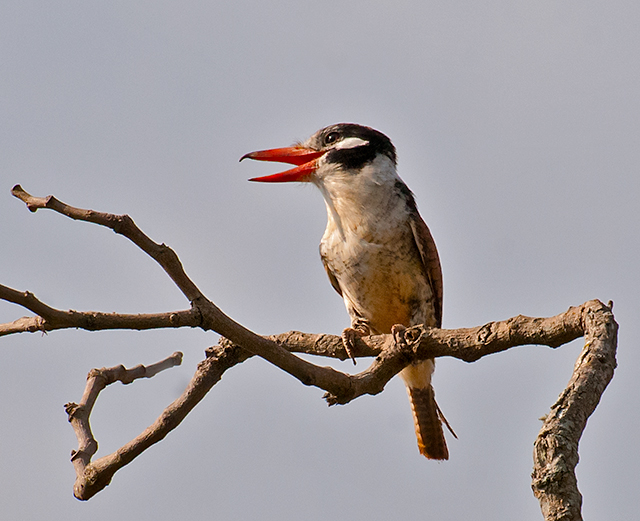
Chestnut-capped Puffbird
Bucco macrodactylus
Order: Piciformes / Family: Bucconidae

Wikimedia Commons
About the Chestnut-capped Puffbird
The Chestnut-capped Puffbird, Bucco macrodactylus, is a uniquely fascinating bird of the Bucconidae family, known for its vibrant chestnut crown and contrasting white throat. This species inhabits the neotropical regions of South America, where it plays a crucial role in the ecosystem as both predator and prey. The bird's presence spans across the Amazon Basin, including countries such as Brazil, Peru, Ecuador, Colombia, and Bolivia. It prefers dense, humid lowland forests and edges, where it can be seen perched quietly, often motionless, waiting for its next meal. Despite its relatively small size, the Chestnut-capped Puffbird's role as an insectivore helps control insect populations. Additionally, through seed dispersal from any fruits consumed, it aids in forest regeneration. This bird is primarily non-migratory, adapted to a sedentary lifestyle within its lush forest habitat. Seasonal behaviors include increased vocal activity during breeding, which aids in territory establishment and mate attraction. The puffbird's call, a series of whistles, becomes more pronounced during the wet season when breeding activity peaks. Understanding the ecological significance of the Chestnut-capped Puffbird requires an appreciation of its intricate relationship with the forest ecosystem, where it contributes to maintaining the ecological balance.
The Chestnut-capped Puffbird belongs to the family Bucconidae, within the order Piciformes. These birds typically live estimated around 5 years, with some individuals reaching up to 8 years..
How to Identify a Chestnut-capped Puffbird
Field identification of the Chestnut-capped Puffbird centers on its distinct chestnut-colored cap, contrasting sharply with its white face and throat. The bird's underparts are buffy white, complemented by its dark brown wings and tail. Adult plumage remains consistent across sexes, with males and females exhibiting similar appearance, a common trait among puffbirds. Juveniles, however, may show a slightly duller plumage with less pronounced chestnut coloring. One might confuse the Chestnut-capped Puffbird with other members of the puffbird family, but its unique cap and stout body distinguish it. In flight, its broad wings and rapid, direct flight pattern are characteristic. When perched, the Chestnut-capped Puffbird adopts an upright posture, often remaining motionless for extended periods, blending seamlessly into its forest environment, a behavior that aids in ambush hunting.
Having trouble telling birds apart? Upload a photo to our bird identification tool for an instant species match.
Chestnut-capped Puffbird Habitat and Range
Preferred Habitat
The Chestnut-capped Puffbird thrives in the dense lowland rainforests of the Amazon Basin. It favors thick undergrowth and forest edges, environments that provide ample cover and abundant prey. These birds typically inhabit elevations from sea level up to 900 meters. Unlike some bird species, the Chestnut-capped Puffbird does not frequently shift habitats seasonally, as it remains within its preferred forested areas year-round. While primarily a forest dweller, it occasionally ventures into degraded forest areas, adapting well to certain levels of habitat disturbance. However, it is rare to find this species in urban settings, as it relies on the dense forest canopy and understory for both foraging and nesting.
Geographic Range
The Chestnut-capped Puffbird's range encompasses much of the Amazon Basin, a region renowned for its biodiversity. It resides primarily in northern Brazil, extending into southeastern Colombia, eastern Ecuador, eastern Peru, and northern Bolivia. This bird is a year-round resident, with no significant migratory movements. Within its range, population densities vary, with higher concentrations found in areas where forest cover remains intact and unfragmented. These dense populations highlight the species' reliance on pristine forest habitats. While its range is extensive, the species' presence is closely tied to regions that maintain the ecological attributes of primary forests, making it a strong indicator of forest health.
Want to know which birds visit your area? Browse our backyard birds by location guides for region-specific species lists.
What Does the Chestnut-capped Puffbird Eat?
The diet of the Chestnut-capped Puffbird is primarily insectivorous. It preys on a variety of insects, including beetles, grasshoppers, and caterpillars, which it catches through a sit-and-wait hunting strategy. The bird perches silently and watches for movement, swooping down to capture prey with precision. During certain seasons, it may also consume small fruits, providing a dietary supplement when insects are less abundant. This fruit consumption inadvertently aids in seed dispersal, contributing to the forest's regenerative processes. Prey size typically ranges from small to medium, with the bird showing remarkable adaptability in its foraging techniques. Feeding activity peaks during the early morning and late afternoon, aligning with periods of increased insect activity.
Chestnut-capped Puffbird Behavior and Social Structure
The Chestnut-capped Puffbird exhibits solitary and territorial behavior, often seen alone or in pairs. It defends its territory vigorously against intruders, using both vocal and physical displays. Courtship involves mutual preening and soft calls, strengthening pair bonds. Unlike some social bird species, the Chestnut-capped Puffbird does not form flocks, preferring solitude or the company of its mate. In response to predators, it relies on its cryptic plumage and a motionless posture to remain undetected. Daily activity patterns show peaks during dawn and dusk, times when it is most vocal and active. The bird's alert nature and keen vision enable it to detect and evade predators effectively, securing its place within the dynamic forest ecosystem.
Chestnut-capped Puffbird Nesting and Reproduction
Nesting for the Chestnut-capped Puffbird involves excavating a burrow in a termite mound or earthen bank. This choice of nesting site provides protection from predators and environmental elements. The bird lays a clutch of 2 to 3 eggs, which both parents incubate over approximately 15 to 18 days. Post-hatching, both adults share responsibilities in feeding and caring for the chicks. Fledging occurs around 25 to 30 days after hatching, with young birds staying close to the nest site under parental supervision. Typically, the Chestnut-capped Puffbird raises one brood per year, though favorable conditions may allow for a second. Nesting site selection, coupled with the bird's secretive nature, contributes to its reproductive success.
Chestnut-capped Puffbird Sounds and Vocalizations
The primary song of the Chestnut-capped Puffbird consists of a series of clear, melodic whistles, often delivered in a descending pattern. These vocalizations serve as both territorial markers and mating calls. The bird's call notes are softer and more subdued than its song, used primarily for communication between mates. Alarm calls, in contrast, are sharp and abrupt, alerting others to potential threats. During the dawn chorus, the puffbird's song blends harmoniously with the forest soundscape, creating a symphony of natural sound. Comparatively, its song resembles the flute-like tones of certain thrush species, though with a distinct rhythmic structure.
Interesting Facts About the Chestnut-capped Puffbird
- 1The Chestnut-capped Puffbird can remain motionless for long periods, a strategy that aids in ambush hunting.
- 2This puffbird species often selects termite mounds for nesting, taking advantage of their structural stability.
- 3Despite its sedentary nature, the Chestnut-capped Puffbird exhibits strong territorial behavior, defending its home range vigorously.
- 4The bird's primary song comprises melodious whistles that can carry over considerable distances in dense forests.
- 5Chestnut-capped Puffbirds occasionally consume small fruits, playing an unexpected role in seed dispersal.
- 6Unlike many birds, the Chestnut-capped Puffbird's plumage does not markedly differ between males and females.
- 7This species' presence correlates closely with intact forest habitats, making it an indicator of ecological health.
Chestnut-capped Puffbird Conservation Status
Currently classified as Least Concern by the IUCN, the Chestnut-capped Puffbird's population appears stable across its range. However, ongoing threats such as deforestation and habitat fragmentation pose significant risks. Conservation efforts focus on habitat preservation, with emphasis on protecting large tracts of primary forest within the Amazon Basin. Historical population changes remain poorly documented, but consistent habitat loss signals potential future challenges. Ensuring the survival of the Chestnut-capped Puffbird necessitates continued conservation actions, particularly in regions experiencing rapid environmental change.
Other Bucconidae Species


Birds Similar to the Chestnut-capped Puffbird
These species are often confused with the Chestnut-capped Puffbird due to similar appearance or overlapping range.