
Chestnut-shouldered Antwren
Terenura humeralis
Order: Passeriformes / Family: Thamnophilidae

Wikimedia Commons
About the Chestnut-shouldered Antwren
The Chestnut-shouldered Antwren (Terenura humeralis) thrives in the lush, evergreen forests of South America, particularly in the humid lowland regions of the Amazon Basin. This small bird, belonging to the family Thamnophilidae, plays a crucial ecological role by participating in mixed-species foraging flocks, which contribute to the biodiversity and stability of its habitat. Its range extends across several countries, including Brazil, Peru, Bolivia, and Colombia, where it frequents the understory of tropical forests.
The significance of the Chestnut-shouldered Antwren within its ecosystem cannot be overstated. As part of mixed-species flocks, it aids in the dissemination of seeds and control of insect populations, thereby maintaining ecological balance. Its presence is often an indicator of healthy forest ecosystems, as it relies heavily on dense, undisturbed habitats for breeding and foraging.
Seasonally, the Chestnut-shouldered Antwren exhibits some behavioral shifts, though it is predominantly a resident species. During the breeding season, which aligns with the rainy season between October and March, it may become more territorial, focusing its activities on nesting and raising young. Outside of breeding, its interactions with mixed-species flocks become more pronounced, as it joins other insectivorous birds to exploit available food resources efficiently. This bird’s adaptability to seasonal changes in food availability underscores its resilience in a dynamic environment.
The Chestnut-shouldered Antwren belongs to the family Thamnophilidae, within the order Passeriformes. These birds typically live average 4 years, with a maximum recorded of 6 years..
How to Identify a Chestnut-shouldered Antwren
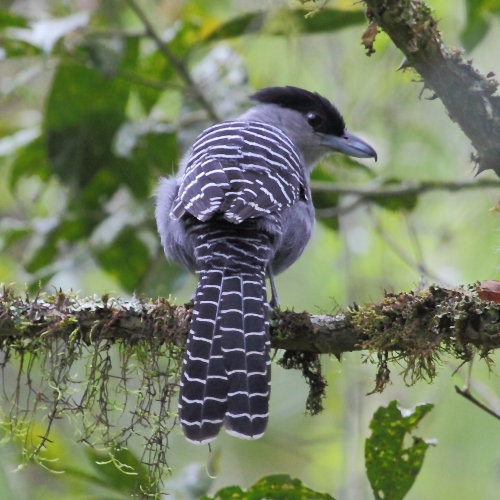
Identifying the Chestnut-shouldered Antwren involves noting several key features. Adult plumage is characterized by its striking chestnut shoulder patches, a distinguishing feature that contrasts with its otherwise grayish-brown body. Males and females are similar in appearance, though males may exhibit slightly brighter chestnut coloration. Juveniles often appear duller, lacking the full intensity of the chestnut patches seen in adults.
In terms of behavior and posture, this antwren tends to perch upright, frequently flicking its wings and tail as it forages. Its small size, typically around 10 to 11 centimeters in length, and its relatively slender build make it less conspicuous than some of its larger relatives. Its flight is swift and direct, often in short bursts as it moves through the underbrush.
While similar species such as the Bland-colored Antwren may cause confusion, paying close attention to the chestnut shoulders of Terenura humeralis can aid in accurate identification. Its preference for denser vegetation also helps distinguish it from other antwrens that favor more open environments.
Having trouble telling birds apart? Upload a photo to our bird identification tool for an instant species match.
Chestnut-shouldered Antwren Habitat and Range
Preferred Habitat
The Chestnut-shouldered Antwren primarily inhabits tropical and subtropical moist lowland forests. These ecosystems, rich in biodiversity and characterized by a dense canopy, provide the perfect environment for the antwren's foraging and nesting habits. It is typically found at elevations ranging from sea level up to 1,500 meters, though it is most commonly observed in lowland areas.
Unlike some other bird species, the Chestnut-shouldered Antwren shows little inclination towards urban or heavily altered landscapes, preferring the undisturbed understory of primary forests. Seasonal shifts in habitat use are minimal, as it remains a year-round resident within these forested areas. However, during the non-breeding season, it may venture slightly higher in elevation, following the abundance of insect prey.
This species is notably absent from open or semi-open habitats, and it rarely occurs in secondary growth forests, highlighting its reliance on pristine forest conditions for survival.
Geographic Range
The range of the Chestnut-shouldered Antwren spans several countries in South America, with its core distribution centered around the Amazon Basin. It is present in Brazil, Peru, Bolivia, and Colombia, where it occupies vast tracts of lowland rainforest. This bird does not undertake long-distance migrations, remaining within its breeding territories year-round.
Within these countries, the antwren's population is most concentrated in the extensive, undisturbed forests of the Amazon. While it is not considered migratory, there is some limited altitudinal movement as it may shift slightly in elevation in response to seasonal changes in food supply.
Despite its broad geographical range, the Chestnut-shouldered Antwren is not evenly distributed, with population densities being highest in areas of optimal habitat conditions. This includes regions where forest tracts remain intact and are less impacted by deforestation and human encroachment.
Want to know which birds visit your area? Browse our backyard birds by location guides for region-specific species lists.
What Does the Chestnut-shouldered Antwren Eat?
The diet of the Chestnut-shouldered Antwren primarily consists of small arthropods, with insects making up the bulk of its nutritional intake. This bird is an adept forager, using its agility to glean insects from leaves and branches in the forest understory. Its diet includes beetles, ants, spiders, and occasionally small caterpillars, which it skillfully extracts from foliage.
Seasonal variations in diet are largely dictated by the availability of prey, with the antwren adjusting its foraging strategy accordingly. During the rainy season, when insect populations peak, it may consume a greater variety of prey types, while in drier periods, it specializes more on the most abundant prey items.
The Chestnut-shouldered Antwren typically forages throughout the day, often joining mixed-species flocks to increase foraging efficiency and reduce predation risk. Its foraging technique involves short, rapid flights from branch to branch, combined with meticulous searching of leaves and twigs for hidden prey.
Chestnut-shouldered Antwren Behavior and Social Structure
The Chestnut-shouldered Antwren exhibits a complex array of behaviors that facilitate its survival in the dense forests it inhabits. Socially, it is often found in mixed-species flocks, a strategy that enhances foraging success and offers protection from predators. These flocks typically consist of various insectivorous species, each occupying a specific niche within the forest ecosystem.
Territorial behavior becomes more pronounced during the breeding season, as pairs defend their nesting area from intruders. Courtship displays are subtle, often involving mutual preening and soft vocalizations between mates. The antwren's response to predators includes a combination of alarm calls and evasive maneuvers, utilizing the dense foliage for cover.
Daily activities of the Chestnut-shouldered Antwren begin at dawn, with peak foraging occurring in the early morning and late afternoon. During the hottest part of the day, it may reduce its activity, seeking shade and conserving energy until temperatures drop. This pattern ensures minimal energy expenditure while maximizing foraging opportunities.
Chestnut-shouldered Antwren Nesting and Reproduction
Nesting for the Chestnut-shouldered Antwren involves constructing a cup-shaped nest, typically made from leaves, grass, and spider silk, which provides structural integrity. Nests are strategically placed in dense foliage, usually between one and three meters above the ground, ensuring concealment from predators.
The typical clutch size consists of two eggs, which are incubated primarily by the female, although both parents participate in feeding the chicks. The incubation period lasts about 14 to 16 days, followed by a fledging period of approximately 10 to 12 days, during which the young are nurtured and taught essential foraging skills.
Parental roles are well-defined, with both the male and female actively involved in provisioning and protecting the young. The Chestnut-shouldered Antwren typically raises one brood per year, although in regions with prolonged favorable conditions, a second brood may be attempted.
Chestnut-shouldered Antwren Sounds and Vocalizations
The primary song of the Chestnut-shouldered Antwren is a quick, repetitive series of high-pitched notes that can be described as 'tsip-tsip-tsip.' This song is often delivered from a concealed perch within dense foliage, serving both to establish territory and to communicate with mates.
In addition to its song, this antwren produces a variety of call notes, ranging from sharp 'chit' sounds used in alarm situations to softer contact calls when foraging. Alarm calls are particularly sharp and rapid, serving to alert other birds of potential threats within the vicinity.
During the dawn chorus, the Chestnut-shouldered Antwren's vocalizations contribute to the rich acoustic tapestry of the forest, blending with the calls of other antbirds and forest-dwelling species. Its vocal repertoire, while not as elaborate as that of some songbirds, is nonetheless an integral component of its communication strategy.
Interesting Facts About the Chestnut-shouldered Antwren
- 1The Chestnut-shouldered Antwren, a member of the Thamnophilidae family, often forms part of mixed-species flocks that can include up to 15 different bird species.
- 2Despite its small size, the Chestnut-shouldered Antwren can consume a considerable number of insects daily, playing a vital role in controlling forest pest populations.
- 3The nest of this antwren is often secured with spider silk, which provides remarkable strength and flexibility to withstand the forest's elements.
- 4In addition to its distinctive chestnut shoulders, its rapid 'tsip-tsip' song helps it communicate effectively in the dense undergrowth.
- 5Unlike more adaptable species, the Chestnut-shouldered Antwren is highly sensitive to habitat disturbance, making it a key indicator of forest health.
- 6During the breeding season, the Chestnut-shouldered Antwren becomes more vocal and territorial, with males frequently engaging in song duets with their mates.
- 7The Chestnut-shouldered Antwren's reliance on mixed-species flocks highlights the interdependence of species within the Amazon ecosystem.
Chestnut-shouldered Antwren Conservation Status
The Chestnut-shouldered Antwren is currently listed as Least Concern by the IUCN, thanks in part to its relatively wide distribution across the Amazon Basin. However, its population trend is suspected to be decreasing, largely due to habitat loss from deforestation and land conversion for agriculture. Primary threats to this species include logging, mining, and infrastructure development, which lead to fragmentation and degradation of its forest habitat. Conservation efforts for the antwren are focused on protecting large tracts of intact forest, particularly within protected areas and national parks. Historical data indicate that while the population has remained relatively stable in some core areas, peripheral populations are more vulnerable to anthropogenic pressures. Continued monitoring and habitat preservation are crucial to ensure the long-term survival of the Chestnut-shouldered Antwren.
Other Thamnophilidae Species



Birds Similar to the Chestnut-shouldered Antwren
These species are often confused with the Chestnut-shouldered Antwren due to similar appearance or overlapping range.

