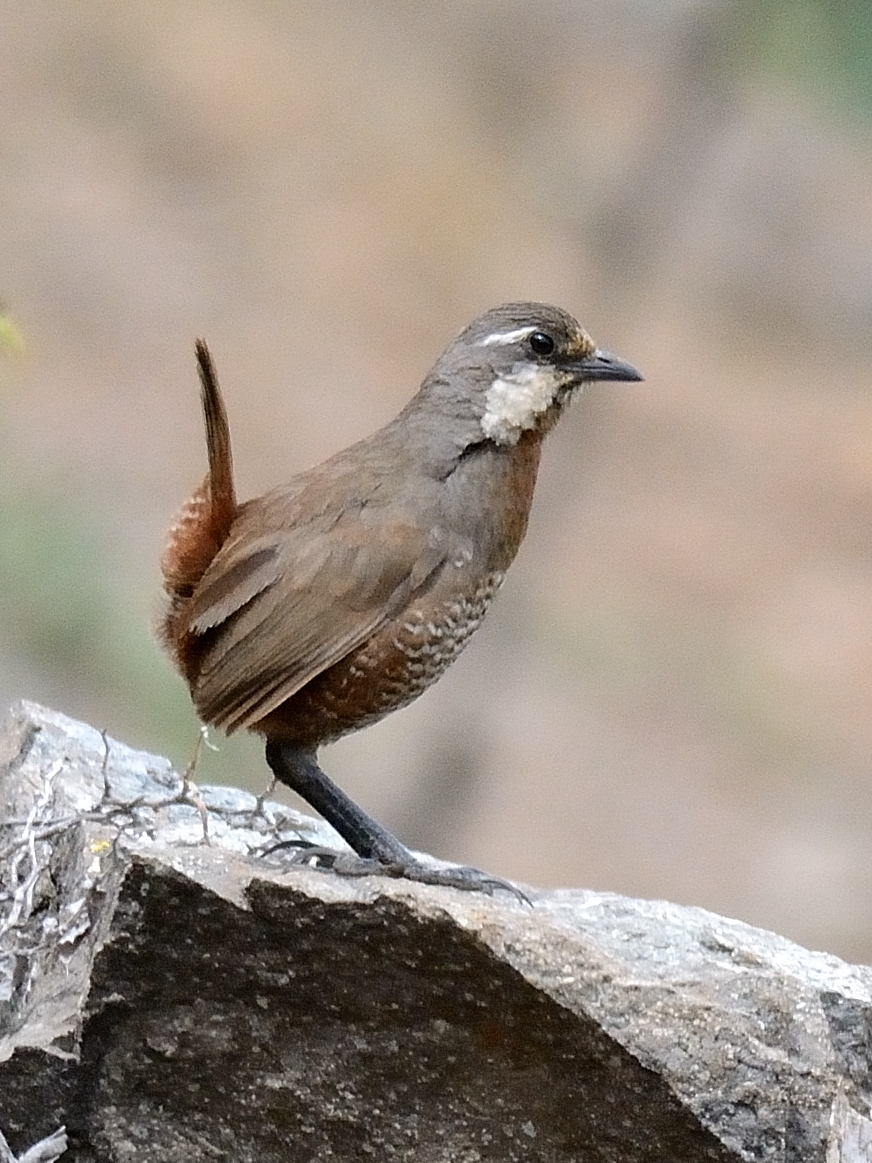
Chestnut-throated Huet-huet
Pteroptochos castaneus
Order: Passeriformes / Family: Rhinocryptidae

Wikimedia Commons
About the Chestnut-throated Huet-huet
The Chestnut-throated Huet-huet (Pteroptochos castaneus) is a distinctive member of the Rhinocryptidae family, commonly found in the temperate forests of southern Chile and Argentina. This robust, ground-dwelling bird thrives in the dense understory of both primary and secondary forests, often at elevations between 200 and 1,500 meters. Renowned for its loud, rhythmic calls that resonate through the forest, the Chestnut-throated Huet-huet plays a significant role in the acoustic landscape of its habitat. Its presence is often an indication of healthy forest ecosystems, as it relies on the complex structure of the undergrowth for foraging and nesting.
The bird's ecological role is multifaceted. As a ground forager, it contributes to the control of insect populations, consuming a variety of invertebrates that dwell in the leaf litter. This diet places it in the important ecological niche of a mid-level predator, impacting the distribution of invertebrates and influencing the forest floor's biological diversity. Furthermore, the Chestnut-throated Huet-huet aids in the dispersal of seeds and spores, inadvertently carrying them on its plumage or through its digestive system, thus supporting the regeneration of the forest.
Seasonal behaviors of the Chestnut-throated Huet-huet vary subtly, with territoriality becoming more pronounced during the breeding season. Typically solitary or found in pairs, this bird's interactions during mating season are marked by cooperative displays and vocalizations, underscoring its role in maintaining pair bonds and territory defense. Outside the breeding season, its presence remains a constant in its preferred habitats, where it continues its essential ecological functions.
The Chestnut-throated Huet-huet belongs to the family Rhinocryptidae, within the order Passeriformes. These birds typically live average 6 years, max recorded 9 years.
How to Identify a Chestnut-throated Huet-huet
The Chestnut-throated Huet-huet is a medium-sized bird with a robust build, characterized by its striking chestnut-colored throat and upper breast. The rest of its plumage is primarily dark brown to black, providing excellent camouflage against the forest floor. Its short wings, long tail, and powerful legs are adaptations for its terrestrial lifestyle, allowing it to move adeptly through dense undergrowth.
Juveniles display a similar pattern but with a duller overall coloration and less distinctive chestnut throat, which develops as they mature. Males and females are similar in appearance, making it challenging to distinguish between the sexes in the field. However, the strength and frequency of their vocalizations often reveal their sex, especially during the breeding season when males are more vocally active.
In silhouette, the Chestnut-throated Huet-huet's profile is distinctive due to its relatively long tail and short, rounded wings. While perched, it often adopts a horizontal posture, keeping close to the ground or on low branches. This bird can sometimes be confused with the Black-throated Huet-huet, but careful attention to the throat coloration and vocalizations can help in accurate identification.
Having trouble telling birds apart? Upload a photo to our bird identification tool for an instant species match.
Chestnut-throated Huet-huet Habitat and Range
Preferred Habitat
The Chestnut-throated Huet-huet predominantly inhabits temperate rainforests and Nothofagus forests of southern Chile and Argentina. These environments provide the dense understory crucial for its foraging and nesting activities. It thrives at elevations ranging from 200 to 1,500 meters, although it shows a preference for mid-elevation forests where humidity and leaf litter are abundant.
While primarily a forest dweller, this species occasionally ventures into more open areas adjacent to dense forest, particularly during foraging bouts or territorial disputes. The Chestnut-throated Huet-huet does not typically inhabit urban areas, maintaining a strong preference for natural, undisturbed habitats. Seasonal habitat shifts are not pronounced in this species, as it remains within its home range year-round, provided that food resources remain stable.
Geographic Range
The range of the Chestnut-throated Huet-huet is limited to the temperate regions of southern South America, specifically in Chile and Argentina. It is predominantly found in the coastal and Andean regions, stretching from the Bío-Bío River in Chile southward to Tierra del Fuego. The bird's presence is most concentrated in the Valdivian temperate rainforests, where the dense canopy and rich understory provide ideal conditions.
This species is non-migratory, with no significant seasonal movements. It remains resident within its established territory throughout the year. Population density is highest in protected areas and national parks, where forest integrity is maintained, supporting the bird's complex habitat needs.
Despite its limited range, the Chestnut-throated Huet-huet's population is considered stable within these regions, benefiting from conservation efforts that protect its forest habitats from logging and land conversion.
Want to know which birds visit your area? Browse our backyard birds by location guides for region-specific species lists.
What Does the Chestnut-throated Huet-huet Eat?
The diet of the Chestnut-throated Huet-huet primarily consists of invertebrates, including insects, spiders, and other arthropods found within the leaf litter of its forest habitat. It uses its strong legs to scratch and dig through the undergrowth, uncovering prey hidden beneath the surface. This foraging technique is complemented by its keen eyesight, which helps it detect movement in the dim light of the forest floor.
Seasonally, its diet may expand to include small fruits and seeds, especially during periods when insect availability might be lower. The Huet-huet's flexible diet allows it to adapt to variations in food supply, though it remains predominantly insectivorous.
Typically, the bird forages alone or in pairs, maintaining a consistent feeding schedule that begins shortly after dawn and continues until dusk. This daily routine ensures that it meets its high energy demands, especially during the breeding season when energy requirements increase.
Chestnut-throated Huet-huet Behavior and Social Structure
The Chestnut-throated Huet-huet exhibits fascinating social and territorial behaviors. Primarily solitary or found in pairs, it becomes more territorial during the breeding season, vigorously defending its area with vocalizations and physical displays. These territorial calls are a defining behavior, serving both to warn rivals and to communicate between partners.
Courtship involves a series of cooperative displays, including synchronized movements and duet-like vocalizations that strengthen pair bonds. Unlike many bird species, the Chestnut-throated Huet-huet does not form large flocks, maintaining a more solitary existence that aligns with its territorial nature.
Daily activity patterns are consistent, with foraging taking place primarily during daylight hours. The bird exhibits a high degree of vigilance, responding quickly to predators with alarm calls and strategic retreats into dense cover. Its ground-dwelling nature necessitates a heightened awareness of threats, including both avian and terrestrial predators.
Chestnut-throated Huet-huet Nesting and Reproduction
The nesting habits of the Chestnut-throated Huet-huet are closely tied to its forested environment. It constructs its nest in a concealed location, often at the base of a tree or within thick shrubbery. The nest itself is a dome-shaped structure made from twigs, moss, and leaves, providing camouflage and protection from predators.
Typically, the female lays a clutch of two to three eggs, which she incubates for approximately 21 days. Both parents share in the responsibilities of feeding and caring for the young. Once hatched, the chicks remain in the nest for about three weeks, during which time the parents are highly attentive, ensuring their rapid growth and development.
The Chestnut-throated Huet-huet typically raises one brood per year, though favorable conditions may allow for a second. Parental roles are shared, with both the male and female playing active parts in the nurturing and defense of their offspring.
Chestnut-throated Huet-huet Sounds and Vocalizations
The primary song of the Chestnut-throated Huet-huet is a series of rhythmic, throaty notes that carry well through the dense forest. These calls are often described as repetitive and melodious, with a rich, resonant quality. The bird uses this song to mark its territory and to communicate with its mate.
In addition to its song, the Huet-huet emits a variety of call notes, including sharp, piercing alarms used to warn of predators. These alarm calls are rapid and urgent, contrasting with the more measured rhythm of its song.
During the dawn chorus, the Huet-huet's calls are particularly prominent, joining the symphony of sounds that define its forest habitat. Its vocalizations, both song and calls, are crucial aspects of its behavior, serving as tools for communication and territory maintenance.
Interesting Facts About the Chestnut-throated Huet-huet
- 1The Chestnut-throated Huet-huet's call can be heard up to 500 meters away, an adaptation to its dense forest habitat.
- 2This bird's name 'Huet-huet' mimics the sound of its distinctive call, a common practice in bird naming.
- 3Despite its strong legs, the Chestnut-throated Huet-huet is a poor flyer, preferring to walk or hop through the undergrowth.
- 4The Huet-huet's diet includes small reptiles and amphibians, not just invertebrates, showcasing its dietary adaptability.
- 5Both male and female Huet-huets participate in vocal duets during courtship, a behavior that strengthens pair bonds.
- 6The Chestnut-throated Huet-huet is non-migratory, remaining within the same territory throughout its lifetime.
- 7Its dense feathering provides excellent insulation, allowing it to thrive in the cool, temperate forests of its range.
Chestnut-throated Huet-huet Conservation Status
The Chestnut-throated Huet-huet currently holds a conservation status of Least Concern according to the IUCN. Its population appears stable, largely due to its residence within protected forest areas and national parks in Chile and Argentina. However, its reliance on undisturbed forest habitats makes it vulnerable to deforestation and habitat fragmentation. Primary threats include logging activities and land conversion for agriculture, which reduce the available habitat for this ground-dwelling species. Conservation efforts focus on preserving its forest environments through sustainable land management and legal protection of critical habitats. Historically, the population of the Chestnut-throated Huet-huet has shown resilience, maintaining numbers in areas where forest conservation is prioritized. Continued efforts are essential to ensure this species remains a thriving component of its natural ecosystem.
Other Rhinocryptidae Species


Birds Similar to the Chestnut-throated Huet-huet
These species are often confused with the Chestnut-throated Huet-huet due to similar appearance or overlapping range.