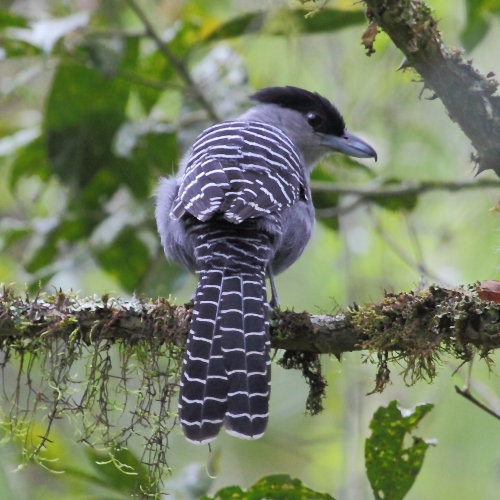
Cocha Antshrike
Thamnophilus praecox
Order: Passeriformes / Family: Thamnophilidae

Wikimedia Commons
About the Cocha Antshrike
The Cocha Antshrike, known scientifically as Thamnophilus praecox, is a member of the Thamnophilidae family, comprising some of the most specialized insectivorous birds in the New World tropics. This species inhabits a limited range within the Amazon Basin, specifically in Ecuador, where it thrives in tropical lowland forests. Its ecological role primarily involves insect population control, as it voraciously consumes a variety of arthropods. The Cocha Antshrike contributes significantly to the biodiversity of its environment, acting as both a predator to insects and occasionally as prey to larger bird species. Its presence indicates a healthy forest ecosystem, as it relies on dense understory vegetation that characterizes pristine habitats. During the breeding season, the Cocha Antshrike exhibits unique behaviors, such as elaborate vocalizations and territorial displays. These activities are crucial for mating success and maintaining territories in their densely vegetated habitats. The bird is an essential component of the local fauna, intricately linked to the seasonal cycles of the Amazon rainforest. In the wet season, increased insect activity provides ample food resources, while the dry season challenges the antshrike with reduced prey availability, leading to more aggressive territorial behaviors and increased vocal activity. Despite its restricted range, the Cocha Antshrike's adaptability to specific habitat niches highlights its evolutionary success in the Amazon Basin, making it a subject of interest for ornithologists and conservationists alike.
The Cocha Antshrike belongs to the family Thamnophilidae, within the order Passeriformes. These birds typically live average 6 years, with a maximum recorded of 10 years..
How to Identify a Cocha Antshrike
The Cocha Antshrike exhibits distinct field marks that facilitate identification. Adult males are characterized by their black plumage with subtle white streaks and a conspicuous white wing bar, a feature that becomes more noticeable in flight. In contrast, females display a rich brown coloration, providing an excellent example of sexual dimorphism. Juvenile Cocha Antshrikes resemble females but are often paler and lack the fully developed wing bars seen in adults. Differentiating between males and females is straightforward due to these stark differences in plumage. The bird's posture, typically upright with a slightly cocked tail, is a useful identification cue. When comparing the Cocha Antshrike to similar species, such as the Black-crowned Antshrike, note the Cocha's more pronounced white wing bar and the males' solid black coloration. In flight, the Cocha Antshrike presents a compact silhouette, with rounded wings and a short tail, aiding in quick maneuverability through dense foliage. While perching, these birds often hold their tails slightly raised, a behavior that can assist observers in the field.
Having trouble telling birds apart? Upload a photo to our bird identification tool for an instant species match.
Cocha Antshrike Habitat and Range
Preferred Habitat
The Cocha Antshrike predominantly inhabits lowland tropical forests, particularly favoring the dense understory near rivers and streams within the Amazon Basin. Its presence is most notable in primary and secondary growth forests, where the complex plant structure provides ample cover and food resources. The species thrives at elevations close to sea level, typically not exceeding 300 meters. Unlike many other bird species, the Cocha Antshrike shows little seasonal habitat shift, maintaining year-round residency in these lush habitats. Urbanization has not significantly impacted its preferred environments, as it avoids urban spaces and heavily altered landscapes, instead thriving in undisturbed areas with rich biodiversity.
Geographic Range
The Cocha Antshrike's range is notably restricted to the Amazon Basin in Ecuador, particularly within the Napo and Orellana provinces. This limited distribution means the species does not undergo long-distance migrations, remaining resident within its habitat throughout the year. Its population density tends to be higher in areas with denser forest cover, where food resources are abundant. The bird's preference for specific habitat conditions limits its range expansion, confining it to regions where the ecological requirements are consistently met. There have been few reports of the Cocha Antshrike outside its known range, emphasizing its relatively sedentary lifestyle in comparison to more migratory relatives.
Want to know which birds visit your area? Browse our backyard birds by location guides for region-specific species lists.
What Does the Cocha Antshrike Eat?
The Cocha Antshrike primarily feeds on insects, including beetles, ants, and caterpillars, which it forages from the forest understory. Its diet may also include small spiders and other arthropods, particularly during the wet season when these are more plentiful. The antshrike employs a methodical foraging technique, gleaning prey from foliage and occasionally hawking insects mid-air. It typically hunts alone or in pairs, avoiding large mixed-species flocks. The bird's ability to exploit various microhabitats allows it to maintain a consistent diet despite seasonal fluctuations in prey availability. During periods of scarcity, the Cocha Antshrike may increase its foraging range to ensure sufficient food intake.
Cocha Antshrike Behavior and Social Structure
Cocha Antshrikes exhibit a solitary or pair-based social structure, with pairs maintaining exclusive territories that they defend vigorously. Territorial disputes involve vocal displays and physical posturing, with males often engaging in wing-fluttering and tail-fanning to assert dominance. During courtship, males perform elaborate displays, including intricate vocalizations, to attract mates. These displays are crucial for pair bonding and successful breeding. The species generally avoids forming large flocks, though it may occasionally join mixed-species foraging groups. When faced with predators, Cocha Antshrikes employ a series of alarm calls and evasive maneuvers, capitalizing on the dense understory for cover. Their daily activity peaks during the early morning and late afternoon, coinciding with peak insect activity.
Cocha Antshrike Nesting and Reproduction
Cocha Antshrikes construct cup-shaped nests from plant fibers, leaves, and twigs, typically located low in dense shrubbery or saplings. The female lays a clutch of two to three eggs, which both parents incubate for approximately 14-16 days. Upon hatching, both parents share feeding responsibilities, providing a diet rich in insects to the chicks. The fledging period lasts around 12-15 days, after which the young birds remain with their parents for additional weeks, learning essential survival skills. The Cocha Antshrike generally raises one brood per year, although favorable conditions may occasionally lead to a second brood.
Cocha Antshrike Sounds and Vocalizations
The primary song of the Cocha Antshrike is a series of clear, melodious whistles that rise and fall in pitch, often described as enchanting and flute-like. These vocalizations play a central role in territory establishment and mate attraction. In addition to its song, the Cocha Antshrike produces a variety of call notes, including sharp 'chip' sounds used for communication between mates and alarm calls when predators are near. During the dawn chorus, its melodious song stands out among the cacophony of the rainforest, often initiating the day’s avian symphony.
Interesting Facts About the Cocha Antshrike
- 1The Cocha Antshrike's name 'praecox' means 'early' in Latin, referring to its early morning vocal activity.
- 2Unlike many birds, Cocha Antshrikes rarely join mixed-species flocks, preferring to forage alone or in pairs.
- 3The species was first described by scientists in 1991, making it a relatively recent addition to ornithology.
- 4Females, with their rich brown plumage, provide excellent camouflage in the forest understory.
- 5Cocha Antshrikes are highly territorial, with males engaging in vocal displays to ward off rivals.
- 6Despite their limited range, Cocha Antshrikes have been the subject of numerous ecological studies due to their unique behaviors.
- 7The Cocha Antshrike's melodious song can carry over long distances, an adaptation to dense forest environments.
Cocha Antshrike Conservation Status
The Cocha Antshrike is currently listed as Near Threatened on the IUCN Red List, with its population trend showing a decline primarily due to habitat destruction. Deforestation for agriculture and logging poses significant threats to its limited range. Conservation efforts focus on habitat preservation and sustainable land management practices in the Amazon Basin. Historical records suggest that the population was once more widespread, but human activities have since fragmented its habitat, leading to its current restricted distribution.