
Colinus Suilium
Colinus suilium
Order: Galliformes / Family: Odontophoridae
About the Colinus Suilium
The Colinus Suilium, commonly referred to as the Suilium Quail, plays a vital role in its ecosystem as both a seed disperser and prey species. Native to Central and South America, this bird frequents regions like the Chaco and Pampas of Argentina, as well as the Cerrado of Brazil. Its presence in these biodiversity hotspots highlights its ecological importance. The Suilium Quail adapts well to varying elevations, from lowland savannas to montane forests, though it prefers areas with ample ground cover for protection and foraging. Seasonal behaviors include forming larger coveys during the non-breeding season to improve survival rates against predators. During the breeding season, pairs become more territorial, establishing distinct home ranges. This quail aids in seed dispersal through its diet, which consists primarily of seeds and insects, thereby contributing to plant propagation and pest control. Its role as prey for larger birds of prey and mammals makes it a crucial component of the food web. The Suilium Quail's adaptability to different habitats underscores its resilience, yet habitat destruction poses a significant threat. Conservation efforts focus on preserving its natural habitats, ensuring the survival of not only the quail but the myriad species that depend on these ecosystems.
The Colinus Suilium belongs to the family Odontophoridae, within the order Galliformes. These birds typically live average 3-4 years with a maximum recorded of 6 years.
How to Identify a Colinus Suilium
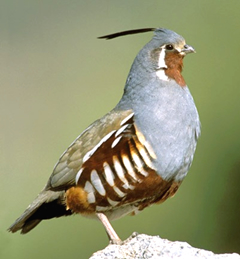
The Colinus Suilium is a small to medium-sized quail with a stout build. Adults display a striking plumage of chestnut brown spotted with white on their underparts, while their upperparts are more uniformly brown with subtle black barring. The male usually presents brighter colors and a more pronounced pattern than the female, which is slightly duller overall. Juveniles resemble females but lack the full intensity of coloration and distinctive markings. The Suilium Quail might be confused with the Northern Bobwhite (Colinus virginianus), but the latter lacks the distinctive chestnut hue of the Suilium. In flight, the Suilium exhibits a rapid fluttering pattern typical of quails, with rounded wings and a short tail, providing a robust, compact silhouette. When perched, it maintains a low profile, often crouching close to the ground in vegetation, which aids in camouflage.
Having trouble telling birds apart? Upload a photo to our bird identification tool for an instant species match.
Colinus Suilium Habitat and Range
Preferred Habitat
Colinus Suilium thrives in a variety of grassland and scrub habitats. It is commonly found in the dense grasslands and shrublands of the Argentine Pampas and the Brazilian Cerrado. These regions offer an abundance of seeds and insects, its primary food sources. The bird prefers elevations ranging from sea level to approximately 1500 meters, favoring areas with dense ground cover. During the breeding season, it seeks out areas with ample vegetation for nesting. While primarily rural, the Suilium Quail can occasionally be spotted on the outskirts of urban areas, particularly where natural habitats remain intact. Seasonal shifts in habitat preference see this quail moving to slightly more open areas during colder months, where foraging is more accessible.
Geographic Range
The Colinus Suilium primarily occupies regions in Central and South America. Its breeding range spans the Chaco region of Paraguay and northern Argentina, extending to the Cerrado and Pantanal areas of Brazil. During winter, the bird may move slightly northward, taking advantage of milder climates. Migration corridors are not well-defined for this species, as it tends to be resident in most of its range. Population density is highest in areas where grasslands meet scrub woodlands, offering optimal foraging and nesting opportunities. In Argentina's Pampas, the Suilium Quail is particularly abundant, owing to the extensive grasslands that provide both food and cover.
Want to know which birds visit your area? Browse our backyard birds by location guides for region-specific species lists.
What Does the Colinus Suilium Eat?
The Colinus Suilium primarily feeds on seeds, making up about 70% of its diet, with the remainder consisting of insects and small invertebrates. This quail favors seeds from native grasses and agricultural crops, such as wheat and sorghum, which it forages for on the ground. During wetter months, when insects are more plentiful, the Suilium supplements its diet with beetles and caterpillars, which provide essential proteins for breeding and rearing young. It employs a ground-scratching technique to uncover food, using its feet to sift through leaf litter and soil. Foraging typically occurs in the early morning and late afternoon, allowing the bird to avoid the midday heat.
Want to attract Colinus Suiliums to your yard? See our recommended feeders and seed types for the best results.
Colinus Suilium Behavior and Social Structure
The Colinus Suilium exhibits a complex social structure, with a tendency to form coveys of up to 20 individuals outside the breeding season. These groups provide safety in numbers, reducing predation risks. During the breeding season, pairs become territorial, with males performing courtship displays that include calling and wing-flapping to attract females. Territorial disputes are common and often involve aggressive interactions. The Suilium is diurnal, with peak activity at dawn and dusk. It relies on dense ground cover for protection against predators, such as hawks and foxes. When threatened, it often freezes or flushes into cover. Its alarm calls serve as an early warning system for the covey.
Colinus Suilium Nesting and Reproduction
The Colinus Suilium constructs its nest on the ground, often concealed under dense vegetation or within tall grass. The nest is a simple scrape lined with grass, leaves, and feathers. Clutch size ranges from 8 to 12 eggs, with the female primarily responsible for incubation, which lasts about 21 to 23 days. Both parents participate in feeding the chicks, which fledge approximately 14 to 16 days after hatching. The Suilium Quail typically raises two broods per year, depending on food availability and environmental conditions. Nest predation by snakes and mammals poses a significant threat, necessitating the selection of well-hidden sites.
Colinus Suilium Sounds and Vocalizations
The Colinus Suilium is known for its loud, clear call, often described as a series of whistled notes that rise in pitch. This call is used primarily during the breeding season and serves to establish territory and attract mates. The bird also produces a variety of other vocalizations, including sharp alarm calls that alert the covey to potential danger. During the dawn chorus, its calls can often be heard resonating across grasslands, forming a vital part of the soundscape. Compared to other quail species, its call is mellower and more musical, lacking the harshness found in some relatives.
Interesting Facts About the Colinus Suilium
- 1Colinus Suilium can form coveys of up to 20 individuals, providing safety in numbers during non-breeding seasons.
- 2This quail's diet consists of about 70% seeds, with the remainder comprising insects and small invertebrates.
- 3During the breeding season, males perform elaborate displays, including wing-flapping and calling, to attract females.
- 4The Suilium Quail constructs its nest on the ground, often using grass and leaves to create a concealed scrape.
- 5Despite its adaptability, the Colinus Suilium faces threats from habitat destruction due to agriculture and urbanization.
- 6The bird's call is a series of whistled notes, often heard during the dawn chorus, contributing to the soundscape of grasslands.
- 7Juveniles resemble females but lack the full intensity of adult coloration, aiding in their camouflage.
Colinus Suilium Conservation Status
Currently, the Colinus Suilium is not listed as threatened by the IUCN, but habitat loss due to agriculture and deforestation poses a growing risk. Population trends vary by region; in areas where habitat is preserved, the species appears stable. Conservation efforts focus on habitat preservation and restoration, particularly in regions like the Argentine Pampas and Brazilian Cerrado. Historically, population numbers have fluctuated with land-use changes, highlighting the importance of sustainable agricultural practices. Conservation programs aim to balance human activity with the needs of this and other native species.
Attracting Colinus Suiliums to Your Feeder
The Colinus Suilium is a regular visitor to backyard bird feeders across its range. At the Eye On The Fly feeding station, we observe Colinus Suiliums regularly and capture footage with our feeder cameras.
Other Odontophoridae Species


Birds Similar to the Colinus Suilium
These species are often confused with the Colinus Suilium due to similar appearance or overlapping range.
