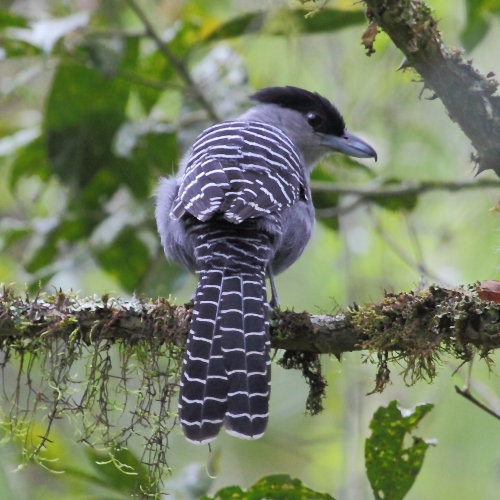
Cordillera Azul Antbird
Myrmoderus eowilsoni
Order: Passeriformes / Family: Thamnophilidae

Wikimedia Commons
About the Cordillera Azul Antbird
The Cordillera Azul Antbird, scientifically known as Myrmoderus eowilsoni, is a captivating species endemic to the dense lowland forests of the Cordillera Azul National Park in Peru. This species has become a symbol of the region's rich biodiversity, offering a unique glimpse into the ecological dynamics of its habitat. As a member of the Thamnophilidae family, this antbird plays a crucial role in the ecosystem by regulating insect populations through its feeding habits. These birds are often found flitting through the dense understory, their presence more often detected by their distinctive calls than by sight.
Their significance extends beyond their ecological role. The discovery of the Cordillera Azul Antbird helped bring international attention to the need for conservation efforts in the region. The varying seasonal behaviors of Myrmoderus eowilsoni add to its allure. During the breeding season, pairs become highly territorial, displaying complex vocalizations to assert dominance and secure nesting sites. In the non-breeding season, these antbirds may form loose flocks with other species, showcasing a more social aspect of their nature. Such interactions highlight the species' adaptability and its role in sustaining the intricate balance of the forest ecosystem.
The Cordillera Azul Antbird's existence is tightly interwoven with the health of its rainforest habitat. Conservation efforts aimed at preserving these forests directly impact the survival chances of this unique bird. By studying the Cordillera Azul Antbird, researchers gain insights into the broader health of the rainforest ecosystem, making it a valuable indicator species. Its presence signifies a thriving habitat, capable of supporting a diverse array of life forms, including many yet to be discovered or fully understood.
The Cordillera Azul Antbird belongs to the family Thamnophilidae, within the order Passeriformes. These birds typically live average 5-7 years with a maximum recorded of 10 years..
How to Identify a Cordillera Azul Antbird
Identifying the Cordillera Azul Antbird in the field involves observing several key features. Adult plumage showcases a striking combination of deep blue and black, with males often displaying more vibrant coloration than females. Males have a distinctive blue crown and back, while the underparts are predominantly black. Females, on the other hand, tend to exhibit a duller blue with more grayish tones on the back and breast, contributing to sexual dimorphism in the species.
Juveniles differ from adults, often having more muted tones and less defined markings, which can make them harder to distinguish from similar species. They gradually develop the adult plumage as they mature, typically over several months. In flight, the Cordillera Azul Antbird presents a compact silhouette with rapid, direct wingbeats. When perched, it often holds its tail slightly cocked, a typical posture among antbirds, which aids in species identification.
Confusion with similar species can occur, particularly with other members of the Myrmoderus genus. However, the combination of vocalizations, habitat preference, and distinctive coloration usually aids in proper identification. The Cordillera Azul Antbird's unique calls, combined with its bright plumage, make it a memorable sight for birders fortunate enough to encounter it.
Having trouble telling birds apart? Upload a photo to our bird identification tool for an instant species match.
Cordillera Azul Antbird Habitat and Range
Preferred Habitat
The Cordillera Azul Antbird thrives in the lowland tropical rainforests of the Cordillera Azul National Park in Peru. This park, covering vast tracts of pristine forest, provides the ideal environment for the antbird's survival. The dense understory and abundant leaf litter create a perfect backdrop for their foraging activities and nesting requirements.
Typically found at elevations ranging from 400 to 1,200 meters, the Cordillera Azul Antbird shows a preference for areas with high humidity and dense canopy cover. These conditions support a rich diversity of insects, which form the bulk of their diet. While primarily a forest bird, it occasionally ventures into adjacent shrublands or secondary growth areas, particularly during non-breeding seasons when competition for resources is lower.
The species shows little tolerance for urban environments or highly disturbed habitats, emphasizing the importance of preserving intact forest ecosystems. Their presence in forested areas signifies healthy habitats, as they rely heavily on the ecosystem's integrity for survival.
Geographic Range
The Cordillera Azul Antbird is endemic to Peru, specifically within the boundaries of the Cordillera Azul National Park. This narrow range makes them particularly vulnerable to habitat changes but also highlights the park as a biodiversity hotspot. Unlike many birds with extensive migratory paths, the Cordillera Azul Antbird remains largely resident within its range throughout the year.
Their breeding range is confined to the humid lowland forests, where they establish territories and engage in reproductive activities. As a non-migratory species, they do not undertake long-distance migrations, instead exhibiting local movements in response to resource availability. These movements might include minor altitudinal shifts to exploit seasonal food resources but generally remain within a relatively small geographical area.
Population density tends to be higher in regions where the forest is most intact and undisturbed. These areas, often characterized by rich biodiversity, provide ample food resources and suitable nesting sites, supporting stable populations of the Cordillera Azul Antbird.
Want to know which birds visit your area? Browse our backyard birds by location guides for region-specific species lists.
What Does the Cordillera Azul Antbird Eat?
The Cordillera Azul Antbird primarily feeds on insects, playing a significant role in regulating these populations within its habitat. Their diet consists of ants, beetles, spiders, and other small invertebrates, which they skillfully extract from the leaf litter and understory vegetation.
Foraging techniques of the Cordillera Azul Antbird are both methodical and efficient. They often engage in a behavior known as sallying, where they perch quietly before darting out to snatch prey in mid-air or from foliage. This technique requires precision and speed, reflecting their adaptation to the complex rainforest environment. On the ground, they may also scratch through leaf litter to uncover hidden insects.
Seasonal changes can influence their diet, with certain prey items becoming more or less abundant at different times of the year. During wetter months, when insect activity is at its peak, these antbirds may expand their dietary preferences to include a wider range of arthropods. Their feeding schedule is primarily diurnal, with peak foraging activity occurring in the early morning and late afternoon, aligning with the periods of highest insect activity.
Cordillera Azul Antbird Behavior and Social Structure
The Cordillera Azul Antbird displays a fascinating array of behaviors, reflective of its complex social and ecological interactions. They are generally monogamous, with pairs maintaining territories and exhibiting strong site fidelity. Territorial behavior is prominent during the breeding season, with pairs vigorously defending their chosen area from intruders through a combination of vocalizations and physical displays.
Courtship displays are a captivating aspect of their behavior, often involving synchronized movements and vocal duets between mates. These displays serve to strengthen pair bonds and ensure successful breeding. Outside of the breeding season, these antbirds may exhibit more social tendencies, occasionally forming mixed-species flocks with other understory birds. This behavior likely aids in predator detection and increases foraging efficiency.
Their response to predators includes alarm calls and erratic flight patterns to confuse and evade potential threats. Daily activity patterns are largely dictated by light levels, with most foraging and social interactions occurring during daylight hours. As dusk approaches, these birds retreat to secure roosting sites, where they remain until the first light of dawn.
Cordillera Azul Antbird Nesting and Reproduction
The nesting habits of the Cordillera Azul Antbird reflect their adaptation to the dense rainforest environment. Nests are typically cup-shaped and constructed with a combination of twigs, leaves, and plant fibers, providing camouflage and protection from predators. These nests are often placed low in the understory, within dense vegetation, to further conceal them from potential threats.
Clutch size generally consists of two to three eggs, a common trait among antbirds, which balances the need for reproductive success with the challenges of raising young in a predator-rich environment. Both parents participate actively in incubation duties, which last approximately two weeks. This shared responsibility extends to feeding and caring for the chicks once they hatch.
The fledging timeline is relatively short, with young birds leaving the nest within two to three weeks of hatching. Parental roles are clearly defined, with males often taking on a more prominent role in territorial defense, while females focus on nurturing the young. Typically, the Cordillera Azul Antbird produces one to two broods per year, depending on environmental conditions and resource availability.
Cordillera Azul Antbird Sounds and Vocalizations
The vocalizations of the Cordillera Azul Antbird are a key characteristic, aiding in both identification and behavioral studies. Their primary song consists of a series of melodious whistles, often rising in pitch and delivered in a rapid sequence. This song serves multiple purposes, including territory establishment and mate attraction.
In addition to their primary song, these antbirds produce a variety of call notes, ranging from sharp, repetitive chips to more complex alarm calls in response to threats. Alarm calls are delivered with a more urgent tempo, often prompting nearby birds to take cover or investigate potential dangers.
During the dawn chorus, the Cordillera Azul Antbird becomes particularly vocal, contributing to the symphony of sounds that characterizes the rainforest at first light. Comparisons can be drawn between their vocalizations and those of other antbird species, although the Cordillera Azul Antbird's calls tend to be more melodious and less harsh, reflecting their unique acoustic niche within the forest environment.
Interesting Facts About the Cordillera Azul Antbird
- 1The Cordillera Azul Antbird was named in honor of famed biologist Edward O. Wilson, highlighting its significance in the field of biodiversity.
- 2Despite being a relatively recent discovery, the Cordillera Azul Antbird has become a flagship species for conservation efforts in the region.
- 3This species is known for its unique sallying behavior, a foraging technique that involves swift movements to catch prey.
- 4The antbird's habitat in the Cordillera Azul National Park is home to over 6,000 plant species, emphasizing the biodiversity of the region.
- 5The Cordillera Azul Antbird's song is used in scientific studies to understand acoustic communication in dense forest environments.
- 6Their preference for undisturbed forests makes them a critical indicator species for assessing ecosystem health.
- 7Cordillera Azul National Park, the bird's primary habitat, spans an impressive 13,500 square kilometers, providing crucial protection.
Cordillera Azul Antbird Conservation Status
The conservation status of the Cordillera Azul Antbird is currently classified as Near Threatened by the IUCN. This classification reflects concerns about habitat loss and fragmentation, which pose significant threats to their survival. The primary driver of these threats is deforestation, often linked to agricultural expansion and illegal logging activities. Population trends for the Cordillera Azul Antbird suggest a gradual decline, primarily due to the reduction in suitable habitat. Conservation efforts within the Cordillera Azul National Park aim to mitigate these threats by protecting existing forested areas and promoting sustainable land use practices. Historically, the bird's population remained stable due to the remote and inaccessible nature of its habitat. However, recent pressures have underscored the need for continued vigilance and action to ensure the species' long-term survival. Efforts to raise awareness and engage local communities in conservation initiatives have shown promise, contributing to a broader understanding of the importance of preserving this unique bird and its habitat.