Corvus cecilae
Corvus cecilae
Order: Passeriformes / Family: Corvidae
About the Corvus cecilae
The Corvus cecilae, a remarkable member of the Corvidae family, is an intelligent and adaptable bird found primarily in temperate regions. Known commonly as the Cecilia's crow, this bird exhibits a strong presence in both rural and urban settings. It thrives in a variety of environments, including deciduous and mixed forests, agricultural fields, and metropolitan areas. The species plays a significant ecological role by controlling insect populations and aiding in seed dispersal, thus contributing to the health of its ecosystems.
Cecilia's crow is particularly significant due to its high cognitive abilities, which include problem-solving skills and the use of tools. This intelligence is not just captivating to ornithologists but also offers insights into avian brain function and the evolution of intelligence across species. The Corvus cecilae's ability to thrive in diverse environments makes it a subject of interest for studies on adaptation and urban ecology.
Throughout the year, the Corvus cecilae displays varied behaviors. In spring, the breeding season begins, marked by complex courtship displays and vocalizations. As summer progresses, these birds become more territorial, defending their nesting sites aggressively. By autumn, they shift focus towards foraging, taking advantage of the seasonal abundance of food. During winter, Cecilia's crow is less territorial, often seen in larger flocks that roost together for warmth and protection. This seasonal behavioral shift highlights the bird's adaptability and social structure.
The Corvus cecilae belongs to the family Corvidae, within the order Passeriformes. These birds typically live typically 8-12 years, with a maximum recorded of 16 years..
How to Identify a Corvus cecilae
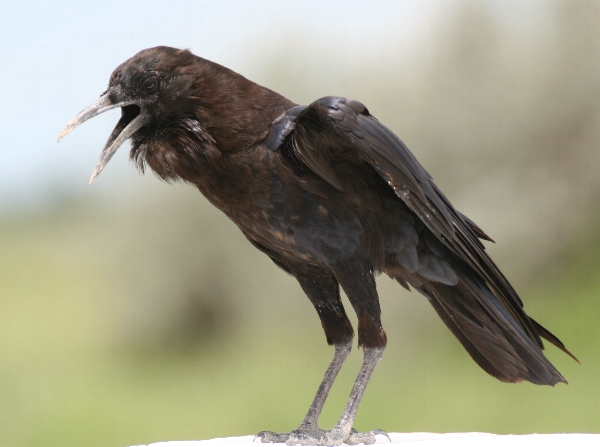
The Corvus cecilae is a medium-sized bird, measuring approximately 45-50 centimeters in length. Its plumage is predominantly glossy black, which can appear iridescent in sunlight, showcasing hints of blue and purple. Adults possess a sturdy black bill and dark eyes that contribute to their keen and intelligent expression.
Juvenile Corvus cecilae can be distinguished by their slightly duller plumage and brown-tinted feathers, which gradually darken as they mature. Unlike many bird species, there is minimal sexual dimorphism in this species, with males and females appearing quite similar. However, males tend to be marginally larger and heavier.
In flight, Cecilia's crow presents a robust silhouette with broad wings and a fan-shaped tail. Its flight is direct and purposeful, characterized by strong and steady wingbeats. When perching, this bird often adopts an upright posture, its sharp gaze scanning the surroundings. Similar species such as the common raven (Corvus corax) can be differentiated by their larger size and wedge-shaped tail.
Having trouble telling birds apart? Upload a photo to our bird identification tool for an instant species match.
Corvus cecilae Habitat and Range
Preferred Habitat
Corvus cecilae thrives in a variety of habitats, including deciduous and mixed forests, where it finds ample food and nesting sites. It is equally comfortable in agricultural landscapes, often seen foraging in fields and orchards. Urban areas provide an abundance of food sources and nesting opportunities, making cities a favored habitat.
The species is adaptable to elevations ranging from sea level to mountainous regions up to 2000 meters. It demonstrates seasonal habitat shifts, favoring areas with abundant food supply during winter and more secluded nesting sites in spring. Unlike some other birds, the Corvus cecilae is not restricted to pristine environments and is frequently observed in human-modified landscapes.
Geographic Range
The Corvus cecilae is primarily found across the temperate zones of Europe and Asia. Its breeding range extends from the western parts of Europe, including Spain and France, through Central Europe to the temperate regions of Russia. During the breeding season, populations are dense in regions like the Black Forest in Germany and the Carpathian Mountains.
In winter, some populations may migrate southward, although many remain year-round residents in their breeding areas, especially in milder climates. The bird's adaptability allows it to occupy both densely populated cities and rural countryside. Migration corridors are less defined compared to other species, as many birds prefer to stay within their home range, relying on their ability to find food and shelter in varied environments.
Want to know which birds visit your area? Browse our backyard birds by location guides for region-specific species lists.
What Does the Corvus cecilae Eat?
The diet of Corvus cecilae is omnivorous, comprising a wide range of food sources. Primary foods include insects, small mammals, and bird eggs, which are abundant during the breeding season. In autumn and winter, the bird shifts its diet to include more plant material, such as seeds, fruits, and nuts.
Cecilia's crow employs diverse foraging techniques, including ground foraging and aerial hunting. It is known for its ability to use tools to access food, showcasing its intelligence. The bird's feeding schedule is flexible, often foraging both in the early morning and late afternoon. Prey size varies, though it typically targets small animals that can be easily subdued.
Corvus cecilae Behavior and Social Structure
Corvus cecilae exhibits complex social structures and behaviors. It is known for its territorial tendencies during the breeding season, often engaging in vocal displays and aerial chases to defend its territory. Courtship involves intricate displays, with males showcasing their agility and vocal prowess to attract females.
Outside the breeding season, Cecilia's crow is more gregarious, forming flocks that can number in the dozens. These flocks often roost communally, providing safety in numbers and shared warmth during cold nights. The bird's daily activity pattern includes peak activity during dawn and dusk, with periods of rest and preening in between.
In response to predators, Corvus cecilae relies on its alertness and vocal alarms to warn conspecifics. It may mob predators collectively, using its intelligence and social structure to mitigate threats.
Corvus cecilae Nesting and Reproduction
Corvus cecilae builds large, sturdy nests predominantly in tall trees, though it occasionally nests on buildings or cliffs. The nest is constructed from twigs and lined with softer materials such as grass, feathers, and moss.
The typical clutch size ranges from 3 to 5 eggs, with both parents sharing incubation duties over a period of approximately 18-21 days. After hatching, both parents are involved in feeding the chicks, which fledge about 30-35 days post-hatching. Cecilia's crow usually raises one brood per year, though a second brood may occur if conditions are favorable. The parental roles are well-defined, with males providing food while females primarily tend to the young.
Corvus cecilae Sounds and Vocalizations
The primary song of Corvus cecilae is a series of varied caws, with a rhythm that is both deliberate and resonant. The pitch can vary, but it is generally low and carries well over long distances. Call notes include a harsher, more abrupt 'kra-kra,' often used in alarm or when alerting others to danger.
During the dawn chorus, Cecilia's crow displays its full vocal range, combining melodic and harsh calls in a complex sequence. Compared to other corvids, its calls are distinct yet can be reminiscent of the American crow, though with a more musical quality.
Interesting Facts About the Corvus cecilae
- 1Corvus cecilae can recognize individual human faces, displaying memory skills comparable to primates.
- 2This species has been observed using sticks as tools to extract insects from tree bark.
- 3Cecilia's crow can mimic sounds, including human speech, in controlled environments.
- 4It participates in 'funerals,' where groups gather quietly around deceased conspecifics.
- 5The bird's brain-to-body size ratio is one of the largest among avian species, indicating high intelligence.
- 6Corvus cecilae often engages in play behavior, such as sliding down snowy slopes for enjoyment.
- 7Its problem-solving abilities have been likened to those of the great apes in comparative studies.
Corvus cecilae Conservation Status
Currently, the IUCN lists Corvus cecilae as a species of Least Concern, reflecting its stable population status. Despite urbanization and habitat modification, the bird has maintained healthy numbers due to its adaptability. However, localized threats include habitat destruction and pollution. Conservation efforts focus on habitat preservation and reducing human-wildlife conflicts. Historical population changes have shown resilience, with the bird often rebounding in numbers following periods of decline.
Other Corvidae Species


Birds Similar to the Corvus cecilae
These species are often confused with the Corvus cecilae due to similar appearance or overlapping range.