
Crested Bobwhite
Colinus cristatus
Order: Galliformes / Family: Odontophoridae

Wikimedia Commons
About the Crested Bobwhite
The Crested Bobwhite (Colinus cristatus) is a fascinating bird native to Central and South America. Its presence is significant across countries like Colombia, Venezuela, and parts of the Caribbean, where it inhabits grasslands, savannas, and open woodlands. The species plays a crucial ecological role as both predator and prey, controlling insect populations while serving as a food source for larger predators. During the breeding season, these birds become more vocal and active, often heard before seen. Their calls resonate through the open fields and understory, signaling territory establishment and attracting mates. Crested Bobwhites exhibit seasonal behavioral changes, adapting to the wet and dry cycles typical of their habitats. In the dry season, they may shift their focus closer to water sources, while during the wet season, they take advantage of the abundant food supply and begin nesting activities. The bird's adaptability to various semi-open habitats allows it to thrive, even as human activity encroaches on natural landscapes. This adaptability is evident in their occasional presence in agricultural fields and pasturelands, where they continue to find resources and nesting sites. As a member of the family Odontophoridae, the Crested Bobwhite contributes to the biodiversity of the ecosystems it inhabits, maintaining the balance by participating in seed dispersal and insect control. Their presence is a testament to the health of their ecosystem, making them an essential species for conservationists to monitor.
The Crested Bobwhite belongs to the family Odontophoridae, within the order Galliformes. These birds typically live average 2-3 years, with some living up to 5 years..
How to Identify a Crested Bobwhite
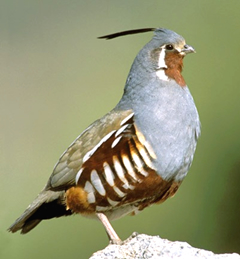
Crested Bobwhites are small, compact birds, measuring around 20 to 23 cm in length. They are easily recognized by their prominent crest and intricate plumage. Adult males display a striking combination of black, white, and chestnut on their faces, with a distinct white throat patch. Their bodies are adorned with a rich mix of brown, black, and white, providing excellent camouflage in their natural habitat. Females are slightly duller, with more muted tones of brown and white, lacking the stark facial contrasts of the males. Juveniles resemble females but are paler and more uniformly colored. In flight, Crested Bobwhites exhibit a rounded silhouette with rapid wingbeats, typical of many ground-dwelling birds. Their wings are short and rounded, aiding in quick, agile flight over short distances rather than endurance flying. While perched, they maintain a low profile, often remaining motionless to avoid detection. Confusion with other quail species is possible, but the Crested Bobwhite's distinctive crest and facial markings are reliable identifying features. Observers should note the bird's behavior and habitat as additional clues for identification.
Having trouble telling birds apart? Upload a photo to our bird identification tool for an instant species match.
Crested Bobwhite Habitat and Range
Preferred Habitat
Crested Bobwhites inhabit a variety of open and semi-open habitats across their range. They are particularly fond of grasslands, savannas, and open woodlands, often at elevations from sea level up to 1,500 meters. These birds adapt well to disturbed areas, including agricultural fields and pasturelands, as long as there are patches of natural vegetation for cover and foraging. During the dry season, they may be found near water sources, seeking moisture and food. Seasonal shifts in habitat preference are influenced by resource availability. In wetter periods, they spread out into less dense areas, capitalizing on the abundance of insects and seeds. While generally avoiding urban areas, Crested Bobwhites can occasionally be spotted on the outskirts of towns where suitable habitat persists. Their ability to thrive in varied environments highlights their resilience and adaptability.
Geographic Range
The Crested Bobwhite's range extends across much of Central and South America, primarily in countries such as Colombia, Venezuela, and into the Guianas. Their range includes parts of the Caribbean, particularly Trinidad and Tobago. They are non-migratory, residing year-round in their preferred habitats. Population densities are highest in regions with abundant grasslands and savannas, where food and cover are plentiful. Unlike many other bird species, Crested Bobwhites do not undertake long migrations, though they may move locally in response to climatic conditions and food availability. This sedentary nature allows for stable population monitoring, although changes in land use and habitat destruction can impact local populations significantly.
Want to know which birds visit your area? Browse our backyard birds by location guides for region-specific species lists.
What Does the Crested Bobwhite Eat?
Crested Bobwhites have a varied diet consisting primarily of seeds, grains, and insects. During the wet season, their diet shifts to include more insects, which are abundant and provide necessary protein for breeding and raising young. They forage on the ground, often in small groups, using their bills to sift through leaf litter and soil. They eat a wide range of seeds and grains, such as those from grasses and cultivated crops, making them occasional visitors to agricultural areas. Insects such as beetles, ants, and grasshoppers form an important part of their diet, especially during the breeding season. Foraging occurs throughout the day, with peaks in activity during the cooler morning and late afternoon hours.
Want to attract Crested Bobwhites to your yard? See our recommended feeders and seed types for the best results.
Crested Bobwhite Behavior and Social Structure
Crested Bobwhites are generally social birds, often seen in small coveys outside the breeding season. These groups provide safety in numbers, reducing the risk of predation. During the breeding season, males establish territories and perform courtship displays to attract females, often involving vocalizations and posturing. The species exhibits a distinctive territoriality, with males defending their chosen area through calls and occasional physical confrontations. These birds are diurnal, with most activity occurring in the early morning and late afternoon. They spend much of the day foraging, resting during the hotter midday hours. In response to predators, Crested Bobwhites rely on their cryptic plumage to remain undetected, often freezing in place until the threat has passed. When necessary, they take flight with sudden bursts of speed to escape danger.
Crested Bobwhite Nesting and Reproduction
Crested Bobwhites prefer to nest on the ground, often concealing their nests within tall grass or under shrubs. The nests are shallow depressions lined with grass, leaves, and feathers, providing a soft base for the eggs. Clutch sizes typically range from 8 to 14 eggs, with incubation lasting about 21 to 23 days. Both males and females may participate in nest building, but females primarily handle incubation duties. Once hatched, chicks are precocial, leaving the nest shortly after birth to follow their parents. Fledging occurs within two to three weeks, though young remain with the parents for several weeks thereafter. Depending on environmental conditions, Crested Bobwhites may raise one or two broods per year, with nesting activities closely tied to the rainy season.
Crested Bobwhite Sounds and Vocalizations
The primary song of the Crested Bobwhite is a clear, whistled 'bob-white' or 'bob-bob-white', often repeated several times in succession. This call is used by males to establish territory and attract mates. Their repertoire also includes various clucks and whistles used for communication within groups. Alarm calls are sharp and abrupt, serving to alert the covey to potential danger. These vocalizations are most frequent during the early morning hours, forming part of the dawn chorus that characterizes many tropical environments. The Crested Bobwhite's calls can be likened to a clear whistling, reminiscent of other quail species yet distinct in its rhythm and tone.
Interesting Facts About the Crested Bobwhite
- 1Crested Bobwhites can produce up to 14 eggs per clutch, one of the largest among quail species.
- 2Their distinctive 'bob-white' call is used by males to attract mates and establish territory.
- 3Crested Bobwhites are capable of quick, explosive flights, but they prefer to remain grounded.
- 4The species is non-migratory, residing in the same areas year-round, adapting to local seasonal changes.
- 5Juvenile Crested Bobwhites can leave the nest within hours of hatching, showcasing their precocial nature.
Crested Bobwhite Conservation Status
The Crested Bobwhite is currently classified as Least Concern by the IUCN, with stable populations across much of its range. However, habitat loss due to agricultural expansion and land conversion poses ongoing threats. Conservation efforts focus on habitat preservation and maintaining ecological corridors to ensure genetic diversity. Historically, populations have fluctuated in response to environmental changes, highlighting the importance of monitoring and adaptive management. In some areas, hunting can also impact local numbers, though it remains a lesser threat compared to habitat alteration. Ensuring sustainable land use practices remains crucial for the long-term conservation of this species.
Attracting Crested Bobwhites to Your Feeder
The Crested Bobwhite is a regular visitor to backyard bird feeders across its range. At the Eye On The Fly feeding station, we observe Crested Bobwhites regularly and capture footage with our feeder cameras.
Other Odontophoridae Species


Birds Similar to the Crested Bobwhite
These species are often confused with the Crested Bobwhite due to similar appearance or overlapping range.
