
Crested Guineafowl
Guttera pucherani
Order: Galliformes / Family: Numididae
Wikimedia Commons
About the Crested Guineafowl
The Crested Guineafowl (Guttera pucherani), a member of the Numididae family, captivates bird enthusiasts with its unique appearance and fascinating behaviors. This species thrives in the diverse habitats of sub-Saharan Africa, from the dense rainforests of the Congo Basin to the open savannas of East Africa. The Crested Guineafowl plays a significant ecological role as both a seed disperser and an insect predator, contributing to the balance of its ecosystem. During the breeding season, which varies by region but typically peaks after the rainy season, these birds engage in complex courtship displays that underscore their social nature. While primarily non-migratory, the Crested Guineafowl may undertake local movements in response to food availability or climatic conditions. This adaptability allows the species to maintain stable populations despite environmental changes. The Crested Guineafowl's presence in diverse environments underscores its ecological versatility, as it navigates both tropical forests and open woodlands. Its diet comprises a wide range of seeds, insects, and small invertebrates, which it forages from the forest floor, often in the company of conspecifics. By consuming a variety of food items, the Crested Guineafowl helps control insect populations and aids in seed dispersal, promoting forest regeneration. The Crested Guineafowl's social structure is evident in its year-round flocking behavior, as groups of up to 20 individuals move together in search of food. These flocks exhibit a complex social hierarchy, with dominant individuals leading the search for resources. Such sociality not only facilitates efficient foraging but also offers protection against predators. When threatened, these birds rely on their swift running abilities rather than flight, an adaptation that suits their terrestrial lifestyle. The Crested Guineafowl's ecological importance extends beyond its immediate environment, as it serves as a prey species for larger predators, thus occupying a crucial niche within the food web. Conservation efforts for the Crested Guineafowl focus on preserving its natural habitats, as deforestation and habitat fragmentation pose significant threats to its populations. The species is currently classified as Least Concern by the IUCN, yet ongoing habitat loss necessitates vigilant conservation measures. Understanding the Crested Guineafowl's role within its ecosystem highlights the interconnectedness of species and the importance of maintaining biodiversity.
The Crested Guineafowl belongs to the family Numididae, within the order Galliformes. These birds typically live typically around 10 years in the wild, with certain individuals living up to 15 years..
How to Identify a Crested Guineafowl
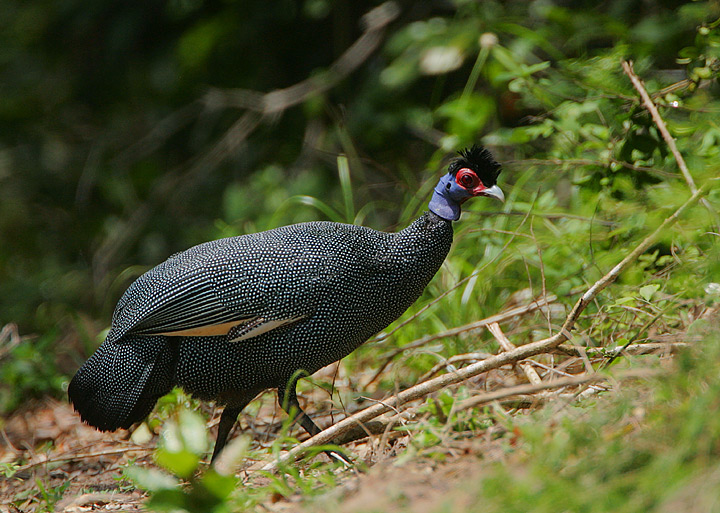
The Crested Guineafowl's unmistakable appearance makes it a favorite among birdwatchers. Adult Crested Guineafowls display a predominantly black plumage, intricately patterned with white spots that provide excellent camouflage in dappled forest light. A distinctive mop-like crest of curly black feathers adorns the head, setting it apart from other guineafowl species. In terms of size, these birds measure approximately 50-56 cm in length, with males generally being slightly larger than females. Juveniles resemble adults but may have less distinct spotting and a shorter crest. Both sexes share similar plumage, but males may exhibit more robust body size during mating displays. In flight, the Crested Guineafowl shows a rounded wing silhouette, with short, broad wings that are more adapted for rapid bursts of speed rather than sustained flight. When perched, these birds maintain an upright posture that accentuates their crest and spotty appearance. While the Crested Guineafowl could be confused with other guineafowl species, its unique crest and specific spotting pattern provide clear differentiators.
Having trouble telling birds apart? Upload a photo to our bird identification tool for an instant species match.
Crested Guineafowl Habitat and Range
Preferred Habitat
The Crested Guineafowl inhabits a range of habitats across sub-Saharan Africa, demonstrating remarkable adaptability. It thrives in tropical and subtropical forests, including the rainforests of Central Africa and the miombo woodlands of Southern Africa. These birds are also found in savannas, provided there is sufficient underbrush for cover. Typically, the Crested Guineafowl resides at elevations from sea level up to 2000 meters, though they prefer areas with dense vegetation for foraging and protection. Seasonal habitat shifts occur primarily due to changes in food availability, with these birds moving to areas where insect and seed abundance peaks. The Crested Guineafowl tends to avoid heavily urbanized areas, but it can be occasionally spotted in rural farmlands adjacent to forests, where it benefits from the diverse food resources found at the forest edges.
Geographic Range
The Crested Guineafowl's range extends across a broad swath of sub-Saharan Africa, from the western fringes of Sierra Leone and Ghana to the eastern landscapes of Kenya and Tanzania. In Central Africa, populations are robust in countries like the Democratic Republic of the Congo and Gabon. The bird's presence is also noted in the woodlands of Zambia and Angola, as well as the coastal forests of Mozambique. These birds are primarily resident, although local movements occur in response to environmental factors such as rainfall and food availability. Population density hotspots include the rich biodiversity of the Congo Basin and the Rift Valley regions, where the complex mix of habitats supports large flocks. Despite the bird's wide distribution, habitat fragmentation and deforestation threaten local populations, underscoring the need for habitat conservation.
Want to know which birds visit your area? Browse our backyard birds by location guides for region-specific species lists.
What Does the Crested Guineafowl Eat?
The Crested Guineafowl's diet is diverse, comprising primarily of seeds, insects, and small invertebrates. During the wet season, when the insect population is at its peak, the guineafowl consumes large quantities of beetles, ants, and termites, using its strong beak to probe the leaf litter. As the dry season approaches, their diet shifts towards seeds and fallen fruits, which they forage from the forest floor. They have been observed scratching the ground with their feet to uncover hidden food sources. The size of prey varies, but they typically capture insects less than 2 cm long. Feeding primarily occurs during the cooler morning and late afternoon hours, allowing the birds to avoid midday heat. This dietary flexibility not only aids in their survival but also supports ecosystem health by controlling insect populations and facilitating seed dispersal.
Crested Guineafowl Behavior and Social Structure
The Crested Guineafowl exhibits complex social behaviors, often forming flocks that enhance their foraging efficiency and provide protection against predators. Each flock comprises 10-20 individuals, with a well-established hierarchy that dictates foraging order and mating opportunities. During the breeding season, males engage in elaborate courtship displays, characterized by bobbing movements and vocalizations to attract females. Territorial behavior is pronounced, with flocks defending their feeding grounds against rival groups. When threatened, the Crested Guineafowl relies on its remarkable running speed to escape, often taking refuge in dense underbrush rather than taking flight. Daily activity patterns revolve around feeding, with peak activity in the early morning and late afternoon. At night, the birds roost in trees, a behavior that reduces predation risk.
Crested Guineafowl Nesting and Reproduction
Crested Guineafowls nest on the ground, favoring secluded sites with dense vegetation for cover. The nest itself is a simple scrape, lined with leaves and grass to provide insulation and camouflage. During the breeding season, females lay clutches of 4-8 eggs, with the incubation period lasting approximately 23-26 days. The female primarily undertakes incubation duties while the male stands guard. Once hatched, chicks are precocial, leaving the nest shortly after birth to follow their parents in search of food. Both parents participate in rearing the young, teaching them vital survival skills. The fledging period lasts around 2-3 weeks, after which the chicks join the flock. Typically, Crested Guineafowls breed once a year, although favorable conditions can lead to multiple broods.
Crested Guineafowl Sounds and Vocalizations
The Crested Guineafowl's vocalizations are an essential aspect of its social interactions. Its primary call is a resonant "kow-kow-kow," repeated in quick succession, serving both as a contact call and a territorial signal. These birds also produce a series of sharp clucks and whistles, particularly during alarm situations. The alarm calls are rapid and high-pitched, alerting the flock to potential danger. At dawn, the guineafowl's calls become more frequent and varied, contributing to the morning chorus that fills the forest. Their vocalizations, while not melodious, are distinctive and vital for maintaining group cohesion.
Interesting Facts About the Crested Guineafowl
- 1The Crested Guineafowl's distinctive crest consists of curly feathers, resembling a mop, which is unique among guineafowls.
- 2Despite their ability to fly, Crested Guineafowls prefer running and can reach impressive speeds when evading predators.
- 3These birds play a crucial role in controlling insect populations, consuming a wide variety of insects during the wet season.
- 4Crested Guineafowls are known to form social flocks, sometimes mingling with other bird species to enhance foraging success.
- 5Their ground-nesting habits make Crested Guineafowls particularly vulnerable to predation, necessitating well-camouflaged nests.
- 6The Crested Guineafowl's range covers a vast area, but it is most commonly found in the biodiverse Congo Basin.
- 7Their intricate plumage pattern, with white spots on black feathers, provides excellent camouflage in dappled light environments.
Crested Guineafowl Conservation Status
The Crested Guineafowl is currently listed as Least Concern by the IUCN, with stable population trends across most of its range. Primary threats include habitat destruction due to logging and agricultural expansion, which reduce available nesting and foraging sites. Conservation efforts focus on habitat preservation and the establishment of protected areas to ensure sustainable populations. While historically the population has remained stable, ongoing habitat loss in critical regions necessitates continued vigilance to prevent future declines.
Other Numididae Species


Birds Similar to the Crested Guineafowl
These species are often confused with the Crested Guineafowl due to similar appearance or overlapping range.