
Vulturine Guineafowl
Acryllium vulturinum
Order: Galliformes / Family: Numididae

Wikimedia Commons
About the Vulturine Guineafowl
The Vulturine Guineafowl (Acryllium vulturinum), distinguished by its striking cobalt blue chest and bare neck, is the largest and most visually stunning of all guineafowl species. Native to eastern Africa, it is primarily found across Kenya, Ethiopia, Somalia, and Tanzania. This bird thrives in arid and semi-arid regions, often inhabiting savannas and scrublands. Its ecological role is significant, as it plays a vital part in controlling insect populations and dispersing seeds through its droppings.
The guineafowl's preference for open landscapes allows it to capitalize on the sparse vegetation for foraging. It feeds on a diverse diet consisting of insects, seeds, and small reptiles, adjusting its diet seasonally based on availability. During the wet season, the Vulturine Guineafowl moves towards areas that offer abundant food resources, while in the dry season, it retreats to more sheltered environments. This adaptability showcases its resilience to fluctuating environmental conditions.
Socially, the Vulturine Guineafowl is a gregarious bird, often found in flocks ranging from a dozen to several hundred individuals. These flocks exhibit a complex social hierarchy, with established pecking orders and cooperative behaviors. The guineafowl's brilliant plumage is not merely for show; it serves as a signal during courtship and plays a role in maintaining group cohesion. This species' vibrant presence in its native ecosystems underscores its ecological importance, as it contributes to both the natural beauty and biodiversity of the regions it inhabits.
The Vulturine Guineafowl belongs to the family Numididae, within the order Galliformes. These birds typically live typically around 15 years in the wild, with a maximum recorded lifespan of 20 years..
How to Identify a Vulturine Guineafowl
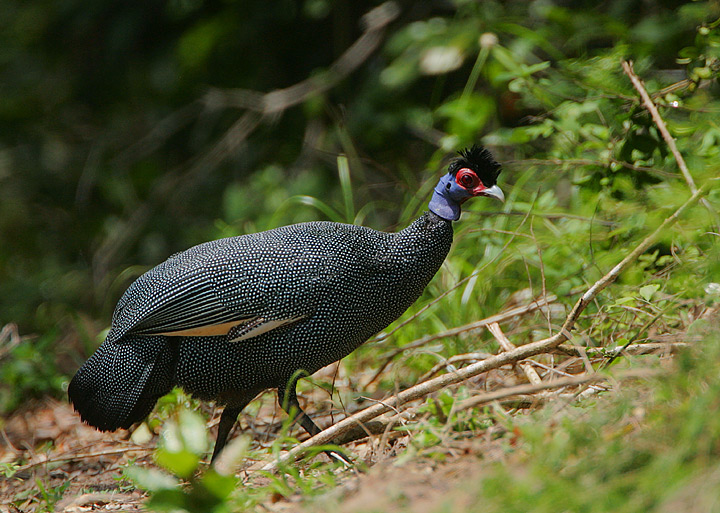
The Vulturine Guineafowl is easily identified by its vivid blue chest, elongated neck with a bare, pale head, and strikingly striped black-and-white wings. Adults possess a unique silhouette, accentuated by their long necks and tails. Juvenile guineafowls display a duller plumage, which gradually intensifies as they mature. Differentiating between males and females can be challenging, as both sexes exhibit similar plumage. However, males tend to be slightly larger, a characteristic observable when they group together.
Confusion with other guineafowl species may occur, yet the Vulturine Guineafowl's distinctive blue and white markings and size set it apart. When viewed in flight, the bird's wings appear short and rounded, while its tail feathers trail noticeably, offering an unmistakable profile. Perched, they maintain an upright stance, often scanning the surroundings for predators or other potential threats.
Despite its vibrant appearance, the Vulturine Guineafowl's coloration provides effective camouflage in the dappled light of its native scrubland habitat. Observers can often spot these birds by looking for their characteristic movements across open grounds, where they frequently forage in groups.
Having trouble telling birds apart? Upload a photo to our bird identification tool for an instant species match.
Vulturine Guineafowl Habitat and Range
Preferred Habitat
The Vulturine Guineafowl primarily inhabits the dry savannas and scrublands of eastern Africa. It prefers regions with sparse vegetation, which facilitate easy movement and foraging. These habitats typically include areas with scattered acacia trees and low-lying shrubs. The guineafowl rarely ventures into densely wooded areas, favoring open landscapes where it can quickly detect predators.
While most commonly found at low elevations, this bird occasionally occupies higher altitudes if the terrain remains open and arid. Seasonal habitat shifts occur, with guineafowl moving towards wetter areas during the dry season to access water and food sources. Conversely, during the wet season, they may spread out into more arid zones as resources become abundant.
In terms of urban presence, the Vulturine Guineafowl is less frequently encountered in cities, primarily sticking to rural areas where its natural habitat remains intact. However, it may occasionally be spotted in agricultural lands adjacent to its preferred environments, where it takes advantage of crop residues and insects.
Geographic Range
The Vulturine Guineafowl's range extends across eastern Africa, with significant populations in Kenya, Somalia, Ethiopia, and Tanzania. This bird is non-migratory, maintaining a year-round presence within these regions, although it may undertake local movements in response to seasonal changes in resource availability.
During the breeding season, guineafowl tend to concentrate in areas that offer ample food and nesting sites, such as the savannas and open woodlands of Kenya and northern Tanzania. Ethiopia's semi-arid regions also support substantial numbers, with the birds inhabiting both protected areas and private lands.
While the Vulturine Guineafowl is not considered a long-distance migrant, its local movements are essential for survival. These movements are often influenced by rainfall patterns, prompting shifts in population density and temporary hotspots in areas where food and water are plentiful. Despite its regional movements, the guineafowl remains a staple resident of eastern Africa's diverse avian community.
Want to know which birds visit your area? Browse our backyard birds by location guides for region-specific species lists.
What Does the Vulturine Guineafowl Eat?
The Vulturine Guineafowl's diet is diverse and adaptable, primarily consisting of seeds, insects, and small vertebrates. Seasonal changes in food availability influence its dietary habits. During the wet season, when insect populations flourish, guineafowls primarily feed on beetles, ants, and termites, which provide essential protein.
In the dry season, seeds and fruits become more prominent in their diet. They forage by scratching the ground with their strong feet to uncover hidden seeds and insects. This behavior is crucial for maintaining their energy levels, especially when insect availability decreases.
The guineafowl's foraging technique is both opportunistic and cooperative. Within flocks, individuals communicate and share information about food sources. This social feeding strategy increases their efficiency in locating and exploiting food resources. Smaller prey such as lizards and small snakes are occasionally consumed, supplementing their diet with additional protein. Feeding primarily occurs during the cooler parts of the day, early morning, and late afternoon, which helps the birds avoid the midday heat.
Vulturine Guineafowl Behavior and Social Structure
The Vulturine Guineafowl exhibits complex social behaviors, typically forming large flocks that can number in the hundreds. These flocks maintain a hierarchical structure, with dominant individuals often leading foraging expeditions. Social bonds within the flock are strong, aiding in predator detection and resource sharing.
Courtship displays are both intricate and vibrant, involving a series of calls, struts, and wing displays. Males showcase their striking plumage to attract females, often engaging in competitive displays with rival suitors. Once paired, guineafowl pairs remain monogamous, cooperating in raising their young.
In terms of daily activity, the Vulturine Guineafowl is diurnal, with most of its activities concentrated in the early morning and late afternoon. During these times, they forage, engage in social interactions, and perform maintenance behaviors such as preening. The midday hours are typically reserved for resting in shaded areas to avoid the intense heat.
When faced with threats, these birds rely on their keen eyesight and group alertness. Alarm calls signal the presence of predators, prompting the flock to either freeze and blend into the background or scatter in multiple directions, confusing the threat.
Vulturine Guineafowl Nesting and Reproduction
Vulturine Guineafowl nest on the ground, often choosing secluded locations under shrubs or within thickets. The nest itself is a shallow depression lined with grass, leaves, and feathers, providing some insulation and camouflage.
The typical clutch size ranges from 6 to 12 eggs, which are cream-colored with speckles. Both parents play active roles during the nesting period, with females primarily responsible for incubation, lasting around 24 to 26 days. Males contribute by guarding the nest and providing food to the incubating female.
Once the chicks hatch, they are precocial, meaning they are relatively mature and mobile. Both parents guide the young in foraging and offer protection against predators. Fledging occurs about 4 to 5 weeks after hatching, though the young remain dependent on their parents for several months, learning essential survival skills.
The Vulturine Guineafowl typically produces one brood per year, though in optimal conditions, especially in areas with abundant resources, they may attempt a second breeding cycle in the same season.
Vulturine Guineafowl Sounds and Vocalizations
The Vulturine Guineafowl produces a range of vocalizations, with its primary song being a series of rapid, high-pitched calls that resemble a cackle. This song is often heard at dawn and dusk, serving as a territorial and communication signal within the flock.
In addition to their primary song, they emit a variety of call notes, including a low, repeated cluck used for maintaining contact when foraging. Alarm calls are sharp and piercing, designed to alert the flock to potential danger quickly.
These vocalizations are not only crucial for communication but also play a significant role in courtship. Males vocalize more frequently during the breeding season, using their calls to establish territory and attract females.
In the quiet of an African savanna morning, the guineafowl's chorus can be a defining soundscape feature, providing insight into their dynamic social structure and the rich biodiversity of their habitat.
Interesting Facts About the Vulturine Guineafowl
- 1The Vulturine Guineafowl is the largest of all guineafowl species, reaching up to 61-71 cm in length.
- 2This guineafowl can form flocks of up to 200 birds, showcasing its highly social nature.
- 3Despite their striking appearance, Vulturine Guineafowls are adept at blending into their scrubland environments.
- 4These birds are capable of short bursts of flight, but they prefer to run at speeds up to 30 km/h when threatened.
- 5The species' bare head and neck, reminiscent of vultures, help prevent overheating in the hot African climate.
- 6Vulturine Guineafowls play a crucial role in their ecosystem by controlling insect populations and dispersing seeds.
- 7Their call is often described as a 'kek-kek-kek,' which can be heard over long distances in their native habitats.
Vulturine Guineafowl Conservation Status
The Vulturine Guineafowl is currently listed as Least Concern by the IUCN, with a stable population trend. Despite this status, certain threats persist, including habitat degradation due to agricultural expansion and human encroachment. While the bird is not currently considered endangered, localized declines have occurred in areas where their natural habitat is heavily altered. Conservation efforts focus on habitat preservation and ensuring that key savanna and scrubland ecosystems remain intact. Historically, the Vulturine Guineafowl has maintained a robust presence across its native range, yet continuous monitoring is crucial. Conservationists advocate for protected areas and sustainable land-use practices to safeguard these birds for future generations. Community involvement in conservation, such as eco-tourism initiatives that highlight the guineafowl's beauty and ecological importance, has become an increasingly effective strategy in promoting awareness and protection efforts.
Other Numididae Species


Birds Similar to the Vulturine Guineafowl
These species are often confused with the Vulturine Guineafowl due to similar appearance or overlapping range.