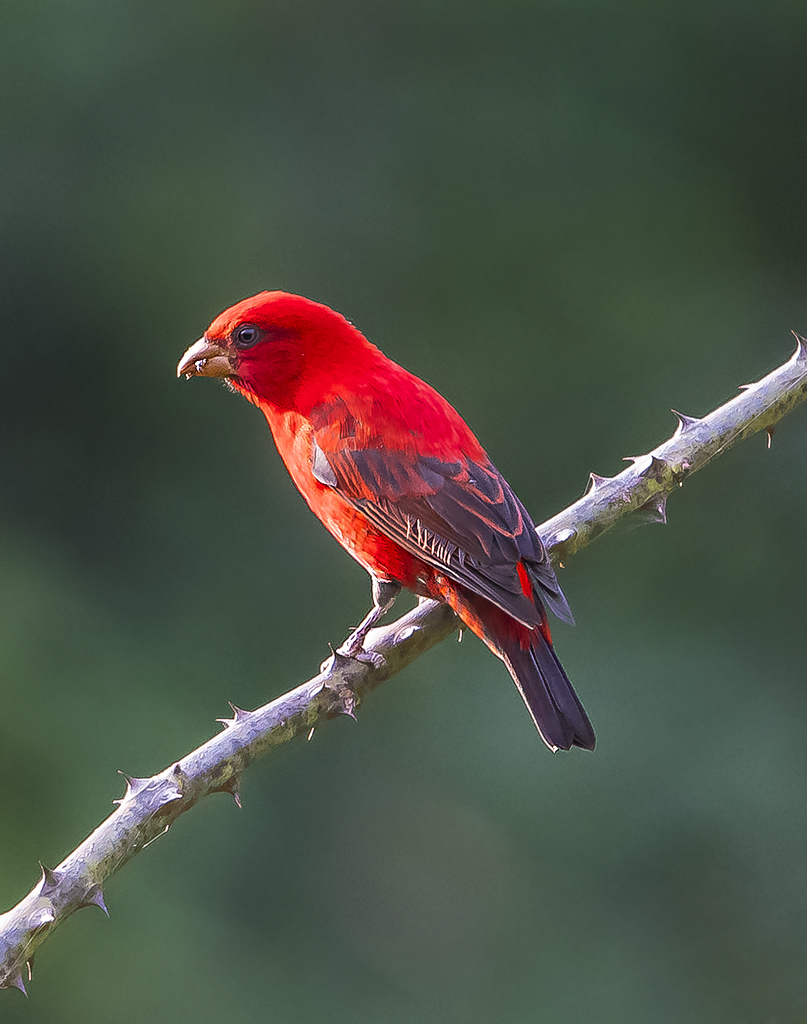
Crimson-browed Finch
Carpodacus subhimachalus
Order: Passeriformes / Family: Fringillidae

Wikimedia Commons
About the Crimson-browed Finch
The Crimson-browed Finch, scientifically known as Carpodacus subhimachalus, is a captivating bird species belonging to the Fringillidae family. It thrives in the temperate and subtropical regions of Asia, particularly in the Himalayan range, Tibet, and Myanmar. This finch is notable for its vivid plumage and social behavior, often spotted in flocks. It plays a crucial ecological role in seed dispersal, particularly in high-altitude forests where it frequently resides.
The significance of the Crimson-browed Finch lies in its contribution to the biodiversity of mountainous ecosystems. It often inhabits mixed forests, consisting of rhododendrons and oaks, which form an integral part of the Himalayan biodiversity. In these regions, the finch participates in the complex food web, acting both as a seed disperser and a prey species to various raptors. Its presence indicates a healthy ecosystem, where it contributes to the stability and diversity of plant life.
Seasonal behaviors of the Crimson-browed Finch include altitudinal migration, where flocks descend to lower elevations during colder months in search of food. Such migrations are vital for the survival of the species, as they allow the finch to exploit different habitats and resources throughout the year. This seasonal movement also influences the finch's role in local ecosystems, as it interacts with different plant and animal communities across its range.
The Crimson-browed Finch belongs to the family Fringillidae, within the order Passeriformes. These birds typically live average 5-7 years, with a maximum recorded of 10 years..
How to Identify a Crimson-browed Finch
The Crimson-browed Finch is distinguished by its vibrant red brow, which gives the species its name. Adult males exhibit a striking crimson forehead and eyebrow, complemented by a rosy pink breast and underparts. Their wings are primarily brown with two white wing bars, while their back and tail are olive-brown. Females and juveniles, however, display more subdued coloration, with brownish tones and less pronounced red markings, making them more challenging to identify.
In contrast to similar species, the Crimson-browed Finch's robust size, about 20 cm in length, and its distinctive red brow make it relatively easier to identify, especially when compared to other finches in its range. The flight silhouette of the finch is characterized by a steady, undulating pattern, common among finches. When perched, it maintains an upright posture, often in the company of conspecifics or other bird species.
Juvenile Crimson-browed Finches resemble females but with more defined streaking, which fades as they mature into their adult plumage. While male and female finches can be distinguished by their coloration, their size and shape remain consistent, aiding in identification by birders.
Having trouble telling birds apart? Upload a photo to our bird identification tool for an instant species match.
Crimson-browed Finch Habitat and Range
Preferred Habitat
Crimson-browed Finches predominantly inhabit temperate and subtropical forests. They prefer the montane regions of the Himalayas, often dwelling in mixed woodland areas rich in rhododendrons and oaks. These forests provide ample food sources and nesting sites. The finch typically occupies elevations ranging from 2,500 to 4,000 meters, though it may descend to lower altitudes during winter months. Seasonal habitat shifts occur as the birds migrate between higher and lower elevations to find food and suitable climatic conditions.
In rural settings, the Crimson-browed Finch can be found in forest edges and clearings, where it forages on the ground. It rarely ventures into urban areas, as its preferred habitat consists of densely wooded regions that offer both protection and food resources. This preference for less disturbed habitats highlights the importance of conserving forested areas within its range.
Geographic Range
The geographical range of the Crimson-browed Finch encompasses parts of South and Southeast Asia. It predominantly breeds in the Himalayan regions, spanning countries such as Nepal, Bhutan, and India. During the breeding season, these finches are more concentrated in dense alpine and subalpine forests. In the winter, they descend to lower elevations, expanding their range to include parts of Tibet, northern Myanmar, and western China.
Migration corridors primarily run along the Himalayan foothills, where the finches can find necessary resources during their altitudinal movements. These corridors are critical for their survival, providing access to seasonal food supplies. Population density hotspots are often found in undisturbed forested areas, where the availability of seeds and nesting sites supports larger flocks.
Though the Crimson-browed Finch is considered uncommon in certain parts of its range, its adaptability to different elevations allows it to occupy a wide geographical area, contributing to its relative abundance in suitable habitats.
Want to know which birds visit your area? Browse our backyard birds by location guides for region-specific species lists.
What Does the Crimson-browed Finch Eat?
The diet of the Crimson-browed Finch mainly consists of seeds, making it an important seed disperser in its ecosystem. It shows a preference for seeds from trees like rhododendrons and various conifers, which are abundant in its habitat. In addition to seeds, it consumes a variety of berries and fruits, particularly during the breeding season when these food sources are more readily available.
In the winter, when seeds become scarce, the finch supplements its diet with buds and small insects, demonstrating dietary adaptability. This seasonal diet change ensures its survival during periods of food scarcity. Foraging typically occurs in flocks, with birds systematically moving through the forest canopy and ground level.
The finch's foraging technique includes picking seeds directly from cones or the ground, displaying remarkable dexterity with its bill. Such behavior not only sustains the finch but also aids in the propagation of various plant species within its range.
Crimson-browed Finch Behavior and Social Structure
Crimson-browed Finches exhibit social behavior, often forming small flocks outside of the breeding season. These flocks provide protection against predators, as multiple eyes can detect threats more efficiently. During the breeding season, however, they become more territorial, with males defending their chosen area through song and display.
Courtship involves intricate displays, where the male exhibits its vibrant plumage and sings to attract a mate. Once paired, the finches work cooperatively to build a nest and rear their young. The species displays limited aggression, generally avoiding conflict unless directly threatened.
In response to predators, such as hawks and eagles, the finches utilize alarm calls to alert their flock and take cover in dense foliage. Daily activity patterns include foraging during the morning and late afternoon, while midday is often spent resting in shaded areas. Their social structure and behavioral adaptability contribute to their success in varied environments.
Crimson-browed Finch Nesting and Reproduction
Crimson-browed Finches construct cup-shaped nests using twigs, moss, and grass. They prefer to place these nests in dense foliage, often in rhododendron or oak trees, which offer both concealment from predators and protection from the elements. The typical clutch size ranges from 3 to 5 eggs, with both parents sharing the responsibility of incubation.
The incubation period lasts approximately 12 to 14 days, during which time the female primarily incubates while the male provides food. Once hatched, the chicks remain in the nest for about 14 to 18 days before fledging. Both parents participate actively in feeding the chicks, ensuring a steady supply of insects and seeds.
The Crimson-browed Finch generally produces one brood per year, although in optimal conditions, a second brood may occur. This reproductive strategy aligns with the availability of food resources and favorable weather conditions in their mountainous habitat.
Crimson-browed Finch Sounds and Vocalizations
The primary song of the Crimson-browed Finch is a series of melodious whistles and trills, characterized by a rhythmic, rising and falling pattern. This song is often used by males during the breeding season to establish territory and attract mates. In addition to their song, these finches produce a variety of call notes, including soft 'chip' sounds used for communication within flocks.
Alarm calls are sharper and more urgent, serving to alert other birds to potential dangers. During the dawn chorus, the finch's song contributes to the symphony of bird calls that fill the Himalayan forests, creating a vibrant soundscape.
Comparatively, the song of the Crimson-browed Finch is less complex than some other finches, but its clear, flute-like quality makes it a distinctive sound within its range.
Interesting Facts About the Crimson-browed Finch
- 1The Crimson-browed Finch has a wingspan of approximately 25 to 30 cm, allowing agile flight in dense forests.
- 2This finch's bright red brow is particularly pronounced in males, serving as a key feature in mate attraction.
- 3Crimson-browed Finches can often be seen in mixed-species flocks, enhancing their foraging efficiency.
- 4During courtship, males perform a unique display involving singing and spreading their wings to showcase their plumage.
- 5Despite their vivid coloration, these finches blend well into their environment, thanks to their olive-brown back.
- 6The altitudinal migration of Crimson-browed Finches helps them avoid harsh winter conditions at higher elevations.
- 7They play a vital role in seed dispersal, contributing to the regeneration of forest ecosystems.
Crimson-browed Finch Conservation Status
The IUCN currently lists the Crimson-browed Finch as a species of Least Concern, indicating a stable population trend. However, localized threats such as habitat destruction due to logging and agriculture pose potential risks. Conservation efforts focus on preserving the montane forests that are crucial for the finch's survival. Historical changes in population distribution have been influenced by habitat modification and climate change, which affect the availability of suitable breeding and foraging sites. Conservationists emphasize the importance of protected areas and sustainable forestry practices to ensure that the finch's habitats remain intact. While the species is not currently endangered, ongoing monitoring and habitat conservation are essential to maintain stable population levels in the face of environmental changes.
Other Fringillidae Species


Birds Similar to the Crimson-browed Finch
These species are often confused with the Crimson-browed Finch due to similar appearance or overlapping range.