
Dark-throated Oriole
Oriolus xanthonotus
Order: Passeriformes / Family: Oriolidae
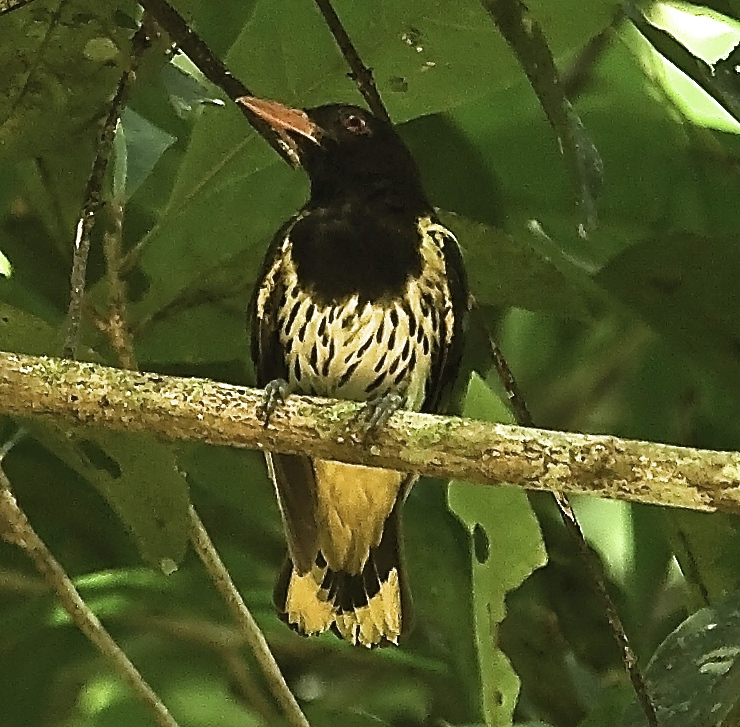
Wikimedia Commons
About the Dark-throated Oriole
The Dark-throated Oriole (Oriolus xanthonotus) stands out in the avian world with its vivid yellow body and contrasting black throat, a feature that not only aids in species identification but also adds to its allure. This bird is primarily found in the tropical rainforests of Southeast Asia, specifically across the Malay Peninsula, Sumatra, and Borneo. Its presence in these regions underscores its preference for humid, dense forest habitats where it plays a crucial role in the ecosystem. As a member of the family Oriolidae, the Dark-throated Oriole contributes to seed dispersal and pest control, which are vital ecological functions. Their diet consists largely of fruits, insects, and small invertebrates, allowing them to influence the population dynamics of both plant and prey species. Seasonally, these orioles display some movement within their range, often dependent on food availability. During the breeding season, which typically occurs during the warmer months, they become more vocal and territorial, establishing and defending their nesting sites. In contrast, the non-breeding season sees them becoming somewhat nomadic in pursuit of abundant food sources. The Dark-throated Oriole's role as both predator and prey creates a delicate balance in its ecosystem, making it an essential component of the forest biodiversity. Its striking appearance and melodious song add an aesthetic dimension to the vibrant soundscape of its habitat, while its behaviors reflect the intricate dynamics of tropical forest life.
The Dark-throated Oriole belongs to the family Oriolidae, within the order Passeriformes. These birds typically live average 8-10 years with a max recorded of 13 years.
How to Identify a Dark-throated Oriole
The Dark-throated Oriole is easily recognized by its striking plumage. Adult birds exhibit a vibrant yellow body contrasted sharply by a deep black throat, a feature that gives the species its name. The wings and tail are also marked with black, adding to the striking appearance. Typically, the male and female are similar in coloration, although the male may display slightly more pronounced black markings. Juveniles, on the other hand, are duller in appearance, possessing a more muted yellow and less distinct black throat patch, which can make them slightly harder to identify at first glance. Compared to similar species, such as the Black-naped Oriole, the Dark-throated Oriole lacks the prominent black nape and instead has a more extensive black throat. In flight, the oriole presents a sleek silhouette with pointed wings and a slightly forked tail, a typical characteristic of the Oriolidae family. When perched, the oriole often sits upright, showing off its bright underparts and contrasting dark head, allowing for easy identification even from a distance. The bird's distinctive coloration and posture make it relatively straightforward to distinguish from other sympatric forest species.
Having trouble telling birds apart? Upload a photo to our bird identification tool for an instant species match.
Dark-throated Oriole Habitat and Range
Preferred Habitat
The Dark-throated Oriole favors the lush tropical rainforests of Southeast Asia, thriving in the humid, dense foliage of areas like the Malay Peninsula, Sumatra, and Borneo. These evergreen forests provide ample cover and abundant food resources essential for their survival. Typically found at low to mid-elevations, they are most commonly observed in primary and secondary forests. However, they also adapt to partially disturbed areas, provided there is sufficient tree cover. Unlike some other oriole species, the Dark-throated Oriole seldom ventures into urban or highly agricultural areas, preferring the natural shelter and resources of the forest. Seasonal shifts may see them move to slightly different elevations or forest types as they track food availability, but they predominantly remain tied to forested habitats year-round.
Geographic Range
The Dark-throated Oriole's range is primarily concentrated in Southeast Asia, with significant populations on the Malay Peninsula, Sumatra, and Borneo. These regions represent their core breeding areas where they are most commonly observed. Unlike many migratory species, the Dark-throated Oriole does not undertake long-distance migrations but may exhibit some altitudinal or local movements in response to food availability. Within these regions, they inhabit a variety of forest types but remain most abundant in primary rainforests. Population densities tend to be higher in undisturbed forest areas, where the availability of food and nesting sites is optimal. Despite this preference, they can sometimes be found in secondary forests, indicating a degree of adaptability. However, they are rarely, if ever, found outside the tropical confines of their Southeast Asian range.
Want to know which birds visit your area? Browse our backyard birds by location guides for region-specific species lists.
What Does the Dark-throated Oriole Eat?
The diet of the Dark-throated Oriole is primarily frugivorous, featuring a variety of fruits and berries that the forests of Southeast Asia abundantly provide. Figs are a particular favorite, though they also consume other soft fruits available in their habitat. In addition to fruit, they supplement their diet with insects and small invertebrates, especially during the breeding season. This provides the necessary protein for raising young and maintaining adult health. Their foraging behavior involves gleaning insect prey from leaves and branches, showcasing a methodical approach to feeding. The oriole's ability to exploit both fruit and insect resources allows it to adapt to seasonal variations in food availability. Feeding predominantly occurs during daylight hours, with peak activity in the early morning and late afternoon when the forest is cooler and prey more active.
Dark-throated Oriole Behavior and Social Structure
Socially, the Dark-throated Oriole tends to be more solitary or seen in pairs rather than large flocks. During the breeding season, they exhibit territorial behavior, with males often engaging in displays to establish dominance and attract mates. These displays include vocalizations and physical posturing, which are essential for maintaining territory boundaries. Courtship involves the male performing a series of calls and displaying plumage to the female. Outside the breeding season, they may join mixed-species foraging flocks, which can offer safety in numbers and increased foraging efficiency. The oriole's daily routine includes periods of foraging interspersed with rest, typically in the cooler parts of the day. In response to predators, they are vigilant and rely on their agility to escape threats, often taking cover in dense foliage. Their alarm calls are sharp and alert other birds to potential danger.
Dark-throated Oriole Nesting and Reproduction
Dark-throated Orioles construct their nests high in the forest canopy, choosing locations that offer both security and proximity to food sources. The nest is a deep, cup-shaped structure woven from plant fibers, twigs, and leaves, providing a sturdy yet flexible cradle for their eggs. Typically, a female lays a clutch of two to three eggs, which she incubates for about two weeks. During this period, the male plays a supportive role, often bringing food to the female and helping defend the nesting territory. After hatching, both parents share in feeding the chicks, which fledge approximately three weeks post-hatching. The species typically raises one brood per year, although in optimal conditions, a second brood is possible. The nesting period is a time of increased activity and vigilance, as parents are diligent in protecting their young from predators.
Dark-throated Oriole Sounds and Vocalizations
The Dark-throated Oriole possesses a rich vocal repertoire, with its primary song being a melodious series of whistles and flutelike notes, resonating through the forest canopy. These songs serve both to attract mates and to establish territorial boundaries. In addition to their song, they have a variety of calls used for communication, including softer contact calls and sharper alarm calls that alert to the presence of predators. During the dawn chorus, their songs are particularly prominent, adding a vibrant auditory component to the forest environment. The oriole's calls and songs are distinctive, yet they can vary slightly between individuals, offering a unique acoustic signature that keen birders can use to identify them.
Interesting Facts About the Dark-throated Oriole
- 1The Dark-throated Oriole has a particularly strong beak, adapted for cracking open hard fruit seeds.
- 2Despite their striking colors, Dark-throated Orioles can be surprisingly elusive, often blending into the dappled forest light.
- 3They are known to mimic the calls of other birds, a trait that may confuse predators and competitors alike.
- 4The oriole's name, 'Oriolus', comes from the Latin word for gold, reflecting their bright yellow plumage.
- 5Dark-throated Orioles have a mutualistic relationship with certain fruiting trees, aiding in seed dispersal.
- 6Their melodious song has been likened to a flute, offering a musical backdrop to the Southeast Asian forests.
- 7Oriolus xanthonotus is one of several oriole species that exhibit minimal sexual dimorphism, making male and female birds difficult to distinguish.
Dark-throated Oriole Conservation Status
The Dark-throated Oriole is currently listed as Least Concern by the IUCN, though its population is affected by the ongoing loss of habitat due to deforestation. While not considered endangered, the reduction of suitable habitat poses a significant long-term threat. Conservation efforts in the region focus on preserving large tracts of rainforest and promoting sustainable land-use practices to ensure these vibrant ecosystems remain intact. Historically, populations have fluctuated with habitat availability, and continued monitoring is essential to assess future trends. Protecting primary forests and encouraging reforestation in degraded areas are critical strategies to maintain healthy populations of this striking species.
Other Oriolidae Species


Birds Similar to the Dark-throated Oriole
These species are often confused with the Dark-throated Oriole due to similar appearance or overlapping range.

