Deep-blue Flowerpiercer
Diglossa glauca
Order: Passeriformes / Family: Thraupidae

Wikimedia Commons
About the Deep-blue Flowerpiercer
The Deep-blue Flowerpiercer, scientifically named Diglossa glauca, is a remarkable member of the Thraupidae family, widely recognized for its distinct deep-blue plumage. This small yet conspicuous bird is primarily found in the Andean regions of South America, particularly thriving in the montane forests of Bolivia, Peru, and Ecuador. Its preference for mid-elevation cloud forests, typically ranging from 1,500 to 3,200 meters, makes it a resident of some of the most biodiverse areas on the planet. The Deep-blue Flowerpiercer plays a significant ecological role due to its unique feeding habits, which involve piercing the bases of flowers to access nectar, often bypassing pollination processes. This behavior has implications for the plant species it interacts with, as they may not always receive the benefits of pollination. However, the bird's presence is an integral part of the complex ecological tapestry of its habitat, contributing to the dynamic interactions within these ecosystems. Seasonally, the Deep-blue Flowerpiercer exhibits some altitudinal movements, typically descending to lower elevations during harsher weather, though it is generally considered a resident species. Its adaptability to different elevations and habitats within its ecological range underscores its resilience and importance in the montane forest ecosystems of the Andes.
The Deep-blue Flowerpiercer belongs to the family Thraupidae, within the order Passeriformes. These birds typically live 7-9 years with a maximum recorded of 11 years.
How to Identify a Deep-blue Flowerpiercer
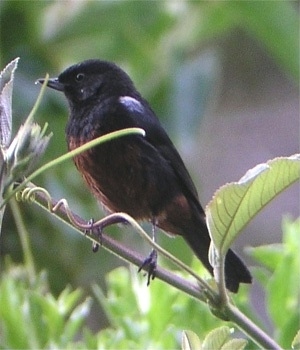
The adult Deep-blue Flowerpiercer is easily identifiable by its vibrant deep-blue plumage, which shimmers in sunlight, offering a striking contrast against the lush green backdrop of its montane forest habitat. Males display this intense blue coloration more vividly, while females tend to have a slightly duller blue with some grayish tinges, particularly on the underparts. Juveniles resemble females but with even more subdued coloring and less defined markings. The bird's sturdy, slightly curved bill is a specialized adaptation for its flower-piercing feeding habit, setting it apart from other tanagers and similar-sized birds. In flight, the Deep-blue Flowerpiercer presents a compact silhouette with rapid wingbeats, typical of small passerines. When perched, it maintains an upright posture, often seen flitting energetically among flowering shrubs. While its coloration is distinctive, ensuring it is not confused with other blue-tinged birds such as certain Euphonias or Blue Dacnises, its unique bill shape and feeding behavior are the most reliable field markers.
Having trouble telling birds apart? Upload a photo to our bird identification tool for an instant species match.
Deep-blue Flowerpiercer Habitat and Range
Preferred Habitat
The Deep-blue Flowerpiercer inhabits the montane cloud forests of the Andes, where it thrives in dense, humid environments rich in flowering plants. Preferentially found at elevations between 1,500 and 3,200 meters, it frequents areas where fog and mist create a lush, diverse ecosystem. These habitats often include a rich understory of shrubs and small trees which provide ample feeding opportunities. The bird shows a marked preference for regions with high floral density, as its diet relies heavily on nectar obtained through its specialized feeding technique. While primarily a resident of remote forested areas, occasional sightings have been reported in semi-urban gardens that mimic its natural habitat conditions.
Geographic Range
The range of the Deep-blue Flowerpiercer primarily encompasses the Andean mountain range, with significant populations in Bolivia, Peru, and Ecuador. It resides predominantly in montane forest regions, with its presence concentrated in local hotspots where floral abundance is high. This species does not undertake long-distance migrations, but it may exhibit altitudinal shifts, descending to lower elevations during adverse weather conditions. Its distribution is largely restricted to specific mountainous areas, where it maintains stable populations in suitable habitats.
Want to know which birds visit your area? Browse our backyard birds by location guides for region-specific species lists.
What Does the Deep-blue Flowerpiercer Eat?
The Deep-blue Flowerpiercer's diet primarily consists of nectar, which it extracts by puncturing the bases of flowers with its specialized bill. This piercing method allows the bird to access nectar directly without facilitating pollination. In addition to nectar, the bird supplements its diet with small insects and arthropods, which provide essential proteins. Seasonal variations in flowering plants influence its dietary choices, with the bird showing adaptability to the availability of different floral resources. Foraging occurs throughout the day, with peak activity during the early morning and late afternoon, coinciding with optimal nectar flow.
Want to attract Deep-blue Flowerpiercers to your yard? See our recommended feeders and seed types for the best results.
Deep-blue Flowerpiercer Behavior and Social Structure
Socially, the Deep-blue Flowerpiercer often forages alone or in pairs, though it may join mixed-species flocks during periods of high feeding activity. Territorial behavior is observed during the breeding season, with males exhibiting aggressive displays to defend feeding sites and nesting areas. Courtship involves aerial displays and vocalizations, with the male showcasing his plumage to attract a mate. In response to predators, the bird employs swift, agile flight and may seek cover in dense foliage. Daily activity peaks during cooler parts of the day, with periods of rest in shaded areas during midday heat.
Deep-blue Flowerpiercer Nesting and Reproduction
The Deep-blue Flowerpiercer typically constructs its nest in dense shrubs or small trees, utilizing a combination of twigs, moss, and other plant materials. Nests are often situated at heights ranging from 1 to 3 meters above ground, providing concealment from predators. The typical clutch size ranges from two to three eggs, with an incubation period of approximately 12 to 14 days. Both parents share responsibilities in incubating the eggs and feeding the hatchlings. Fledging occurs after 15 to 17 days, with parents continuing to care for the young for several weeks post-fledging. Typically, the species raises one to two broods per year, depending on environmental conditions.
Deep-blue Flowerpiercer Sounds and Vocalizations
The primary song of the Deep-blue Flowerpiercer is a melodious series of high-pitched notes, delivered in rapid succession. These notes create a rhythmic and musical quality, often described as a series of whistles interspersed with trills. Call notes are sharper and more abrupt, serving as contact calls between individuals. Alarm calls are more strident, signaling the presence of potential threats. During the dawn chorus, the bird's song blends with the myriad of other avian sounds, contributing to the rich acoustic tapestry of its montane forest habitat.
Interesting Facts About the Deep-blue Flowerpiercer
- 1The Deep-blue Flowerpiercer's bill is uniquely adapted to pierce flowers, a trait almost exclusive to the Diglossa genus.
- 2Despite its small size, the Deep-blue Flowerpiercer plays a crucial role in its ecosystem by influencing pollination through its feeding habits.
- 3The bird's vivid blue coloration serves as a natural camouflage against the bright, flower-laden environments it inhabits.
- 4Researchers have noted that the Deep-blue Flowerpiercer can alter its feeding strategy based on the floral species available, showcasing behavioral flexibility.
- 5The Andean cloud forests, home to the Deep-blue Flowerpiercer, are among the most biodiverse regions in the world, supporting a wide array of flora and fauna.
- 6The Deep-blue Flowerpiercer's song is often used by birdwatchers as an auditory cue to locate other, less visible species in mixed-species flocks.
- 7Its presence in a habitat is an indicator of a healthy, intact montane forest ecosystem, reflecting the area's ecological integrity.
Deep-blue Flowerpiercer Conservation Status
The Deep-blue Flowerpiercer is currently classified as Least Concern by the IUCN, with its populations considered stable. While habitat loss due to deforestation poses a threat, the bird's ability to inhabit a range of elevations offers some protection. Conservation efforts focus on preserving Andean cloud forests and promoting sustainable land use practices. Historically, the species has maintained stable numbers, though ongoing monitoring is essential to ensure its continued well-being, especially in light of environmental changes and habitat degradation.
Attracting Deep-blue Flowerpiercers to Your Feeder
The Deep-blue Flowerpiercer is a regular visitor to backyard bird feeders across its range. At the Eye On The Fly feeding station, we observe Deep-blue Flowerpiercers regularly and capture footage with our feeder cameras.
Other Thraupidae Species


Birds Similar to the Deep-blue Flowerpiercer
These species are often confused with the Deep-blue Flowerpiercer due to similar appearance or overlapping range.